Get Full Government Meeting Transcripts, Videos, & Alerts Forever!
Get email alerts on the It Consolidation topic
No spam. Unsubscribe anytime.
State IT working group approves consolidation planning framework; public raises notice and captioning concerns
Summary
The Enterprise Technology Services working group voted to approve project scope, process, resources and timeline for a State of Hawaii IT consolidation plan to be completed this year; a public commenter said past meetings weren’t properly noticed and said captioning/accessibility features were not available.
The Enterprise Technology Services (ETS) IT Consolidation Working Group voted July 15 to approve the project scope, processes, resources and timeline to develop the State of Hawaii IT consolidation plan, with the goal of submitting a final plan to the Legislature in December.
The approval came after a brief discussion of the planning approach and a procedural public comment in which an attorney, Peter Fritz, said prior meetings were not properly noticed under Hawaii’s Sunshine Law and that live captioning accessibility was not consistently available. Fritz urged the working group to address notice and accessibility errors before moving forward.
The working group’s chair, identified in the meeting as Christine Sakuda, said the group “tries its best to comply with all of the Sunshine rules” and thanked Fritz for raising the issues, adding that ETS would continue to coordinate with the Office of Information Practices and the Department of the Attorney General to ensure compliance.
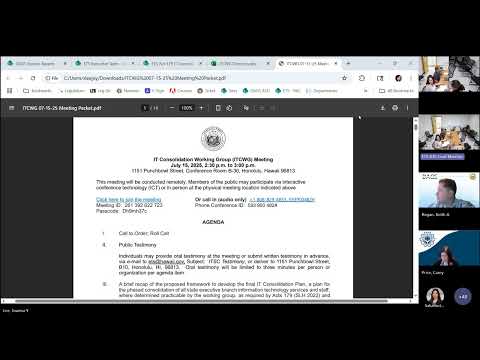
The packet provided to members included a presentation titled “State of Hawaii IT Consolidation Initiative, Working Group and Planning Kickoff Meeting.” The slide deck outlines an approach for developing a consolidation plan over the summer and states an objective to complete and submit the plan to the Legislature by December.
During discussion, Dean Hazama cautioned the group about resource reallocations for federal and special-funded positions, noting those funds are subject to statutes and may be restricted. Hazama said the working group “needs to tread a little carefully because they are somewhat restricted in a certain sense,” and urged attention to those legal and funding limits when defining resource changes.
After a motion from Luis Salaveria to approve the project scope, resources and timeline, the working group conducted a voice/virtual-hand vote and the chair declared the motion passed. The meeting record indicates no roll-call vote; the chair said “That’s everyone” when asking members to raise hands in favor.
In his public comment, Peter Fritz referenced several legal and administrative authorities and prior Office of Information Practices (OIP) guidance when challenging notice and captioning for an earlier ETS meeting. Fritz told the working group, “I can’t participate in this meeting because there are no captions, notwithstanding what you said in your notice.” The chair acknowledged the concern and apologized that captioning features may not have been turned on that day.
The working group did not take any formal action during the meeting to change notice procedures or to mandate captioning; the formal action recorded was approval of the planning framework. The chair said ETS will continue to consult with the deputy attorney general and OIP and to attempt to accommodate members of the public who require accessibility features.
The meeting concluded with a motion to adjourn that was seconded and approved by the group.