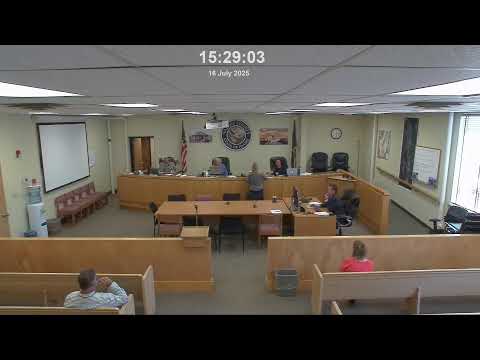
Valley County commissioners begin preliminary review of proposed shore setbacks, stormwater rules
Loading...
Summary
Valley County commissioners held a preliminary discussion July 16 about possible amendments to the county—s water-quality and shoreline rules, focused on setbacks from water bodies, required vegetation, stormwater controls and how to handle wetlands determinations.
Valley County commissioners held a preliminary discussion July 16 about possible amendments to the county—s water-quality and shoreline rules, focused on setbacks from water bodies, required vegetation, stormwater controls and how to handle wetlands determinations.
Director Herrick opened the session by framing the topic as a staff direction question: "So this is just a preliminary discussion about what you're going to want to see for water quality improvements in our ordinance amendments, and in the implementation by whatever department. Because before we actually write it, I'm gonna need to know what you want me to write it to." Herrick specifically tied the work to recent changes in local impact areas and to concerns around Piat Lake and Cascade Lake.
The nut graf: Commissioners discussed raising the standard setback from the current 30 feet to 50 feet for many water bodies, how to treat smaller lake lots and streams, whether variances/waivers should be available, what shore-zone vegetation should be required or prohibited, and whether the county should adopt any wetland delineation requirements now handled by state or federal agencies. The conversation remained at a policy-option level; no ordinance language was adopted and no votes were taken.
Most important facts - Current county lot setback: 30 feet from water bodies (lakes, creeks, irrigation ditches). Commissioners discussed writing a 50-foot setback standard for lakes and other significant water bodies but using a waiver/variance process for constrained lots such as many around Lake Cascade. Chair Malef asked whether a waiver process should apply; Herrick and others agreed variances would be part of the package. - Vegetation and fertilizer controls: Commissioners discussed requiring natural shore vegetation or limiting certain plantings and fertilizer use within the setback to reduce nutrient runoff. Participants noted enforcement challenges and suggested a mix of code provisions, public education and targeted enforcement. - Construction controls: Staff proposed requiring stormwater plans for sites within a defined distance of water bodies (discussion ranged between 100 and 150 feet) and discussed making engineering review and inspections part of the permitting process. Herrick asked whether a stormwater-management plan should be required for sites within 100—150 feet of water bodies; several commissioners said yes for higher-sensitivity areas. - Wetlands: Commissioners debated whether to require site-level wetland delineations. Commissioners and staff warned that requiring delineations on every building permit would raise costs and timelines (consultant travel and fees), and that some wetlands are already overseen by the U.S. Army Corps of Engineers and by Central District Health for septic/sewer setbacks. No change was decided; staff were asked to research practical options and agency roles. - Buffer-width debate: Valley Soil & Water recommendations were discussed in summary (participants noted a prior county 300-foot floodplain threshold and that 300 feet feels excessive for shore zones; some suggested 150 feet as more reasonable in local topography).
Supporting details and context Director Herrick said the county currently does not require floodplain building elevation standards in unincorporated areas, and commissioners contrasted city standards (which may require two feet above base flood elevation) with county practice of avoiding building in floodplains. Herrick and others repeatedly emphasized balancing water-quality protections with buildability on small lots, enforcement capacity and cost impacts to property owners.
Commissioners and staff discussed making the proposed 50-foot setback conditional in older subdivisions platted before adoption (i.e., allow 30-foot or require a variance), and tying stormwater-control requirements during construction to the county engineer's sign-off and permit fees to offset review time. Director Herrick recommended consulting a landscape architect about appropriate shore vegetative treatments and noted McCall's existing 50-foot setback and maintenance-during-construction requirements as a model to review.
Wetland delineation was highlighted as a potential cost driver: staff estimated private delineations could cost "a couple thousand" per site, and commissioners emphasized that many local wetlands are not year-round open water and may not be waters of the U.S. Central District Health's septic setbacks for year-round water sources were flagged as already constraining house and drain-field siting.
Next steps and administration Staff will research: (a) McCall and other jurisdictions' shore-zone standards and maintenance-during-construction lists; (b) practical buffer widths (50 vs. 150 vs. 300 feet) tailored to Valley County topography; (c) whether Central District Health, IDWR or the Corps of Engineers should remain the primary delineation authority or whether the county could require delineations only in higher-sensitivity areas that drain directly to lakes or rivers. Herrick said staff will prepare draft ordinance language and a flowchart addressing preexisting subdivisions and variance paths; the commission scheduled follow-up workshop time.
Ending: The session was exploratory and informational; commissioners directed staff to gather model language, implementation options and cost estimates and to return with draft language and enforcement/cost scenarios for further deliberation.