Get Full Government Meeting Transcripts, Videos, & Alerts Forever!
Get email alerts on the Municipal Finance topic
No spam. Unsubscribe anytime.
Hooper council reviews broad fee-schedule changes including park rentals, planning and sewer costs
Summary
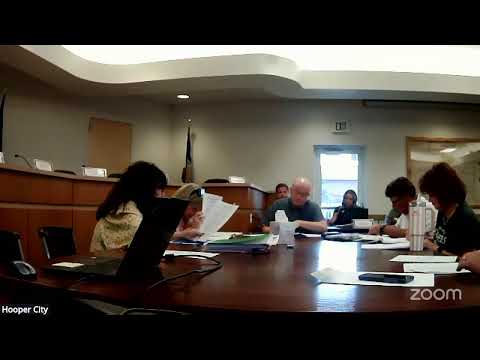
At its July 17 work meeting, Hooper City Council members reviewed a sweeping draft update to the municipal fee schedule that would raise some planning fees, revise park and pavilion rentals, add reinspection charges, and update sewer impact and stormwater connection fees.
Hooper City Council members spent the bulk of their July 17 work meeting reviewing a draft overhaul of the city’s fee schedule, discussing higher charges for planning reviews, new reinspection and escrow fees, updates to park and pavilion rentals, and changes to sewer and stormwater connection charges.
Council members and staff said the current fee schedule was last updated in 2021 and should be reviewed more frequently. Staff presented a page-by-page draft with recommended adjustments intended to align fees with actual staff and professional costs and to recover expenses the city now covers.
Key proposed changes include raising the concept conference fee from $200 to $300 and adding a $100 development-escrow reinspection fee that would apply when inspectors make three or more site visits. Single-family subdivision charges were discussed as effectively doubling some line items (staff recommended an $80 per-lot charge in some cases to reflect the extra work). The draft also consolidates separate preliminary and final subdivision charges where ordinances have already altered the review process.
The parks and facilities section contains several notable staff recommendations. The draft would discontinue charging traditional cash deposits for facility rentals; instead the city would take a credit card on file to recover cleanup or damage costs. Staff proposed combining the large pavilion rental and kitchen access into a single rental (proposed example figures discussed were $100 for residents and $200 for nonresidents for the large pavilion with kitchen use) and set a $25 per-field seasonal rate for ballfields. A full-park rental for certain parks was discussed in the range the packet lists as $750 for the day for residents and $1,500 for nonresidents; staff said these figures aim to align with comparable cities.
Public works and code-enforcement fees were detailed by staff. Proposed inspection and hourly rates include raising additional public-works inspection to $40 an hour, a possible reinspection fee to encourage timely compliance, and equipment and contractor pass-through charges (staff emphasized these are for code-enforcement work only, not a general-for-hire schedule). The draft also includes line items for specialty sign costs (invoice cost plus 20 percent overhead) and updated surface-treatment and overlay references for street work.
Sewer-related fees were a significant point. Staff reported the Central Weaver Sewer Improvement District’s sewer impact fee changed for permits filed after July 1: the packet shows last year’s figure of 3,537 (unit not specified in the packet) and a new fee of 3,575 for post–July 1 applicants. For new sewer pit connections, staff proposed a procedure in which the city would take a deposit (staff discussed a $10,000 deposit example) to cover invoices and then charge actual costs plus a 20 percent overhead; staff said the city would return any difference if the actual invoices were lower. For certain existing pits staff suggested a lower baseline (the draft referenced a $5,000 figure for existing pits).
Staff also flagged one utility-billing change from an outside provider: the packet notes the Taylor West Weaver District increased its shutoff/turnoff fee to $100 for the first occurrence and $200 for a second occurrence within a calendar year; staff proposed mirroring that in the city’s billing language.
Council members asked staff to continue refining the draft, to verify which charges are actually being collected today, and to compare the draft numbers to neighboring jurisdictions. Staff said some items in the packet derive from state-required studies (impact fees) and from recommendations by individual department leads (planning, public works, parks). No final votes were taken; the council scheduled further review at a future meeting and asked staff to bring clarified line items and supporting cost calculations.
Clarifying details included in staff materials: the development-escrow reinspection fee was shown as $100; a public-works additional inspection rate of $40 per hour was discussed; proposed field rental of $25 per field (seasonal); the sewer impact fee listed in the packet changed from 3,537 (prior) to 3,575 for post–July 1 applicants; staff discussed a $10,000 deposit mechanism and a 20 percent overhead on contractor invoices for city-performed sewer pit work, with $5,000 listed for some existing pit scenarios. Staff repeatedly emphasized that several fees are pass-through or invoice-based, not revenue items for general fund spending.
The council directed staff to return a revised fee schedule with clarified rates, explicit units and fee descriptions, an implementation timeline, and benchmarking comparisons to similar municipalities.