Get Full Government Meeting Transcripts, Videos, & Alerts Forever!
Get email alerts on the Code Enforcement topic
No spam. Unsubscribe anytime.
City of Miami hearing orders dozens of code-enforcement settlements; several cases dismissed or upheld for no-shows
Summary
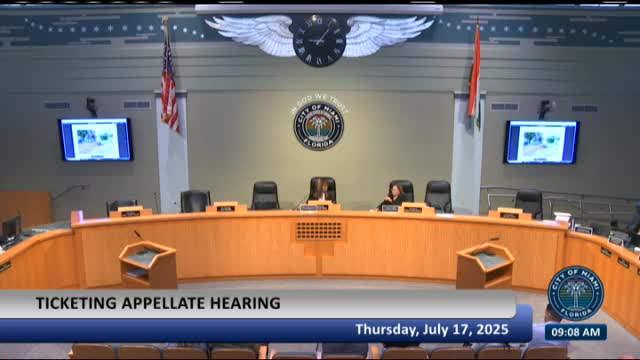
At a City of Miami ticket appellate hearing, a hearing officer signed settlement orders for multiple code-enforcement cases — most resolving with small fines — dismissed one case as not the property owner’s responsibility, reset two BTR revocation hearings to Sept. 18, and upheld a series of no-shows.
Dawn Grace Jones, the hearing officer and magistrate assigned to the City of Miami ticket appellate hearings, signed settlement orders and rulings for a full docket of code-enforcement appeals, concluding most matters by agreement and upholding several cases by default for no-shows.
The hearing officer told attendees the purpose of the session was to hear evidence and determine whether alleged violations occurred and whether the person named in each notice could be held responsible. She said parties could call witnesses and introduce exhibits but that the proceedings would follow relaxed evidentiary rules and that her findings would be based on the record.
Most cases on the calendar resolved as settlements in which the alleged violator or the property representative agreed the violation occurred and accepted financial penalties. Examples recorded on the record include: a $500 settlement for case 108180 (2025 Southwest 20 Third Avenue); $250 settlements for cases 99300 (3045 Northwest 17th Street), 109123 (410 Northeast 52nd/50 Second Terrace), 121003 (1256 Northwest 42nd Street) and multiple others; and smaller amounts such as $100 for case 126734 (746 Northwest 40 First Street). Several commercial property representatives and attorneys signed agreements on behalf of entities, including Jacob1535 Properties Inc., River Blues Inc., and Grove Grama LLC.
At least one case was dismissed after the city concluded the person named was not legally responsible. The hearing officer told the attendee, "So this case is dismissed," when the evidence review found the violation was not the property owner's responsibility.
Two BTR (bed, transient or rental) revocation cases that had been set for that day were reset to Sept. 18; the hearing officer said counsel for both properties had been notified and did not need to appear for an August setting because the hearings would be continued to September.
The docket also included numerous no-shows. The hearing officer announced that no-shows were "automatically upheld," and then read a list of cases the panel deemed defaulted, including case numbers listed on pages 10, 13, 15, 17, 19 and 21 of the docket (examples given in the hearing record). The session concluded after those rulings and the signing of settlement orders.
Not all participants spoke at length; one alleged violator, Jose Hernandez, said on the record, "We're guilty, and we're willing to pay 500. If you wanna lower it to 50, I'd appreciate it." The hearing officer repeatedly confirmed on the record that the violations had been affirmed and that the parties had agreed to the settlements before directing attendees to sign copies of the orders.
The hearing officer also advised that an order issued at the conclusion of a hearing would include the penalty amount and administrative costs and that either party could appeal the order to the Miami-Dade Circuit Court Appellate Division within 30 days of issuance.
The session closed after the hearing officer completed the signed orders, reset the two BTR revocation cases, listed the no-shows that were upheld, and adjourned the hearings.