Get Full Government Meeting Transcripts, Videos, & Alerts Forever!
Get email alerts on the Road Repair Policy topic
No spam. Unsubscribe anytime.
Jacksonville officials, JEA and builders agree to rework 50-foot "case 9" overlay rule for recently repaved streets
Summary
City council members, JEA staff and home builders agreed to meet and draft clearer language on a decades-old rule that requires a mill-and-overlay when recent pavement is cut, in some cases forcing 50 feet of resurfacing on either side of a utility excavation.
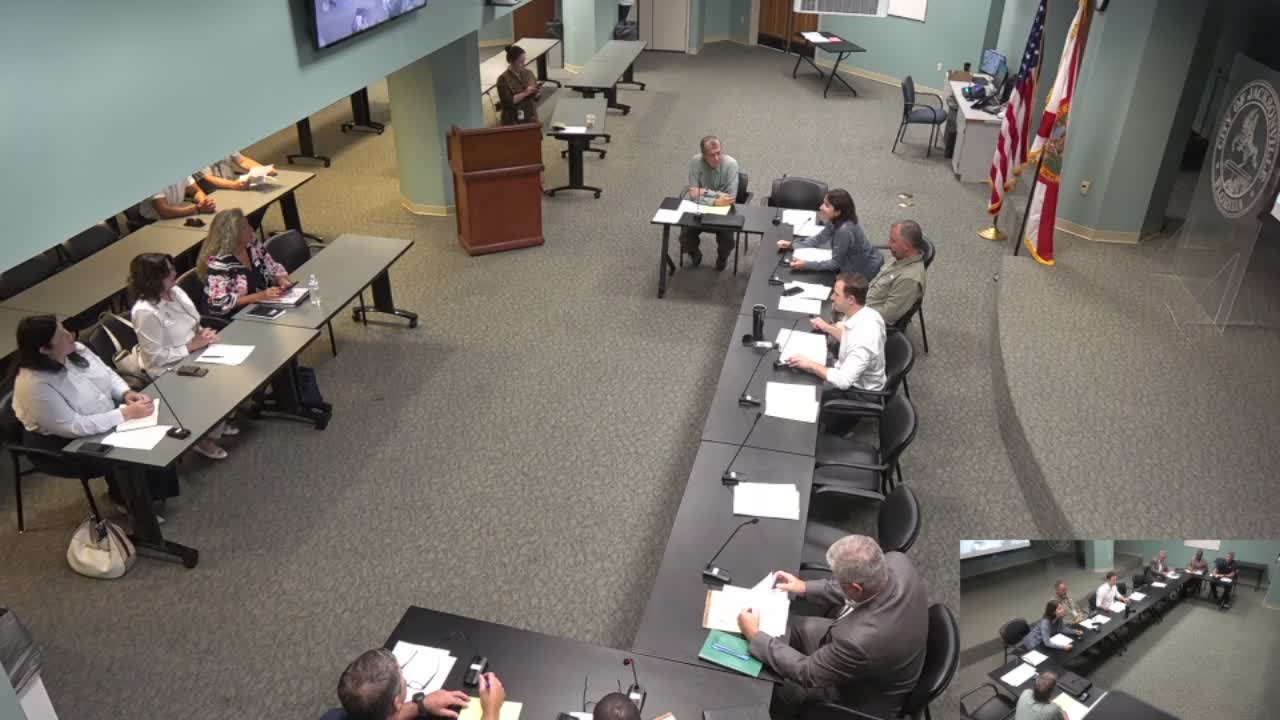
Jacksonville officials, utility staff and local home builders agreed to form a working group to rewrite a long-standing repair rule that requires large resurfacing patches after utility cuts on recently paved streets.
The committee meeting Wednesday focused on the so-called “case 9” repair requirement, described in the meeting as a 50-foot measurement from the roadway center line (a 100-foot overlay total) that is applied when a cut is made in pavement within five years of a resurfacing. Steve Long, public works operations director, said the rule is intended to “make sure that when a roadway is resurfaced or a roadway is newly built, that for the first 5 years is not disturbed, it's not excavated, it's not dug up, except for in an emergency kind of situation.”
Why it matters: Builders and neighborhood stakeholders said the requirement inflates costs for individual home buyers when small utility taps or emergency repairs trigger a large mill-and-overlay. Developers said the rule is especially burdensome in older neighborhoods such as Springfield, where underlying water and sewer infrastructure frequently requires repair after repaving.
At the meeting, David Schechter of Terrace Homes, a Springfield home builder, said he has repeatedly seen small repairs — “about a 10 by 10” — done after the five-year mark that look adequate and questioned whether the large overlay is needed in neighborhoods where existing underground infrastructure will prompt repeated cuts. “I don't think it's appropriate for JEA to be required to do that, case 9 repair,” Schechter said.
JEA and city staff described how the rule is applied and where it differs from Florida Department of Transportation practice. Steve Long said the city measures the 50 feet from the center line of the cut; he noted DOT typically requires 25 feet each way and, near intersections, DOT sometimes requires the full intersection to be resurfaced. Long added that a typical minimum trench repair can be as small as four feet wide, driven by 12-inch backfill requirements, and that the city and JEA coordinate resurfacing lists and conflict memos so utilities can plan projects ahead of paving.
Ellen Cavan, chief of the development services division, explained that requests for right‑of‑way permits are reviewed to determine whether a case 9 repair is required or whether a standard repair will suffice. She said the division enforces the “case 9, the 50 foot” rule when applicable.
Legal and procedural path: City general counsel Carla Loper said changing the underlying city code would require legislation. “If we're talking about making a change to set chapter 7 44, then yes, you would need legislation to do that. Case 9, my understanding, is an internal policy of the public works department,” Loper told the group, indicating a two-step path: stakeholder drafting and an internal policy or standards review followed by formal code changes if needed.
Next steps: Participants agreed to meet — including JEA staff, public works, development services and builders — to draft clearer language before taking a unified proposal to the city’s SSPAC (Standards, Specifications and Procedures Advisory Committee). Renee Goode, JEA director of government relations, said JEA would “love to take the language and tweak it and come back with something for you.” The chair asked for an update in the next couple of months.
Stakeholder reaction: Local nonprofit and neighborhood groups said they support revisiting the rule. Austin Nicholas, representing NEFA, and Michael Haskins, executive director of SPAR, both expressed support for a collaborative rewrite and asked to be included in follow-up conversations. Haskins said his group issued a letter backing the proposal as drafted by area builders but reserved judgment until it sees any final legislation.
The committee did not take a formal vote. Instead, members and staff agreed to convene a working group, prepare proposed language, present unified findings to SSPAC and then, if necessary, pursue ordinance changes through the council legislative process.