Get Full Government Meeting Transcripts, Videos, & Alerts Forever!
Get email alerts on the Land Use 530 Sansom Fire Station 13 topic
No spam. Unsubscribe anytime.
Planning and Recreation & Park commissions certify EIR and approve entitlements for 530 Sansom project, raise shadow limits
Summary
The Planning Commission and Recreation and Park Commission on Thursday certified the Final EIR and approved entitlements and joint shadow actions to advance the 530 Sansom mixed‑use tower and replacement Fire Station 13 project, while public commenters raised historic‑preservation and small‑business concerns.
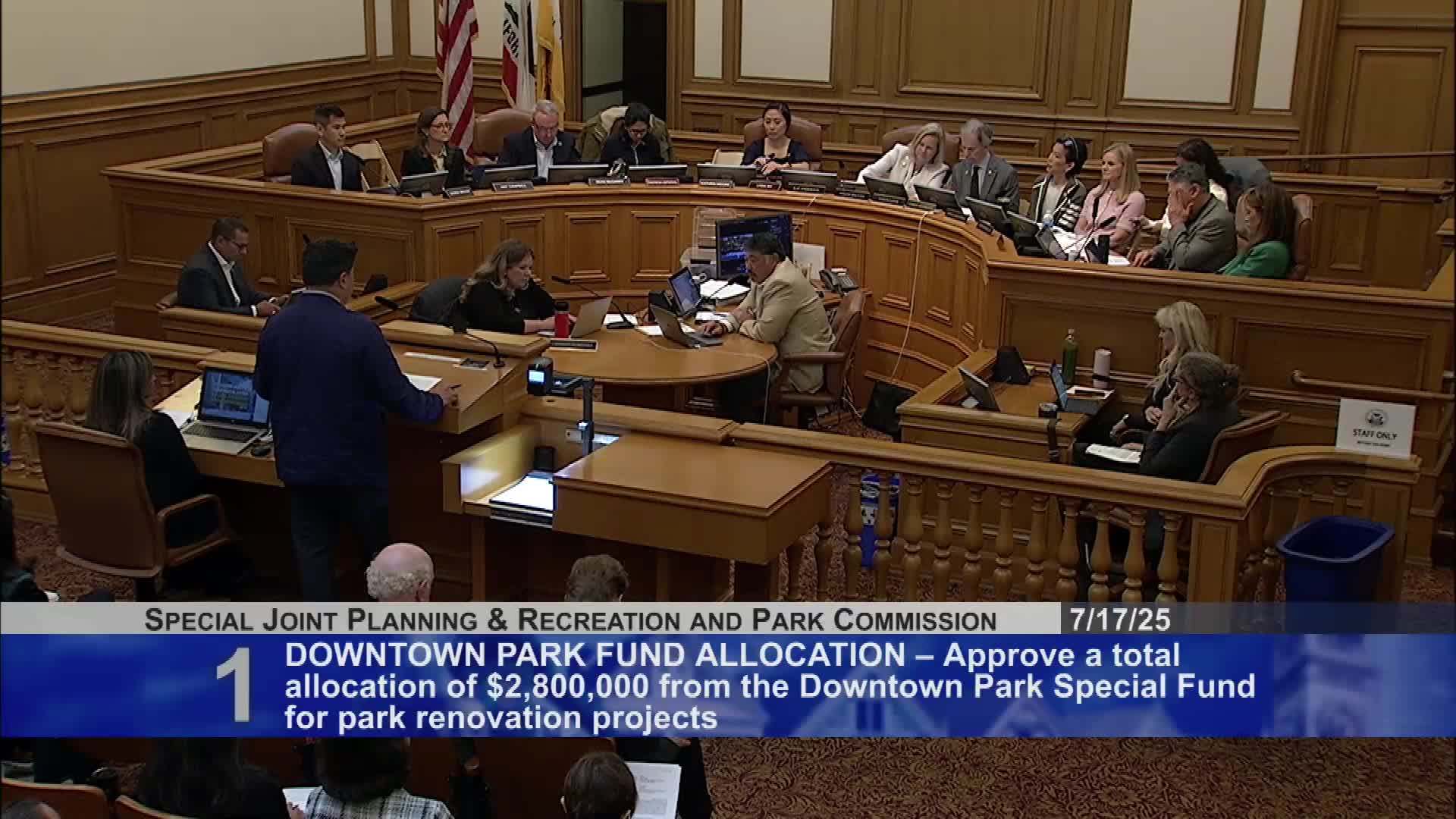
The San Francisco Planning Commission and Recreation and Park Commission on Thursday moved forward on the 530 Sansom mixed‑use tower and replacement Fire Station 13 project, certifying the Final Environmental Impact Report (EIR), approving multiple related entitlements and recommendations, and agreeing to raise absolute cumulative shadow limits (ACLs) for four downtown parks.
Planning Department staff said the Final EIR analyzed demolition of four existing structures on the project site and construction of two components: a separate four‑story replacement fire station on the 447 Battery Street parcel and a 41‑story mixed‑use tower on the remaining parcels. Sherry George, environmental review coordinator for the Planning Department, summarized the EIR findings and said implementation would cause significant and unavoidable impacts to historic resources and air quality even after mitigation; staff recommended certification of the Final EIR and noted that if the commission approved the project it would also need to adopt a statement of overriding considerations under CEQA.
Tita Bell, legislative aide to Supervisor Danny Sauter, told the commissions the supervisor sees the proposal as “the most significant new project in the Northern Financial District in decades” and highlighted public benefits staff and sponsor briefed commissioners on, including a new, seismically upgraded Fire Station 13; nearly $15,000,000 in affordable housing payments intended to support 100% affordable senior housing in Chinatown (with an initial $2,000,000 payment to be made within six months of entitlements); and an estimated $14,000,000 in annual new general fund revenue.
City staff and the project sponsor described project elements and public benefits. Jonathan Cherry, project manager at the Office of Economic and Workforce Development, explained that the development agreement would vest the sponsor’s project rights for eight years, require the sponsor to design and build the new fire station to department specifications, and that the city’s acceptance of the new station is conditioned on construction completion before the tower is occupied. Cherry said the project sponsor would contribute nearly $15 million for affordable housing and about $1,000,000 to the downtown park fund.
Fire Department representatives spoke in support. Deputy Chief Sayumi Brannan said she spent much of her career at Station 13 and described departmental support for a modernized station. Planning and Rec & Park staff presented a shadow analysis and requested joint action to raise ACLs set in a 1989 memorandum implementing the sunlight ordinance. Recreation and Park Department planner Chris Townes explained that the project would slightly increase annualized shadow loads on Washington Square (from 7.47% to 7.48%), Willie Woo Wong Playground (to roughly 48.04%), Maritime Plaza (from 67.84% to 69.92%) and Sue Bierman Park (by 0.004 percentage points to about 42.698%). Staff characterized the timing and location of most new shadows as early morning or late afternoon; staff recommended the commissions consider qualitative factors such as time of day, program locations within parks and public benefits of the project when deciding whether the new shadows have a significant adverse impact.
Public testimony included supporters who emphasized the affordable-housing payments and a new fire station and opponents who urged rejection or more conditions. Danielle Kuznic, owner of San Francisco Wine Society, said she has operated at 447 Battery Street since 2011 and opposed rescinding the building’s landmark designation, saying losing the site would destroy her business and set a precedent for removing landmarks. San Francisco Heritage and other commenters urged the commissions to protect landmarks and warned about precedent. Chinatown Community Development Center urged approval because of the senior‑housing funding. Speakers also raised concerns about construction impacts to nearby residents and businesses and about downtown office vacancy and market effects.
Procedural and voting actions recorded in the hearing include a recusal: Planning Vice President Moore disclosed a retirement payment from a firm associated with the project sponsor team and asked to be excused; a motion to recuse Moore passed unanimously 6‑0. The Planning Commission certified the Final EIR on a motion and recorded a unanimous vote (5‑0). The commissions voted jointly to raise the ACLs for the four parks to accommodate the project; Planning recorded a 5‑0 vote and Recreation and Park recorded a unanimous vote to raise the limits. The Recreation and Park Commission voted that the project’s net new shadow would not have a significant adverse impact on the four parks (roll call recorded as affirmative). The Planning Commission then voted to adopt CEQA findings, shadow findings, recommend general plan and planning-code amendments, recommend a development agreement, adopt conditional use findings and approve a large‑cap office allocation — those items passed on recorded votes (motion passed 5‑0). A separate motion on the planning code text amendment (Article 10 / landmark conditional rescission) passed but recorded a 4‑1 vote, with Commissioner Imperial voting against the code amendment recommendation to the Board of Supervisors.
Staff and sponsor representatives said the project requires additional Board of Supervisors approvals, property‑exchange updates and a separate financial mechanism the city will consider to recapture future revenue to offset fire station construction costs. Project supporters and city staff described job creation, prevailing wage and local hiring commitments in the development agreement and a projected annual economic impact and fiscal contribution to the city budget.
The commissions’ actions advance the project through the city’s entitlement process; the Board of Supervisors will receive the planning commission’s recommendations and consider the landmark rescission, ordinances and related transactional documents before any demolition or construction could begin.