Get Full Government Meeting Transcripts, Videos, & Alerts Forever!
Get email alerts on the County Finance topic
No spam. Unsubscribe anytime.
Marion County budgeters weigh sharp DJJ cost jump that raises fine-and-forfeiture millage
Summary
Budget staff told commissioners that a redistribution of Department of Juvenile Justice (DJJ) costs pushed Marion County's fine-and-forfeiture obligation up by about $1.6 million, forcing officials to weigh drawing on fund balance or a millage increase to balance next year's budget.
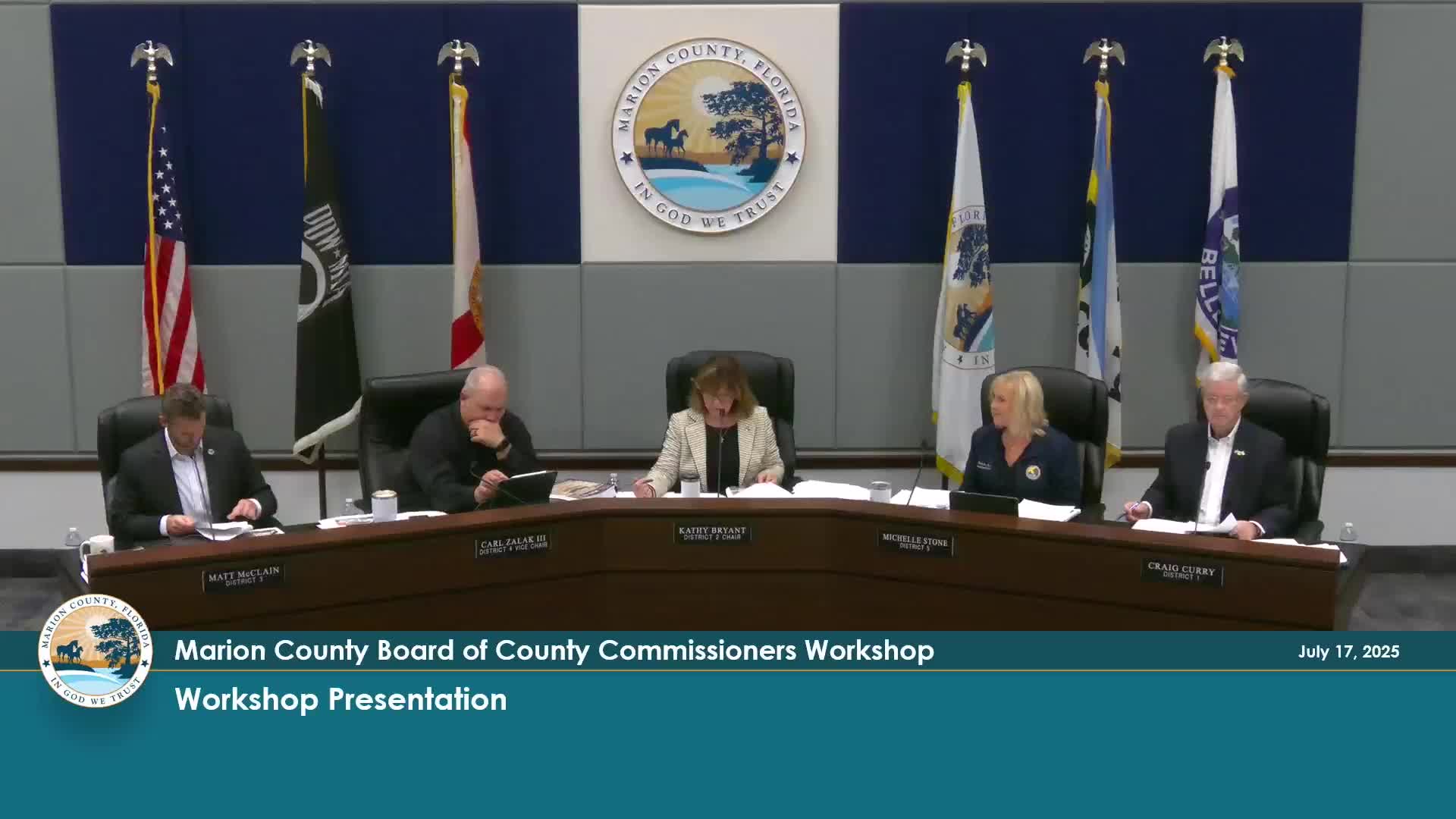
Audrey Fowler, Marion County budget director, told the Board of County Commissioners that the county learned of a large upward revision to its Department of Juvenile Justice (DJJ) cost allocation shortly before the budget workshop, driving an unexpected increase to the fine-and-forfeiture fund.
"We were at $2,700,000 for the 'twenty five budget. It's $4,300,000 was the number that we were supplied to, by the DJJ yesterday afternoon," Fowler said, attributing roughly $1.6 million of the change to a new distribution of DJJ days and related costs rather than a jump in DJJ's overall budget.
Commissioners and staff said the county faces several balancing options. Fowler said the proposed general fund millage was reduced 0.1 mills during earlier work, putting the proposed general fund millage at 3.37 mills compared with the prior adopted level. For the fine-and-forfeiture fund, she said the present proposed rate is 0.87 mills and that the county has roughly $900,000 in nonrecurring fund balance it could use as a one-time balancer.
"If we increase the millage by 0.04 and we use the $900,000 of fund balance carry forward, we can be balanced at 0.87 mills," Fowler said. She also showed alternate options: using no fund balance would require roughly $2.7 million in additional revenues across funds; holding the millage at last year's 0.83 would require about $1.4 million plus the $900,000 in nonrecurring funds.
Commissioners pressed staff about the longer-term effects. Fowler and county staff noted that the budgetary pressure arises from a change in Marion County's percent share of DJJ days: the county's share rose from about 4.3% to 6.7% of DJJ utilization based on days used, while DJJ's total budget rose only about 5%.
Commissioner Sal asked that the calculation for keeping the millage flat be repeated, and Chair Bryant requested impact estimates for an average tax bill if the fine-and-forfeiture millage remains at 0.87. Fowler agreed to prepare follow-up analyses, and the clerk confirmed conversations with Bill Gladson and the sheriff to review requests tied to that fund.
No formal board vote was taken at the workshop; staff sought direction and additional analysis to return with options before final adoption.
Why it matters: the fine-and-forfeiture fund pays court and criminal-justice operating costs the county must fund; a sustained increase in DJJ allocations would either raise taxes for property owners or shift cuts onto constitutionally funded entities paid from the same fund.