Get Full Government Meeting Transcripts, Videos, & Alerts Forever!
Get email alerts on the Parking Enforcement topic
No spam. Unsubscribe anytime.
City staff weigh mailing parking citations, UTC urges lane-width and multifamily parking changes
Summary
Transportation Public Works told the Mobility Committee that mailing parking citations could reduce confrontations and improve enforcement capacity after recent parking code modernizations; the Urban Transportation Commission recommended updates to residential parking program language and arterial lane-width guidance to align with NACTO.
Transportation Public Works officials on July 16 briefed the Austin City Council Mobility Committee on how recent parking-code changes and a proposed pilot to mail parking citations could affect enforcement, compliance and public safety.
The department said the 2025 parking-code modernization — which included changes such as allowing mailed citations and expanding enforcement of bike-lane violations — has already led to stepped-up enforcement: staff issued about 270 warning notices through May, began issuing citations June 1 and have written 80 actual citations since then, while staff logged 516 customer service requests related to bike-lane enforcement.
"Consistent enforcement brings more consistent compliance," Joseph Balhadri, Park Enterprise Manager for Transportation Public Works, told the committee, while describing a proposal to test third-party vendor mailing of citations to reduce confrontations and increase capacity.
Why it matters: TPW said mailed citations could reduce face-to-face confrontations between enforcement officers and the public, reduce traffic disruptions caused when officers stop to write tickets, and allow the city to reach vehicle owners when drivers have already left the scene. Committee members raised concerns that mailed notices can arrive long after a violation, potentially reducing behavioral deterrence and creating fairness issues for shared vehicles or households.
What the city described and the suggested pilot - TPW said it currently lacks a reliable baseline compliance rate and is building metrics for a pilot. The department estimated the current statutory response windows will shift under a mailing program: the usual 20-day early-payment window becomes 30 days in total under the mailing proposal (the 30 days begins only once a citation is mailed and a seven-day mailing receipt period is presumed). - TPW staff said mailings would require third-party integration because municipal court software was not configured for mailed parking citations; vendors can query registration across all 50 states to locate registered owners and manage returned mail issues. - TPW said the pilot scope would include privacy protections and adherence to prior council data-retention directives; procurement and technical integration are next steps before any pilot is presented to council for approval.
Committee concerns and equity context Several committee members said mailed citations create equity and notice concerns because many residents do not regularly check postal mail, share vehicles, or may not be the registered owner of a vehicle. Council Member Vela asked whether other Texas cities use mailed citations; TPW cited Galveston and some California cities (and many university parking programs) as examples. Members also asked staff to estimate revenue impacts and to provide year-over-year baselines for the 516 bike-lane requests; TPW said it would return with updated revenue and request-trend data, noting the city last year logged about 15,000 total parking-related customer requests across all enforcement topics.
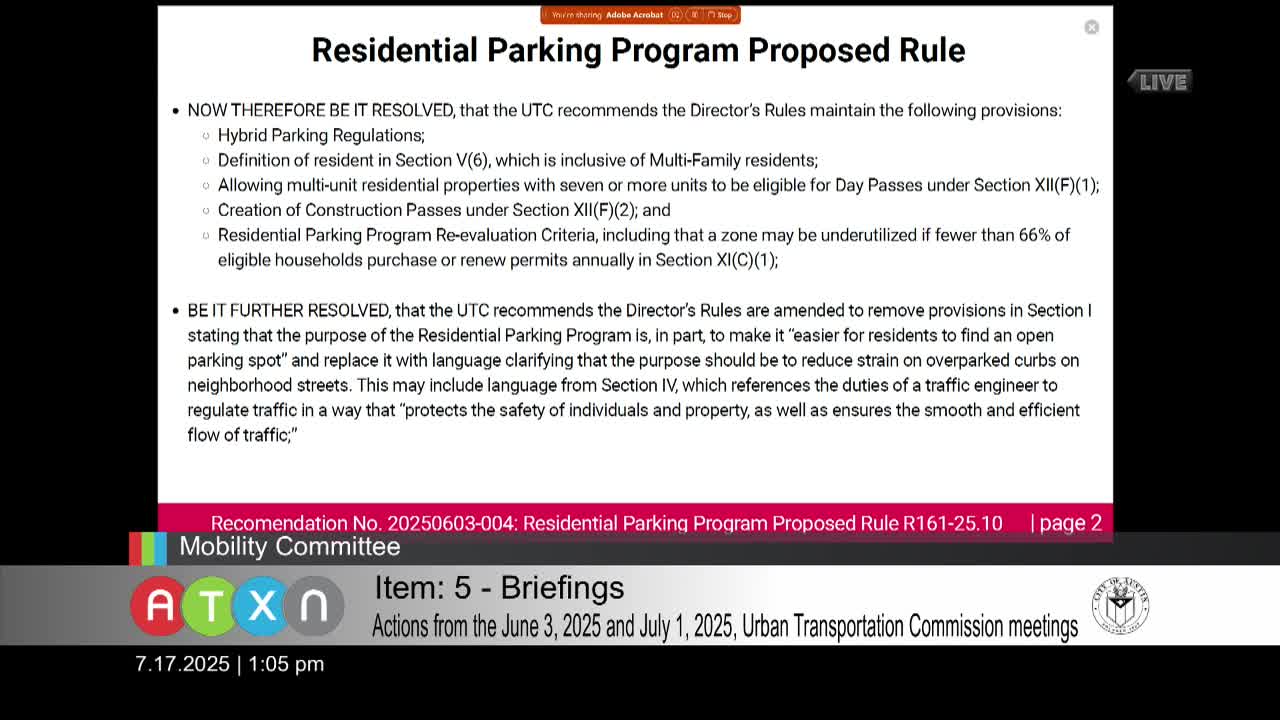
Small businesses, multifamily and RPP language The committee also heard a combined update from the Urban Transportation Commission (UTC). Mister Schumacher, representing the UTC, said the commission supported the recently posted RPP (residential parking permit) director’s rules but urged changes to program language and access for multifamily residents. "We think the program today is really a tool in the tool belt when we have an overpark curb in a residential area," he said, arguing the program's original purpose wording — "to make it easier for residents to find an open parking spot" — no longer reflects current uses. The UTC recommended adding visitor permits or similar benefits for multifamily properties and ensuring small commercial businesses and their employees are treated as interested parties in RPP proceedings.
Lane-width guidance and safety The UTC also recommended that the Transportation Criteria Manual align Level 3 and Level 4 arterial lane-width guidance with NACTO standards by favoring 10–11-foot lanes (rather than 11–12.5 feet) when appropriate. Schumacher said narrower lanes are associated with lower speeds and fewer severe crashes and suggested TPW adopt contextual exceptions, such as when more than 10% of traffic is freight or a transit route requires wider lanes. The commission also recommended a lane-width audit similar to TPW’s earlier speed-audit effort and that future strategic mobility planning include lane-width reduction targets.
Process, safety and technology TPW staff emphasized enforcement hazards for officers — confrontations and traffic impacts when officers must stop to write citations — and recommended technology investments (for example, vehicle- and camera-based enforcement and e-chalking) to align practices with modernized code. TPW said mailing citations could increase capacity and reduce confrontations but acknowledged vendor integration, bouncebacks, and judicial-adjudication workflow require further design and a careful pilot approach.
Votes at a glance - Motion to approve minutes for May 15, 2025 (mover: Vice Chair Cawdry; second: Council Member Harper Madison). Outcome: not specified in the transcript.
What’s next TPW will develop a pilot scope, metrics, privacy and procurement plans and return to council for review. UTC recommendations will move to Transportation Public Works for consideration in rule and manual updates.
Speakers quoted or referenced in this report are listed in the article’s speaker roster below.