Get Full Government Meeting Transcripts, Videos, & Alerts Forever!
Get email alerts on the Urban Design Guidelines topic
No spam. Unsubscribe anytime.
Design Commission outlines rewrite of urban design guidelines, emphasizes accessibility and public realm
Summary
The Design Commission reported on a multi‑year rewrite of the urban design guidelines, described recent case studies and said a draft of updated criteria will be released to stakeholders soon. Commissioners asked the commission to engage pedestrian and accessibility stakeholders during the rewrite.
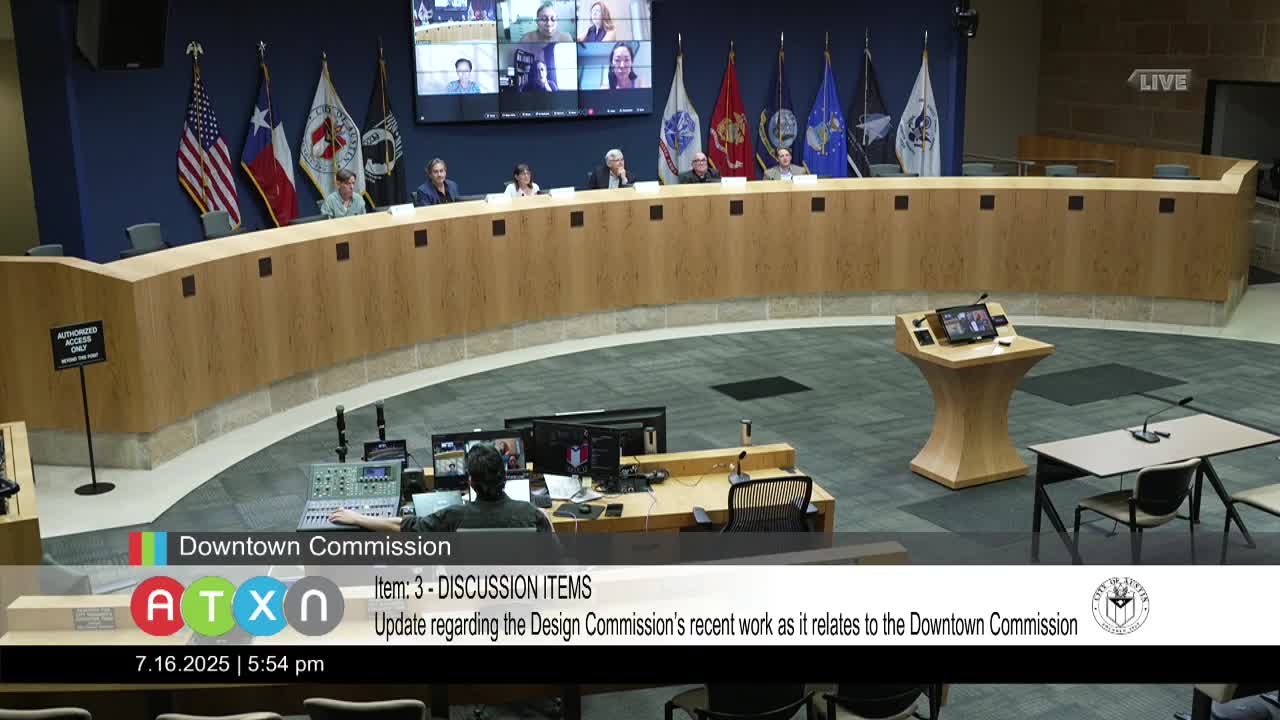
Antiro Gelles, a Design Commissioner representing City of Austin District 3, told the Downtown Commission on July 16 that the Design Commission has been leading a multi‑year rewrite of the city's urban design guidelines and is nearing release of a draft to stakeholders.
"The rewrite began in 2021," Gelles said, describing a preparation phase that moved into a creation phase in March 2024 and is now at the threshold of stakeholder outreach. He said the rewrite has included case‑study reviews of recent projects to assess outcomes on walkability, public‑space integration, façade treatments and pedestrian circulation.
Gelles said the Design Commission's review focuses on whether projects seeking entitlements under the density bonus program comply "substantially" with urban design guidelines and noted the commission provides advisory recommendations to City Council on design implications. The commission has also reviewed sustainability features, public art integration and site‑level impacts such as curb cuts and garage access.
Commissioner Kimberly Levinson, who identified herself as chair of the Pedestrian Advisory Council and a downtown resident, urged attention to the pedestrian environment and ADA accessibility in the rewrite. "I'm very concerned that all these public spaces and plazas and stuff be easily accessible for as many people as possible," Levinson said.
Gelles agreed accessibility and pedestrian safety are central concerns and said the working group has looked at how site plan requirements (including utility and fire access constraints) influence ground‑floor design and pedestrian experience. He said the working group is primarily composed of design professionals with staff support and, at the moment, no external consultant is involved.
Gelles said the draft design criteria is expected to be released to stakeholders "very, very soon," after which the commission will collect feedback, finalize the document and send it to City Council for adoption. Commissioners asked about infrastructure concerns such as recent downtown flooding; Gelles said infrastructure and flood responses have not recently come before the Design Commission but suggested the commission could invite the relevant department to present if commissioners want more information.
The Design Commission presentation emphasized core urban design principles—character, continuity and enclosure, quality of the public realm, legibility of movement and social equity—and the working group's goal to align the guidelines with the city's cultural and sustainability objectives. Commissioners expressed interest in further engagement with the Pedestrian Advisory Council and other stakeholders during the draft review.