Get Full Government Meeting Transcripts, Videos, & Alerts Forever!
Get email alerts on the Capital Improvement Plan topic
No spam. Unsubscribe anytime.
Planning commission finds Derby capital improvement plan consistent with comprehensive plan
Summary
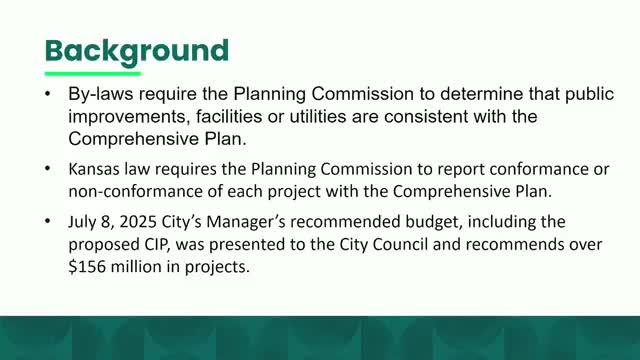
The commission voted 9-0 to find the proposed 2026–2030 capital improvement plan in conformance with the comprehensive plan. The plan includes more than $156 million in projects including transportation retrofits, wastewater/water infrastructure, park improvements, and studies for water reuse and energy-efficiency audits.
The Derby Planning Commission on July 17 voted 9-0 to find the draft 2026–2030 Capital Improvement Plan (CIP) in conformance with the Derby comprehensive plan.
City Planner (presenter) summarized that the proposed CIP contains more than $156 million in projects and organized the plan around comprehensive-plan recommendations. Key categories include retrofit and repair of pedestrian and bicycle facilities (sidewalk gap infill and bike-path repair/replacement), funding set-asides to support a proposed Ninth Street (ARC 95) river crossing (to be used as a grant match or for preliminary engineering), collector-street right-of-way reservation, major sewer and water projects to serve growth north of the city, and a new water treatment facility.
The CIP also contains stormwater projects, park capital projects (including funding listed for Dikarski Park phase 2, High Park phase 1 and other future park projects), maintenance projects for city facilities (roofs and mechanical systems) and studies such as a wastewater treatment master plan, stormwater modeling and a water-reuse feasibility study. Planning staff noted an investment-grade audit for building HVAC upgrades had been performed and that water-reuse study is intended to explore treating effluent for nonpotable reuse.
Commissioners had no recommended changes and moved to find the CIP consistent with the comprehensive plan; the motion passed unanimously. Staff said some CIP items will be prioritized as the annual budget and grant opportunities evolve.