Get Full Government Meeting Transcripts, Videos, & Alerts Forever!
Get email alerts on the Downtown Planning topic
No spam. Unsubscribe anytime.
City staff outlines timeline, engagement approach for Downtown Austin plan update
Summary
Planning Department staff told the Downtown Commission that a 2024 council resolution directed an update of the Downtown Austin plan; staff described the update as a Center City Central District plan, solicited consultant proposals, and outlined a three‑phase public engagement process and next steps through fall 2026.
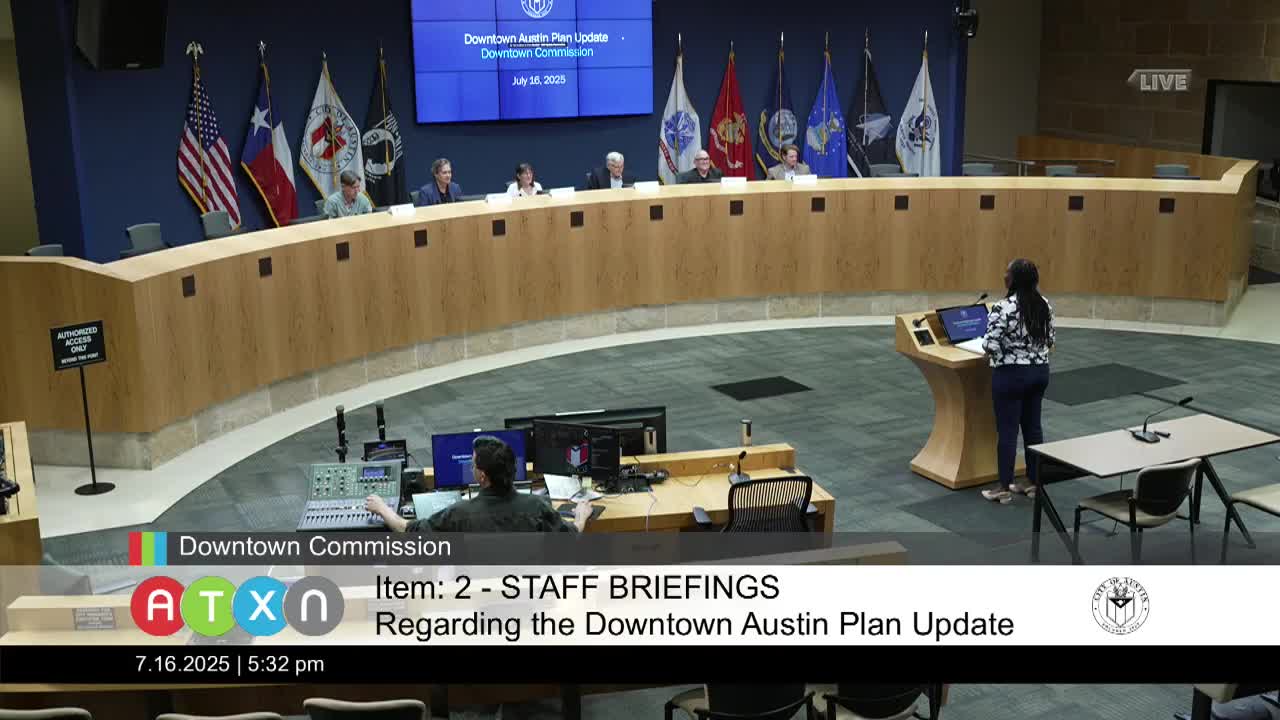
City planning staff told the Downtown Commission on July 16 that a 2024 City Council resolution directed an update of the Downtown Austin plan and that staff are moving the effort forward as a consolidated Center City Central District plan covering downtown, the South Central Waterfront and the UT/University neighborhood overlay.
Shanisha Johnson, a principal planner with the Planning Department overseeing the district planning team, said staff have developed a scope, solicited preliminary cost estimates from planning‑bench consultants and plan to onboard a consultant in August. "We last presented on the Downtown Austin plan update at your December meeting," Johnson said as she summarized the work completed since December 2024 and the tasks underway.
The memo that initiated the work, Johnson said, directed staff to prepare a 10‑year outlook applying equity, resilience and sustainability lenses; to estimate costs; to identify potential partners and funding tools; and to recommend any necessary code amendments. Johnson described the current approach as a district plan designed to prioritize "quick wins or near‑term implementable projects" such as placemaking and low‑cost activations, coordinated with other city initiatives and departments including Transportation and Public Works, Economic Development, Financial Services, the Office of Climate Action and Resilience and the Homeless Strategy Office.
Johnson said staff have collected internal and external stakeholder feedback, issued a May memo to the mayor and council describing the district approach, and solicited final cost proposals from two planning bench consultants last week. She described a three‑phase engagement framework through fall 2026: an initial phase to present existing conditions and identify needs and gaps, a second phase for deeper engagement in each subarea, and a later phase for follow‑up and refinement. "Currently, we are thinking about three phases of engagement through fall of 2026," Johnson said.
Commissioners and attendees pressed staff on coordination with other downtown initiatives. One commissioner expressed concern that funding reductions to Project Connect could change the transit-related assumptions that inform downtown planning; Johnson said staff will coordinate with Austin Transit Partnership, Capital Metro and the department’s equitable transit‑oriented development (ETOD) teams. She also said the Planning Department intends to work with the point of contact for the Downtown Austin Strategic Initiative (DASI); staff identified the deputy city manager as the DASI point of contact and Roberto Turino as the advisor liaison.
On implementation tracking, Johnson said the small‑area plan implementation team and the long‑range planning division have completed an initial phase of cataloging action items from existing small‑area plans and are conducting a second phase of outreach to implementation leads in other departments before publishing a formal tracking report.
On funding, Johnson said ETOD funds will cover at least part of the planning effort because the district contains several station areas. She said the updated scope and consultant proposals should produce a final cost and a contract encumbrance amount; staff expected consultant responses the week after the meeting.
Commissioners and neighborhood representatives urged broad outreach to downtown stakeholders, including neighborhood groups, the downtown creative community, service industry workers and musicians. A speaker who identified themselves as a member of the Downtown Austin Neighborhood Association said their group supports the district planning effort but warned staff to prepare for "pushback from other groups." Johnson said the scope already incorporates themes raised in initial stakeholder engagement and that her team will share additional opportunities for input.
Next steps Johnson listed included finalizing the engagement plan and timeline with consultants, launching a public engagement webpage coordinated with Strategic Communications, and onboarding a consultant in August. She closed by saying staff will return with updates and welcomed further questions at future meetings.
An unrelated procedural motion earlier in the meeting approved minutes from the previous meeting; that vote was recorded as passing.