Get Full Government Meeting Transcripts, Videos, & Alerts Forever!
Get email alerts on the Transportation And Accessibility topic
No spam. Unsubscribe anytime.
Denton committee hears wide-ranging transportation update on sidewalks, ADA transition plan and bike safety
Summary
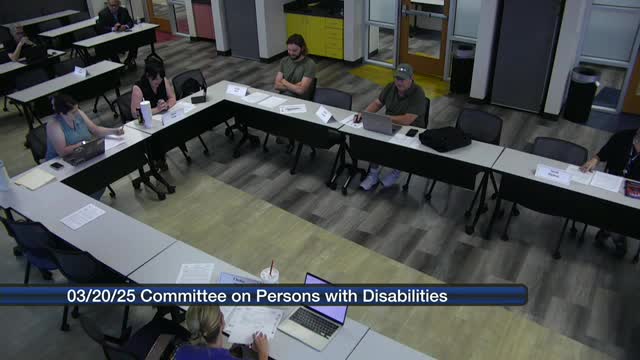
DENTON — Transportation staff reported progress on sidewalks, an eight-year ADA transition and a series of bike- and micro-mobility initiatives at a meeting of the Committee on Persons with Disabilities.
DENTON — Transportation staff reported progress on sidewalks, an eight-year ADA transition and a series of bike- and micro-mobility initiatives at a meeting of the Committee on Persons with Disabilities. Staff described recent project completions paid from a 2019 sidewalk bond, an online ADA dashboard under development and a multi-agency process intended to speed barrier removal and responses to public inquiries.
The briefing, led by a transportation division presenter and Robin Davis, project manager in Capital Projects, summarized completed and planned sidewalk segments, Safe Routes to Schools projects, and criteria changes that will shift prioritization toward locations with fatal or serious injuries. “We’ve built almost 42,000 linear feet of sidewalk with those 2019 sidewalk bond funds,” Robin Davis said, adding that the bond accounted for “about $12,000,000” and that those funds are now largely depleted.
Why it matters: committee members pressed staff on near-term safety fixes for school routes and neighborhood gaps, the role of development review in requiring sidewalks, and how the city tracks pedestrian demand outside mapped routes (for example, where people walk in the street). Staff said the ADA transition plan and a new database/dashboard are intended to make barrier locations and project status visible to staff and the public, and that the city is coordinating across departments to respond to inquiries more quickly.
Sidewalk program details: Davis said the 2019 sidewalk bond provided roughly $2–2.5 million per year over five years. Projects completed or under construction include sidewalk segments near Stuart Road, Emerson and Glenwood tied to school access, and a planned 10-foot sidepath on Sycamore Street that will run from the DCTA train station toward Welch, where a 5-foot sidewalk is planned. Staff told the committee that some segments (Locus, Elm, Russell, Pioneer, Mulberry, Industrial) will depend on additional funding requests in the next budget cycle.
Prioritization and public requests: staff described a pedestrian-potential scoring system that assigns up to nine points to candidate segments and said they are now tracking citizen requests as a separate category. When residents call or submit requests through the city’s 3-1-1 system, staff add those segments to the work plan and rank them alongside data-driven criteria, including proximity to schools, the presence of shelters or social services, and crash history.
ADA transition plan and liaison group: a transportation presenter said the city’s ADA transition assessment identified roughly 9,000 barriers. “We split this ADA transition plan effort into three phases,” the presenter said, describing phase 1 (assessment), phase 2 (prioritization) and phase 3 (annual work plans and project delivery). Staff described an ADA liaison group that includes representatives from capital projects, facilities, streets, parks and recreation, communications and legal to coordinate responses, assign case numbers and archive resolutions. Staff said they aim to acknowledge inquiries within about 48 hours and to submit updated materials to USDOT/TXDOT sooner than the standard multi-year review.
Implementation examples: staff highlighted completed or near-complete local safety implementations they said were prompted by audits or community feedback, including upgraded ADA-compliant crosswalks and detectable warning surfaces at Oak and Welch, signal and detectable surface upgrades at Egan and Kandolf, and two crosswalks on Hickory Street between Fry and Welch with added push buttons and planned floodlights to improve nighttime visibility. Staff said they are moving forward on multiple grants and have incorporated ADA and pedestrian work into awarded projects.
Grants and funding: the presenter said transportation services has applied for roughly $125 million in planning and implementation grants and has been awarded about $40 million to date across multiple programs. Staff listed program awards and applications that include TxDOT’s Highway Safety Improvement Program (staff cited an award in the neighborhood of $8.9 million), Transportation Alternatives set-aside projects, Transportation Improvement Program funds and other federal and state implementation grants that include pedestrian and ADA components.
Bicycle, micro-mobility and safety criteria: staff described a shared-mobility study and an active-transportation planning effort that will distinguish contexts (urban core, suburban, downtown), treat wheelchair users as an ADA category (separate from micro-mobility), and adjust prioritization weights for fatal and serious-incapacitating crashes versus minor crashes. Staff said multi-use paths typically will be 10 feet where space permits and that a 5-foot sidewalk remains appropriate at many locations.
Process and next steps: staff said short-term edits to the transportation criteria manual are underway and a more thorough code and manual review is planned; they also said they will bring the ADA dashboard and training plans to the committee before public release. Committee members asked that staff (1) continue to audit high-injury network locations citywide rather than treat them as isolated fixes, (2) require better temporary pedestrian accommodations during construction (ramps or re-routing rather than leaving sidewalks impassable) and (3) track liaison membership to ensure representation of people with disabilities.
Votes at a glance: earlier in the meeting the committee approved the minutes for March 20, 2025, by voice vote (recorded as “aye” on the transcript; exact tally not specified). The committee also received nominations and elected Chelsea Clark as vice chair by voice vote (recorded as “aye”; exact tally not specified).
What committee members asked for: members repeatedly pressed staff on how sidewalk work is coordinated with utility relocation and street reconstruction (staff said utility relocations and easement purchases can add substantial project cost, citing pole relocation as an example cost of roughly $30,000 per pole), on timetables for specific school-route gap closures, and on whether temporary accessible routes will be required and enforced during construction.
Staff contacts and how to request audits: staff reiterated that members of the public should use Denton 3-1-1 to request audits or report dangerous walking locations; transportation staff said each 3-1-1 inquiry is routed to the relevant team and that a field audit will be scheduled rather than relying on imagery alone.
The meeting also included routine business: approval of minutes and election of Chelsea Clark as vice chair. Transportation staff said they will return with the ADA dashboard, updated criteria and training plans for committee review.