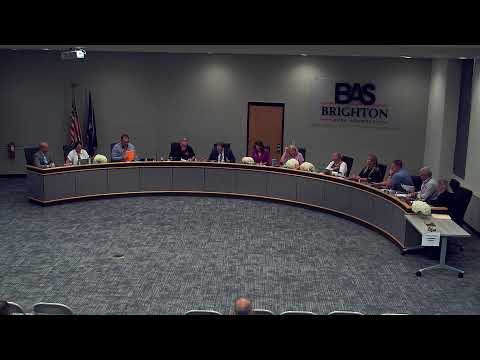
Brighton board narrows bond priorities, sets special meeting for Aug. 4
Loading...
Summary
The Brighton Area Schools Board of Education discussed a prioritized list of potential projects for a November bond, agreed to await detailed cost estimates from consultants King Scott and Clark and scheduled a special bond meeting Aug. 4 to finalize scope and dollar amounts.
The Brighton Area Schools Board of Education discussed which facility projects to prioritize for a possible November bond and agreed to wait for detailed cost estimates from consultants King Scott and Clark before finalizing the bond application.
Board members said they broadly supported a group of items flagged by the board as “necessities” — largely HVAC, roofing, and other deferred-maintenance projects — but emphasized that some items on the draft list require more detailed design and pricing before they can be committed to a ballot package. The board set a special meeting for 7 p.m. Monday, Aug. 4, to decide the final scope and directed staff and consultants to deliver cost estimates in time to meet the district’s filing deadline for a November election.
Why it matters: Board members and administrators said the district must balance replacing urgent systems such as chillers and roofs with adding projects that will attract voter support. Several members stressed the need for items that will be perceived by taxpayers as tangible improvements — performing-arts upgrades, athletic facilities and new learning spaces — not only deferred maintenance.
Board president Dr. Aloff opened the discussion by summarizing the timeline and the consultants’ role. He said King Scott and Clark were continuing due diligence and aimed to provide cost determinations in July so a final board decision could be reached at the August 4 special meeting. “Once we have that information, we will be expected to essentially make a decision at that point whether we are ready to go forward with the bond for the November election,” he said.
Members said the top-tier (green) items on the circulated priority spreadsheet enjoyed broad support. Board members and administrators repeatedly urged patience on more detailed items such as music-suite design and cafeteria expansions, which the consultants need to price after walkthroughs. “HVAC might be one that you feel comfortable with putting on the list here today,” said one board member; other members agreed that HVAC, chillers and major roofs are near-term necessities.
Several board members pressed for hard numbers attached to each project, including the likely ongoing or “legacy” costs of new facilities (maintenance, additional custodial staffing, turf replacement cycles). Administrators noted the district’s capital projects fund contains roughly $9 million that could be deployed for high-priority repairs if a bond is not pursued or does not pass.
Board members also discussed community survey results versus the board’s own ranking. One member noted the public survey placed turf and athletic fields high, while other board-ranked items (for example stadium scoreboard vs. fieldscoreboards) did not always align with public responses. Members asked that consultant reports include estimates of both upfront costs and ongoing maintenance implications so the board can compare community priorities with fiscal realities.
The board agreed to create a campaign steering committee and start recruiting volunteers and PTO partners now so outreach can begin immediately should the board vote to go forward in August. Administrators and multiple board members stressed the compressed timeline: the board must vote to call the election by Aug. 11 to appear on the November ballot; to meet that deadline, the package’s scope and total dollars must be fixed by the Aug. 4 special meeting.
What happens next: King Scott and Clark will finalize cost estimates and suggestions for alternatives. The board expects to receive those numbers before Aug. 4, hold committee-level reviews, then convene Aug. 4 to set the bond scope and Aug. 11 to formally call the election if it chooses to proceed.
The discussion combined technical planning (design alternatives, sequencing and contingency) with political considerations (what will persuade voters). Board members said they will continue to refine the list by email and in short-notice committee meetings once consultant numbers are available.