Get Full Government Meeting Transcripts, Videos, & Alerts Forever!
Get email alerts on the Water Supply Moratorium topic
No spam. Unsubscribe anytime.
Carbondale board reaffirms long‑standing moratorium on out‑of‑town water and sewer taps
Summary
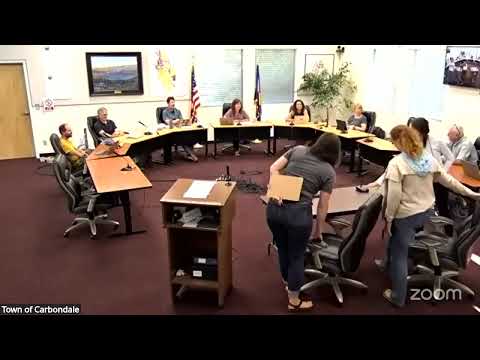
The Town of Carbondale Public Works board reviewed requests for out‑of‑town water and sewer service and indicated informal agreement to maintain a decades‑old moratorium, directing staff to consult the town attorney about clarifying language on taps versus expanded use.
The Town of Carbondale Public Works board reviewed pressure the town has been receiving for out‑of‑town water and sewer taps and signaled informal agreement to maintain its long‑standing moratorium. The board’s discussion traced the moratorium’s history to a 1973 town attorney letter and a 1993 ordinance that limited out‑of‑town taps; staff said the policy has been used for roughly five decades to manage growth and protect the town’s water resources.
Kevin (Public Works staff) told the board that staff have been receiving increasing requests for service outside the town boundary ‘‘for a variety of reasons’’ and that the town’s historical posture has been to refuse outsized out‑of‑town service without additional agreements. He explained that some out‑of‑town connections exist for historical reasons—such as when a main water line required easements across private property—and that the town acquired sewer assets when it dissolved a sanitation district in the past. The board discussed how the moratorium’s intent is to limit volume and additional demand on the system rather than the literal number of holes in a pipe; Kevin said, “it was to limit the amount of water that was leaving our system.”
Board members and staff described the current local pressure points. Staff said most of the recent requests come from properties south of the high school and between the high school and Prince Creek, where about 15 properties are on or near the town’s Nettle Creek water line; staff also said there are roughly 45 to 46 existing Nettle Creek tap holders farther south. Several board members noted fairness concerns where property owners have already installed wells or undertaken upgrades that would be disadvantaged by any sudden rule change.
Annexation and master agreements were part of the conversation. Staff reminded the board the town can encourage annexation for contiguous properties (noting a common contiguity rule that about one‑sixth of a proposed annexation boundary must be contiguous with the town boundary) and discussed ongoing negotiations with CRMS (the campus master plan and EQR allocations). Kevin described efforts to reach a master agreement with CRMS that would clarify the number of equivalent residential units (EQRs) and associated water rights (including shares of the Rockford Ditch) needed for planned expansion; those negotiations have been complicated by how water rights and tap fees historically were handled.
Legal and technical points. Board members asked whether the moratorium applies to expanded use on an existing service versus a new physical tap; staff said that ambiguity exists and that one risk is a legal challenge from a property owner with financial ability to litigate. Several members suggested staff and the town attorney should consider clarifying whether the moratorium covers additional volume or only new physical taps. Mark (town attorney, referenced) was asked to advise, and staff said they would consult him and bring back any recommended clarifying language.
Outcome: The board expressed informal consensus to ‘‘stay the course’’ and maintain the moratorium on out‑of‑town taps. Staff will consult the town attorney about clarifying the moratorium’s language (tap count versus volume/expanded use) and will return with recommended next steps if legal revision is advised.
Related operational updates: Staff also reported the town’s pressure reducing valve (PRV) has been repaired and they expect to bring it back up to full speed; water use has slightly declined from above 1,500,000 gallons per day to about 1.4–1.45 million gallons per day. Staff said drillers will begin work on a Roaring Fork well the following day.
Ending: The board did not take formal action; members asked staff to consult the town attorney and to return if code or ordinance changes are recommended. The moratorium remains in effect pending any legal or policy revision.