Get Full Government Meeting Transcripts, Videos, & Alerts Forever!
Get email alerts on the Criminal Justice Forensic Conditional Release topic
No spam. Unsubscribe anytime.
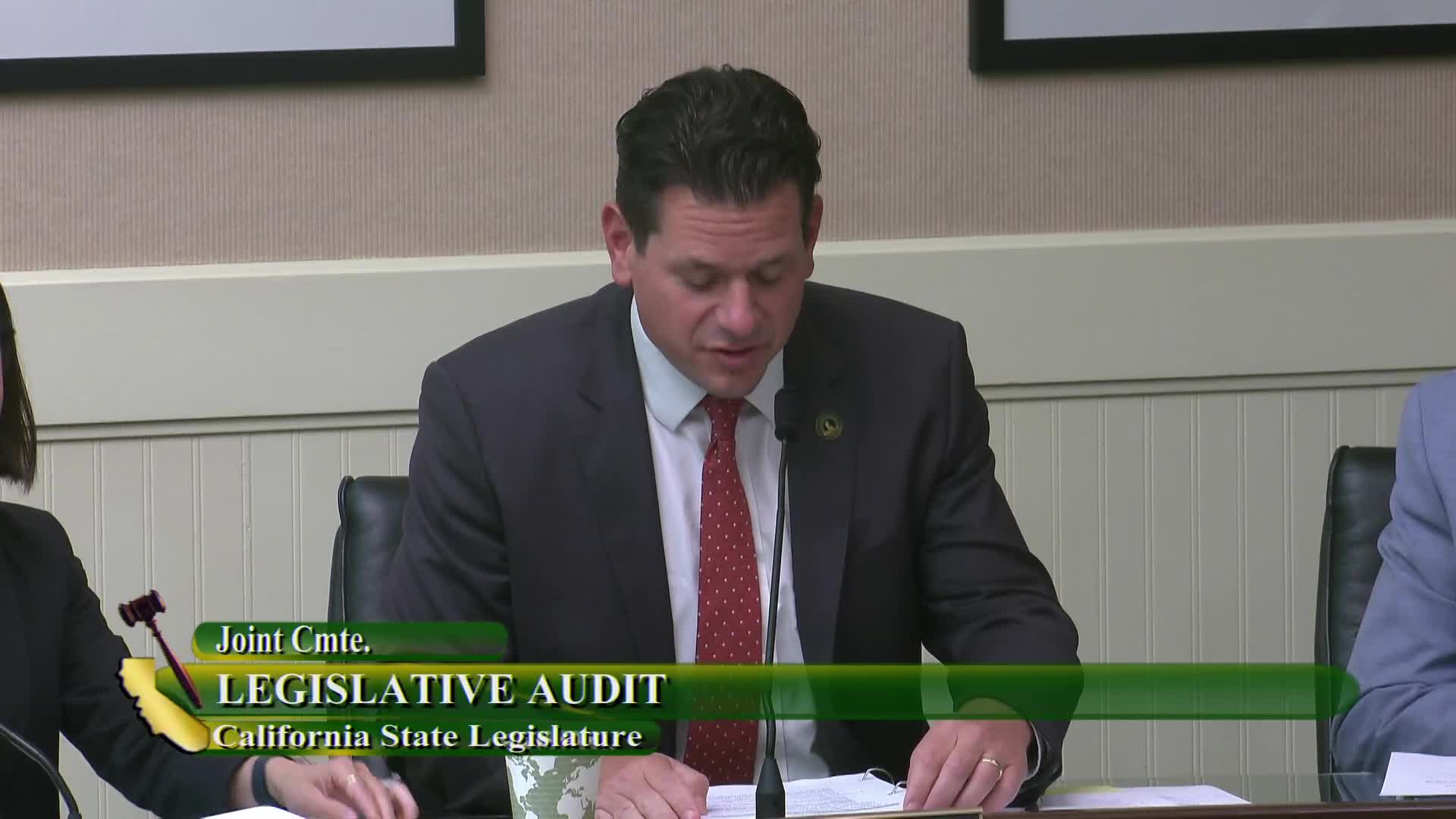
State audit finds slow placements, oversight gaps in CONREP program as lawmakers push reforms
Summary
A state audit released in October 2024 found that California takes far longer than intended to place sexually violent predators (SVPs) into community housing under the Department of State Hospitals’ Conditional Release Program (CONREP), prompting sharp questions from legislators and divided recommendations from the department and its contractor, Liberty Healthcare.
A state audit released in October 2024 found that California takes far longer than intended to place sexually violent predators (SVPs) into community housing under the Department of State Hospitals’ Conditional Release Program (CONREP), prompting sharp questions from legislators and divided recommendations from the department and its contractor, Liberty Healthcare.
State Auditor Grant Parks summarized the report for the Joint Legislative Audit Committee, saying, “SVPs participating in the con rep program were convicted of new offenses less frequently than SVPs who were unconditionally released by the courts,” but he also detailed lengthy placement delays and other problems identified by auditors.
Why it matters: the audit found average waits of about 17 months between a court approving CONREP participation and approval of a specific housing location; for SVPs awaiting placement the average wait was roughly 20 months, with at least one person waiting more than four years. Auditors flagged persistent problems with the housing search process, limited county participation on statutorily required housing committees, and weaknesses in how the Department of State Hospitals (DSH) held Liberty Healthcare accountable for known deficiencies.
Key findings and figures
- Placement delays: auditors reported an average of 17 months from a court’s order authorizing CONREP participation to court approval of a housing location; for the group awaiting placement the report cited a 20-month average wait and one individual waiting 4½ years.
- Public safety outcomes: auditors found 2 of 56 SVPs placed through CONREP were convicted of new offenses while in the community. The audit also found courts revoked CONREP participation and returned 18 of the 56 placed SVPs to state hospitals for noncompliance, a fact several legislators combined with the two convictions to characterize the program’s overall failure rate.
- Costs cited: auditors reported Liberty Healthcare charging up to $2,800 per month per SVP for pre-placement services. The audit listed housing-search costs of $485,000 and costs to hold housing under consideration of $415,000 for fiscal year 2022–23. DSH and witnesses discussed program lifetime and per-year cost estimates at the hearing.
- Program size and caseload: auditors reported 19 SVPs living in the community at the April 2024 audit snapshot; DSH later said 21 clients live in the community and that few SVP patients achieve conditional release (DSH cited roughly 60 total CONREP releases since the program began in 2003).
Department and contractor response
DSH Director Stephanie Clendenin told the committee the department has implemented four of five audit recommendations: it issued guidance for housing-committee designees, conducted a formal program review of Liberty Healthcare (and plans biennial reviews going forward), implemented an outcomes tracker, and completed an analysis of separating contract services. “All have been fully implemented in accordance with the timelines that were identified in the report,” Clendenin said.
On one major recommendation — that California study or establish state-owned transitional housing like several other states use — DSH formally disagreed. Director Clendenin said the department concluded transitional housing would not resolve the core obstacles to timely placements and could add cost and siting problems, arguing statutory residency restrictions, individual risk factors and likely local opposition would limit such facilities’ usefulness.
Liberty Healthcare’s senior vice president, Ken Carabello, defended the program’s supervision and clinical approach. He framed CONREP as an intensive supervision-plus-treatment model intended to catch early signs of decline in the community and return participants to hospital care when needed. “If you do have a conditional release program, you will have more failures due to terms and conditions,” Carabello said, adding that earlier revocations can prevent later reoffenses.
Lawmakers press for changes
Several legislators pressed DSH and Liberty for further reforms or an immediate pause. Senator Jones said the “con rep system is broken, and we need serious reforms,” and said he has legislation in Assembly Appropriations (referred to in the hearing as “SP 380”) that would require DSH to begin developing a transitional housing program.
Assemblymember DeMello (as recorded at the hearing) called the program “perhaps one of the worst programs I have ever come across,” said it was “hemorrhaging taxpayer money,” and urged an immediate suspension of placements. Members from rural districts said their communities — including parts of San Diego County, the Antelope Valley/High Desert and other counties mentioned in testimony — feel disproportionately affected by placement decisions and by the program’s long timelines.
Process and oversight issues raised
Auditors and legislators criticized several structural problems: unclear expectations and deliverables for locally convened housing committees required under recent law; inconsistent documentation and electronic access to clinical and court records for community clinicians; and a lack of a clearly prioritized process by DSH for ensuring Liberty promptly corrects deficiencies identified in reviews. Auditor Parks said some court records cited only generic “noncompliance with program rules” when revocations occurred, limiting the audit’s ability to parse reasons for returns to hospital care.
Questions about vendor behavior and community notice
Several legislators and members recounted homeowner and neighbor complaints that Liberty’s leasing practices sometimes misrepresented the nature of placements or failed to adequately inform neighbors, causing landlords to withdraw properties after signing lease holds. DSH and Liberty said landlords are informed of the nature of a potential placement and that higher-than-market payments are often necessary to recruit landlords; DSH said it participates in multiple internal reviews before a site is presented to the court. Lawmakers pressed for greater accountability on lease/hold costs and for more transparent outreach to affected communities.
Next steps and outlook
Committee members said they will continue legislative work and oversight. Senator Jones and others signaled they will pursue statutory changes, including bills to require transitional housing planning and greater DSH involvement in placement decisions. DSH said it is willing to continue dialogue with the Legislature but maintains transitional housing is not a near-term solution without further statutory changes.
The hearing closed with committee members urging continued scrutiny of DSH and Liberty and further action from the Legislature and the governor’s office.
Ending: The Joint Legislative Audit Committee adjourned after roughly two hours of testimony and questioning; committee members said further oversight and possible statutory fixes are likely to follow.