Get Full Government Meeting Transcripts, Videos, & Alerts Forever!
Get email alerts on the Office Of Inspector General topic
No spam. Unsubscribe anytime.
Dallas inspector general outlines plan to build independent office, seek proactive data tools and later law-enforcement authority
Summary
Newly appointed City of Dallas Inspector General Timothy Manky told the Ethics Advisory Commission he will prioritize fixing audit-identified vulnerabilities, acquiring CJIS-certified case-management and forensic tools, and shifting from reactive to proactive investigations; the commission voted to approve minutes earlier in the meeting.
Timothy Manky, the newly appointed inspector general for the City of Dallas, told the Ethics Advisory Commission on July 15 that his first priorities are addressing vulnerabilities identified in a recent audit, installing a CJIS-certified case-management system and forensic tools, and moving the office from a reactive to a proactive posture to detect fraud, waste and abuse.
The announcement came during a briefing to the Ethics Advisory Commission, which met in person and virtually. Manky said the office’s immediate work will follow recommendations in an audit signed Jan. 17, 2025, by City Auditor Mark Swan and an independent firm. “The first priorities of the office is establishing a foundation now that it is an office not just a division within the city attorney's office,” Manky said. He said that foundation includes both case-management and forensic capabilities.
Manky described the audit’s findings and his plan to address them as the basis for upcoming budget requests. He said the office currently uses EthicsPoint, “a good system for HR and compliance,” but that it creates “bottlenecks of information” and is not an adequate investigative case-management system. He said he wants a Criminal Justice Information Services (CJIS)–certified case-management system that will “protect information that controls flow of information as casework is being done” and allow management to monitor progress in real time.
Manky also said the office lacks data analysts and forensic tools. “Data analytics is gonna be an important aspect moving forward,” he said, describing plans to acquire staff and software to run analyses that surface anomalies and high-risk matters rather than relying solely on tips. Forensic tools he listed include the ability to image hard drives and cell phones when allegations suggest improper activity. He said the aim is to pursue higher-value, higher-profile matters rather than many lower-dollar routine cases.
On strategy and timing, Manky said the city has already created independence for the office — moving it from a division under the City Attorney to an independent office — and that, after shoring up systems and staffing, he would pursue statutory law-enforcement authority for the office. “After we've made the transition to becoming proactive in our approach to detecting fraud and abuse, we then pursue law enforcement authority,” he said, adding that a legislative effort had been attempted in the most recent session but did not pass.
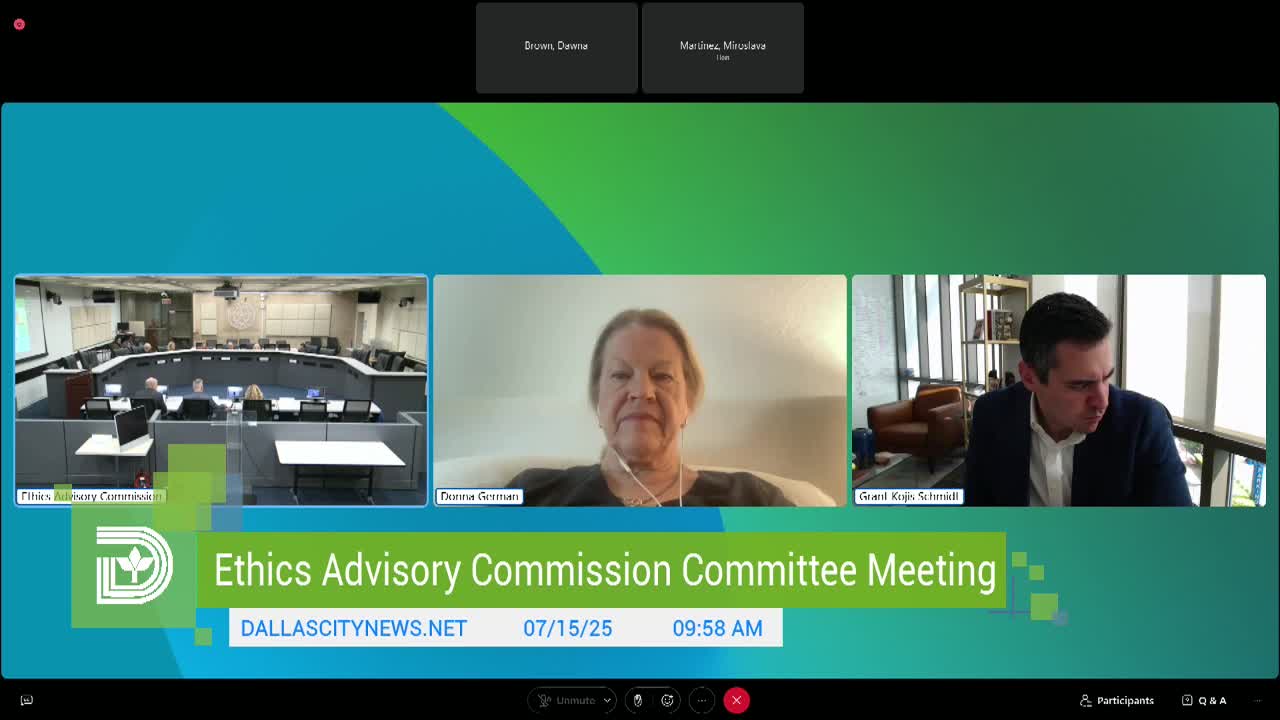
Commission members pressed for practical details and transparency. Commissioner Donna German, introduced as a new member during roll call, asked how Manky would secure the financial and other resources he described; he replied that budget requests are in process and will be presented to city council. Commissioner Susan Bowman asked whether the audit had been circulated; Manky said he would distribute the audit and his resume to the commission after the meeting and would provide a proposed new organizational structure in about 60 days.
Legal and procedural questions were addressed by staff. Laura Phelan of the Office of Inspector General said the office “does have and we have had the power in investigations to subpoena witnesses and documents.” She added that if a witness does not appear at a commission hearing under the code, the office must then seek enforcement of the subpoena through the commission.
City staff and commissioners also discussed the role of the Ethics Advisory Commission in code amendments and oversight. Laura Morrison, legal counsel for the commission, explained that amendments to Chapter 12A (the code of ethics) come through the commission for recommendation, then to a council committee and finally to full council. Staff noted committee work was paused while council reorganized and that committees would resume in August.
Manky said he will seek to build an office that protects both the council and the public and that, compared with similar-size cities, Dallas' inspector general office is under-resourced. “We are $1,000,000 below the average expenditures of similar size cities offices of inspector general,” he said, arguing the office can “do more with less” by leveraging technology and restructuring before adding investigative personnel.
Earlier in the meeting the commission voted to approve the minutes of its April 15 regular meeting; the motion passed unanimously. The commission adjourned and scheduled its next regular meeting for Oct. 21, 2025, at 9:30 a.m.
Manky said he welcomes contact from commission members and others as he establishes the office, and he invited commissioners and council members to visit the OIG office to see existing space and planned changes. He said the office will focus on “quality, not just quantity” of matters referred to the commission and will try to limit routine personnel issues being elevated to the council.
The commission’s staff said it will circulate the audit report, Manky’s resume and the proposed structural changes to commissioners as promised.