Get Full Government Meeting Transcripts, Videos, & Alerts Forever!
Get email alerts on the Signage topic
No spam. Unsubscribe anytime.
Fulshear council narrowly approves limited electronic signs for schools after months of public debate
Summary
The City Council voted 4-3 to amend the coordinated development ordinance to allow small, time-limited electronic signs for schools in specified locations after extensive public comment for and against the change.
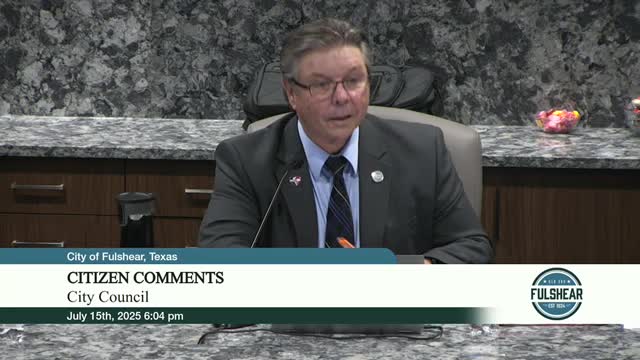
Fulshear City Council voted 4-3 on July 15 to amend the city’s coordinated development ordinance (CDO), allowing limited electronic signs for schools under a new set of restrictions.
Supporters — including parents and PTA leaders — told the council electronic marquees would improve school-to-family communications. “Digital signs allow us to share updates instantly, reminders, school news, celebration, and events, all with just a few clicks,” said Kimberly Wilhelm, a Cross Creek parent. Lisa Abel, who said she represents Shaffer Elementary, told the council the signs reduce missed deadlines and increase volunteerism: “It gives parents very valuable information about school events and informational reminders.”
Opponents — longtime residents and members of local neighborhood groups — argued the signs would alter the city’s character and create a precedent for more commercial signage. “If you allow the schools to put LED signs…you’ll be inundated with all kinds of people wanting all kinds of signs,” said Pat Moller, a 12-year resident who took part in the CDO’s original drafting. Kathy Ward warned the signs could make corridors look like a “Vegas Strip.”
The ordinance adopted by council limits the electronic portion of eligible monument signs to 30 square feet and treats them under downtown-district monument-sign rules (the staff presentation tied use to the downtown district and FM 1093 locations). Council also approved an operational window: the motion as adopted set a daily start time at 5 a.m. and an ending hour at 8 p.m., and removed a proposed annual “summer-only” restriction the council had debated.
City staff said the amendment applies only in the locations and under the design and size limits set in the CDO; the council can revisit the rules in the future. Several council members said the city’s legal advisers had reviewed the ordinance language and that it was patterned to regulate time, place and manner rather than content.
Councilmember discussion focused on balancing schools’ communication needs with neighborhood character and enforceability. Mayor McCoy and others urged that staff monitor the first year of installations closely and report back to council if the city sees unintended consequences.
The measure was contentious: council passed the ordinance by a 4-3 margin after public testimony and a lengthy staff presentation. The City Clerk will publish the final ordinance and the CDO text change will be posted by the city secretary.