Get Full Government Meeting Transcripts, Videos, & Alerts Forever!
Get email alerts on the Transportation Infrastructure topic
No spam. Unsubscribe anytime.
MDOT recommends urban-diamond redesign for I‑75 and 8 Mile Road interchange
Summary
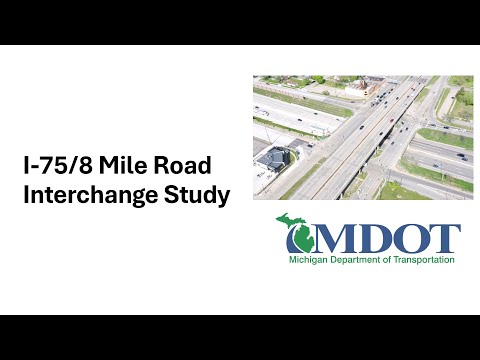
The Michigan Department of Transportation recommended an urban-diamond interchange as the preferred alternative for the I‑75 and 8 Mile Road interchange in a feasibility study that evaluates traffic, safety and community connectivity for the Detroit–Hazel Park border.
The Michigan Department of Transportation recommended an urban-diamond interchange as the preferred alternative for the I‑75 and 8 Mile Road interchange in a feasibility study that evaluates traffic, safety and community connectivity for the Detroit–Hazel Park border.
The study recommends the urban diamond after comparing three conceptual alternatives — a diverging diamond, an urban diamond and a single-point urban interchange — against the existing configuration. MDOT said the urban diamond best balances vehicle operations with improved pedestrian and bicycle access and better local connections across 8 Mile Road.
MDOT identified three primary goals for the study: address recurring congestion on I‑75 (including consideration of adding a fourth through lane in each direction), improve safety and mobility for all users including pedestrians and bicyclists, and respond to community preferences for improved cross-street connections and streetscape enhancements. The project area covers I‑75 mainline and service drives and 8 Mile Road (M‑102) from John R Street to Dequindre Road and from Maxlow Avenue to Lance Avenue on I‑75 service streets.
Study authors reviewed the interchange born of 1960s-era design: the elevated flyover bridges were built in 1969 and currently constrain I‑75 to three lanes in each direction across the 8 Mile bridges, creating a bottleneck where four lanes must merge into three during peak periods. MDOT noted the bridges will need rebuilding and used that replacement need as an opportunity to study alternative interchange configurations.
MDOT and consultants evaluated the three concepts using selection criteria that reflected public priorities. All three conceptual alternatives scored better than the existing configuration for most community-focused criteria, notably pedestrian access and neighborhood connectivity, but removing the flyover bridges creates a trade-off: increasing crossings and local access can modestly worsen traffic operations on 8 Mile Road in some scenarios. After refining performance and trade-offs, MDOT carried forward two practical alternatives (diverging diamond and urban diamond) and selected the urban diamond as the recommended alternative after additional traffic and safety analysis and alignment with community input.
The recommended urban-diamond design would remove the central three-lane flyover bridges, retain four signalized intersections and use crossovers for Michigan-left movements (left turns from 8 Mile to I‑75 service drives would use crossovers just beyond intersections; direct lefts would be permitted from service drives onto 8 Mile). The design includes marked crosswalks, refuge islands and a barrier-protected median path to improve pedestrian and bicycle crossings and reduce driver confusion, MDOT said.
MDOT described the public and stakeholder engagement conducted during the study. Open houses were held in December 2023 at the Hazel Park Community Center and in May 2024 at Nolan Elementary School in Detroit; MDOT also presented to two Department of Neighborhoods District 3 meetings in 2024 and launched an online survey in June 2024 to gather input on the three conceptual alternatives. The agency said an interactive map and other materials were available online and that common public priorities included better pedestrian crossings, improved lighting and signage, exploration of interchange designs, and adding a fourth through lane on I‑75.
MDOT emphasized that the feasibility study is an early planning step. No funding has been identified for engineering or construction. The department said it will pursue potential funding sources, including federal grants, and that, if funding is secured, the project would proceed through the National Environmental Policy Act (NEPA) process, where the public would have additional opportunities to comment during environmental review and design phases.
The study report and renderings of the diverging-diamond and urban-diamond alternatives were listed as available on the project web page; MDOT indicated the final public open house was planned for summer 2025. The agency also noted that, while the urban diamond was recommended, further design and environmental review could change specific features or the preferred alternative as the project advances.
Details from the feasibility study — including the selection criteria scores, traffic-operation trade-offs, and public-input summaries — are in the final report and project materials posted by MDOT.