
Bellflower approves Sound Thinking contract for gunshot detection and expanded license-plate readers
Get AI-powered insights, summaries, and transcripts
Sign Up Free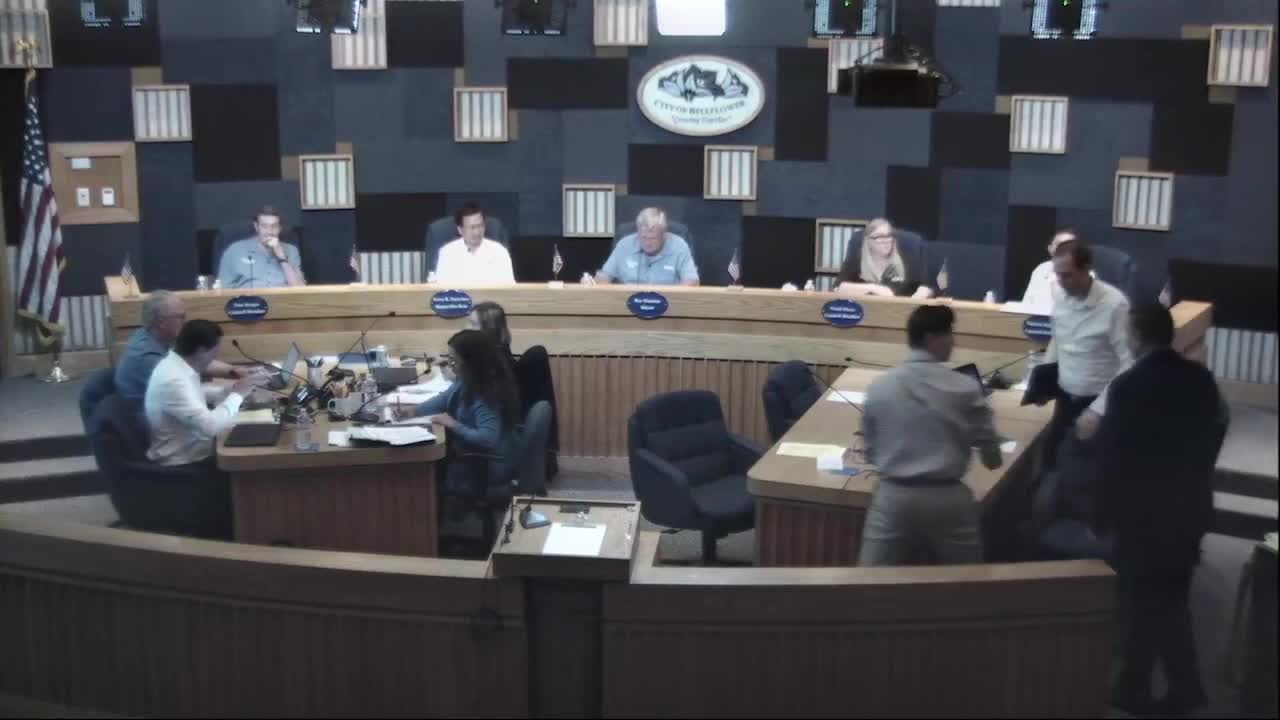
Summary
The City Council authorized a contract with Sound Thinking to deploy ShotSpotter gunshot-detection sensors and expand Plate Ranger license‑plate reader coverage. City staff and company representatives described data safeguards, CJIS storage, investigative uses and a phased implementation timeline.
The Bellflower City Council unanimously authorized the city manager Monday to execute an agreement with Sound Thinking (formerly ShotSpotter) to install gunshot-detection sensors and add automatic license-plate readers (ALPRs) intended to support law-enforcement response and investigations.
Brian, Bellflower’s public safety director, told the council the purchase follows a January public-safety assessment that identified technology as an area for improvement. Jamie, senior director of technology and solutions for Sound Thinking, gave a detailed demonstration of how gunshot detection and Plate Ranger ALPRs work, said the company maintains an incident‑review center to reduce false positives, and described CJIS‑approved cloud storage and legal support services included with the contract.
“Eighty percent of that gunfire goes unreported,” Jamie said during the presentation, citing research the company uses to make the case for detection sensors. He added the system provides location precision and quick notification: “We guarantee that within 90 feet, we're gonna show where those shots occurred.” Jamie and company colleagues also described Plate Ranger features including video capture for reads, vehicle-make/model recognition and tools to generate investigative reports.
Council members asked about privacy and data retention. Jamie said sensor audio is tuned to detect gunfire only and that recorded data are stored in an FBI‑approved government cloud (AWS GovCloud) with controlled access for law enforcement; he said ALPR records are typically retained for 90 days unless local statutes require a shorter period. The company also told the council that legal and prosecution-support services are included as part of the solution and that a customer‑success team will provide onboarding and training for staff and prosecutors.
City staff described current and proposed hardware counts: the city already has 15 ALPR cameras from a prior Motorola/Vigilance deployment and was piloting 10 Plate Ranger cameras with Sound Thinking; the proposed agreement adds 30 more Plate Ranger cameras for a total of 40 Plate Ranger devices. Combined with the existing 15 ALPRs the city anticipates 55 cameras in total under the planned deployment. Staff said Plate Ranger installation could be completed within a few months; deployment of ShotSpotter sensors depends on site approvals and power access and could extend into 2026.
Victor Sanchez moved to authorize the city manager to execute agreement file No. 1097 with Sound Thinking Inc.; Mayor Pro Tem Sonny Santaynes seconded. The council approved the motion on a 5-0 roll call: Victor Sanchez — aye; Mayor Pro Tem Sonny Santaynes — aye; Dan Coops — aye; Wendy Morse — aye; Mayor Dutton — aye.
Council members asked staff to return with a community outreach plan explaining how data will be used and shared with partner agencies. Company representatives said the sheriff's office would control access and that the system can generate scheduled reports for schools, hospitals and other partners upon law‑enforcement request.