Get Full Government Meeting Transcripts, Videos, & Alerts Forever!
Get email alerts on the Facility Maintenance And Animal Safety topic
No spam. Unsubscribe anytime.
Austin Animal Center outlines hot-weather protocols, facility upgrades after staff raise concerns
Summary
AAC staff described new SOPs, cooling equipment, and maintenance processes to keep animals and staff safe during summer heat; building services described preventive HVAC maintenance and spare cooling options.
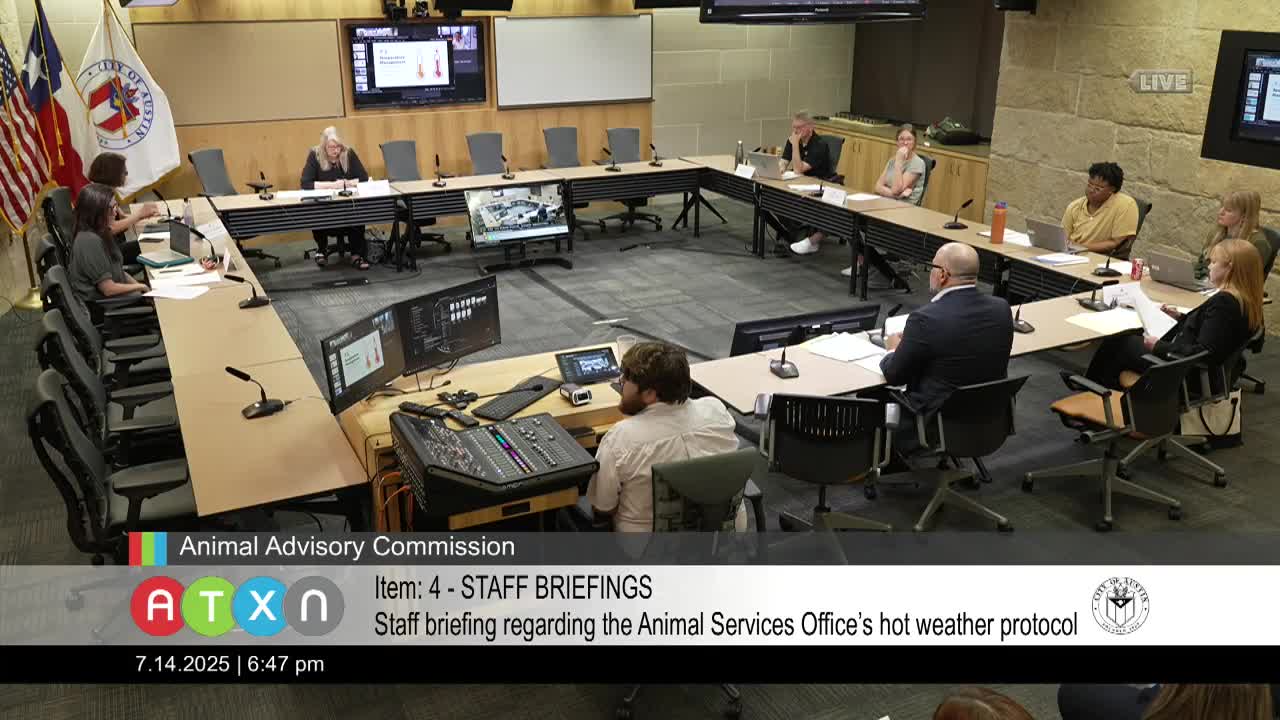
Austin Animal Center staff and Building Services presented the shelter’s hot-weather protocol and facility maintenance procedures to the advisory commission on July 14, describing both daily operational steps and longer-term capital and maintenance work.
Robert Galemboski, division manager for animal care, reviewed day-to-day procedures: morning weather emails to staff with temperature forecasts and heat-safety reminders, added hydration stations and portable fans, more consistent use of shade canopies and pools (volunteer-assisted), and guidance on when runs and guillotine/kennel doors are closed to allow the shelter’s HVAC to recover. Galemboski said the shelter aims to close kennel doors when interior run temperatures exceed 85 degrees and to escalate to building-services support if air-conditioning equipment fails to bring temperatures down.
Pat D’Angelo, building services asset manager, described structural and systems work: AAC is served by more than 21 HVAC units maintained on a monthly preventive schedule, and the city’s building-automation system is used to monitor and adjust set points remotely. D’Angelo said most kennel-area set points are kept in the 74–75°F range; technicians respond quickly to high-temperature alarms, and the department can bring portable evaporative coolers or rented equipment when repairs require parts that are not immediately available.
Commissioners asked about practical concerns that affect operations: broken or propped-open kennel doors, where the open doors let hot outside air reduce indoor cooling efficiency; whether temporary modular buildings are on the building-automation system (D’Angelo said they are air-conditioned but not on the automation system); and how daily weather notices reach non-desk staff. Galemboski said the morning email currently goes department-wide, and commissioners suggested adding visible on-site signage or a flag-style display for staff and volunteers who are not checking email during shifts.
Staff acknowledged challenges: pools and sprinklers can be decommissioned if an infectious-disease risk (e.g., giardia) is present; fans can circulate pathogens if used improperly and therefore require vet approval; and staffing limits mean volunteers are relied on to help maintain pools and water buckets during heat spells. Fernandez said an organizational rework is forthcoming that will include a role with explicit outcome oversight; commissioners and staff discussed adding a visible, non-email method of heat alerts for frontline workers.
Ending: Staff said they will finalize a written SOP for hot-weather operations, coordinate with building services on continued preventive HVAC maintenance, and explore additional on-site signaling (whiteboard/flag) to ensure non-desk staff receive immediate heat-safety alerts.