Get Full Government Meeting Transcripts, Videos, & Alerts Forever!
Get email alerts on the Shelter Statistics And Behavior topic
No spam. Unsubscribe anytime.
Volunteers and commissioners press Austin Animal Center on spike in deaths and behavioral euthanasia notices
Summary
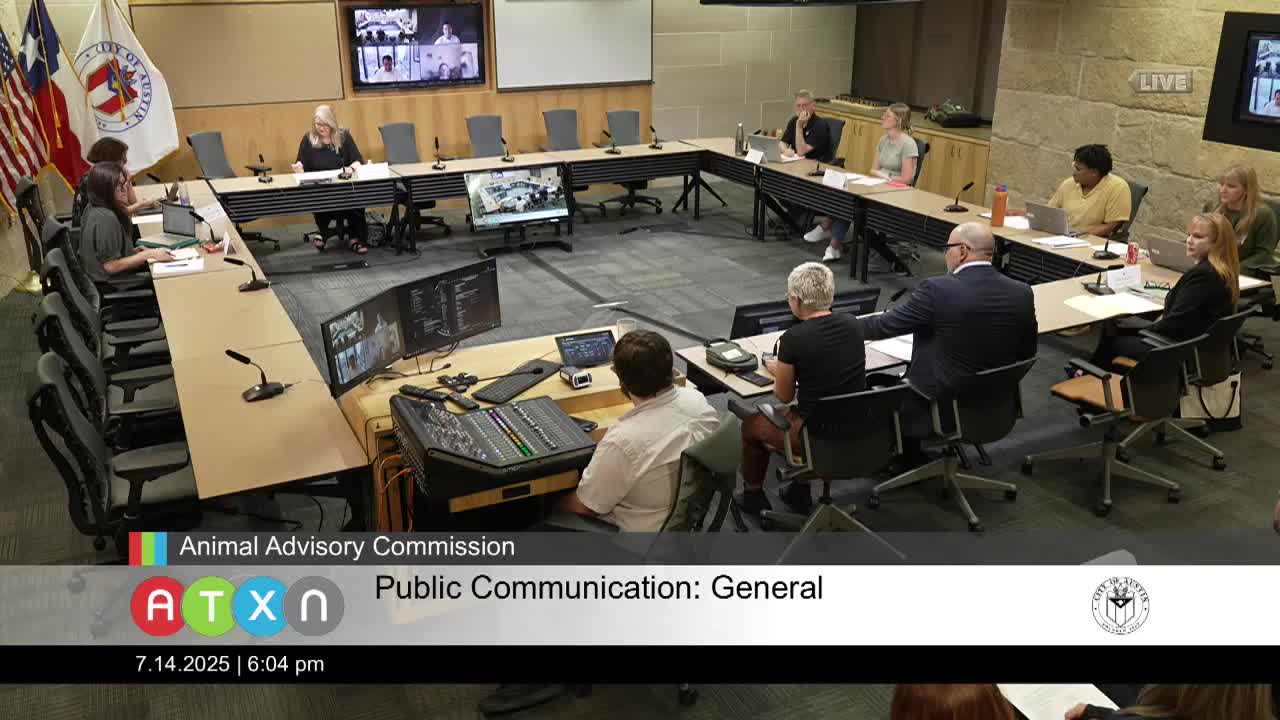
Volunteers and commissioners at the Austin Animal Center Advisory Commission meeting pressed interim shelter leadership about a rise in in-shelter deaths in June and about procedures used to issue euthanasia notices for animals labeled a public-safety risk.
Commissioners and volunteers pressed Austin Animal Center leadership on July 14 about an apparent spike in animal deaths and whether behavior staff were consulted before animals received euthanasia notices.
Caitlin Branstetter, an animal enrichment specialist who recently joined Austin Animal Center staff after years as a volunteer, told the commission that several dogs received euthanasia notices on June 9 “with each 1 being labeled a public safety risk.” She said she was concerned that shelter decision-making did not consistently involve paid behavior specialists: “In fact, the first time I saw the behavioral euthanasia risk assessment rating matrix, which had been promised to be made public since 03/06/2024, was last month in a public information request.”
The concern surfaced again during a later public comment by Shelly Liebman, a cat volunteer, who cited AAC’s statistical report showing 66 “unassisted deaths” in June — 54 of them cats and kittens — and noted that represented about 8 percent of total cat intake for that month. “To put this in perspective,” Liebman said, “last June, there were 10 unassisted deaths for cats and kittens, 2 percent of total cat intake.” She asked whether staffing shortfalls, delays in veterinary care or neonatal care patterns contributed to the increase.
Interim Director Rolando Fernandez acknowledged the spike and said staff were reviewing the underlying data. Fernandez introduced Deputy Jason Garza to explain the shelter’s live-outcome calculation. Garza said AAC reported a 89.24 percent live outcome rate for June and that, on review, 26 of the 66 deaths were animals that were brought to the shelter already dead. Garza said that if those dead-on-arrival cases are separated, the live outcome figure would improve and that staff would seek to add a distinct “DOA” classification to the database so those animals are not conflated with animals that died in kennel or in foster.
Garza said: “Once we start addressing that within the database, hopefully, we will see those report those out differently for anything that's come to us, unfortunately, perish before we were able to provide any care.” Fernandez said the department is planning organizational changes to add oversight focused on outcomes and to reduce missed steps that can occur when staff are stretched.
Commissioners pressed for more detail on causes of the deaths and what follow-up reporting the commission could expect. Commissioner questions focused on whether the deaths were concentrated in neonates (bottle babies), adults, or animals arriving in poor condition; whether the DOA category would be implemented quickly; and whether staffing or procedural changes were likely to be needed.
Branstetter and other volunteers also raised process concerns about euthanasia notices. Branstetter said that although staff told stakeholders an animal’s euthanasia notice was preceded by a “formal discussion” involving the behavior team and leadership, in practice the behavior staff represented at that discussion has been limited. “I can personally attest that the only behavior and enrichment staff who attends this discussion process is my division's supervisor,” she said, adding it was “misleading messaging” to claim a broad panel of behavior professionals took part.
Fernandez said he had heard the concerns and reiterated the department’s intent to create clearer internal roles and oversight for animal outcomes. He said work with human resources and the city’s administrative processes is underway to formalize an organizational chart with clearer responsibilities for outcomes management.
Clarifying details and next steps noted at the meeting included: staff will add a DOA (dead-on-arrival) designation in the shelter database, Fernandez and his team will pursue an organizational change to create explicit oversight for outcomes, and staff said they will return with more detailed breakdowns of causes (medical, neonate, trauma, etc.) once data corrections are complete. The commission asked staff to report back to a future meeting with the DOA-classification implementation plan and with a categorical breakdown of the June deaths when available.
Ending: Commissioners and volunteer speakers asked for follow-up reporting and more transparent documentation of behavior-assessment practices; interim leadership committed to data fixes and an organizational oversight role aimed at improving outcomes.