Get Full Government Meeting Transcripts, Videos, & Alerts Forever!
Get email alerts on the Ethics And Censure topic
No spam. Unsubscribe anytime.
Ione council orders draft censure resolution after investigator sustains multiple allegations against council member
Summary
An independent investigator found several allegations against Council Member Allison Lafane sustained, and the Ione City Council voted to release the report and direct the city attorney to prepare a resolution of censure for consideration at a future meeting.
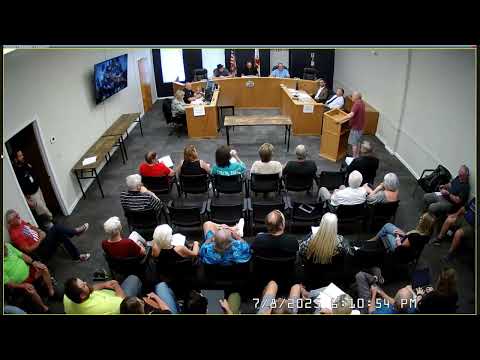
The Ione City Council on July 8 voted to release an independent investigation into allegations against Council Member Allison Lafane and directed the city attorney to prepare a draft resolution of censure for council consideration at a later public meeting.
The investigator, attorney Mark Miles of McKinley, Conger, Jolley & Gallardo, delivered a report that sustained multiple allegations against Lafane, including negotiating with a party in the Castle Oaks golf-course transaction without council approval, interfering with staff at the scene of a sewer incident and filing a hazardous-spill report the investigator said should have been handled by the city manager, and posting social-media comments the investigator found harmful to staff and council relationships. Miles summarized the work behind his findings, saying he interviewed about 17 people and reviewed “over 500 pages of documents, emails, [and] social media posts.”
Why it matters: The council took two formal steps at the special meeting — releasing the investigator’s file and directing the city attorney to draft a censure resolution — setting a process that could lead to a formal reprimand. The city released the documents to the public during the meeting and scheduled further action so Lafane may respond at a subsequent hearing.
Miles told the council he applied a “preponderance of the evidence” standard and described which allegations his review sustained and which it did not. He said the evidence did not support a finding that Lafane disclosed confidential closed-session information, but it did support a finding that “council member Lafane was communicating with the Hahn representatives without council approval” and that, broadly, she had been “negotiating” on the city’s behalf without authorization. Miles used the term “sustained” when summarizing several of the report’s conclusions.
On staff interaction, Miles said testimony and incident statements from contractor Justin Granados and Public Works Superintendent Zach Finch described Lafane speaking over the contractor and demanding immediate remedies while he explained options. Miles also noted that Lafane filed a hazardous-spill report in her capacity as a council member, which the investigator said ordinarily falls to the city manager’s office under city practice. Miles concluded those allegations were sustained.
Miles also reported extensive email exchanges between Lafane and city attorneys. He said there were more than 60 multi-message email chains between Lafane and former City Attorney Andy Penasco during her mayoral term and that the current city attorney had received more than 90 emails from her and billed “more than 20 hours” responding. Miles wrote that those exchanges, in his view, were often matters that would ordinarily be handled through the city manager.
Several public commenters and city staff urged action. Parks and Recreation Director Selena Mitchell said staff morale has been affected, telling the council, “it can be very hard to come to work every day” when employees see repeated social-media posts accusing staff of corruption. Public Works Superintendent Zach Finch, who spoke during public comment, said, “As the public works superintendent, I do not run a personal agenda.”
Mayor Stacy Rhodes moved to release the investigator’s report and related emails during the meeting and told the council the scheduling emails around the special meeting would be made public as well. City Attorney Josh Vrinsky told the council that any motion taken that night would not be binding and that directing him to prepare a censure resolution would be the procedural step needed to place a draft censure before the council at a future meeting: “No action you take here is binding yet. If you wanted to move forward, you would direct me to prepare a resolution of censure.”
The council approved the release of the investigation documents and later voted to direct the city attorney to prepare a resolution of censure. The votes recorded on the transcript show the council approved both measures by voice vote; three council members were present for the session (Council Member Mitchell, Vice Mayor Maida and Council Member Coates), and two (Council Members Dominic Atlin and Allison Lafane) were absent. The council set the procedural next step as preparing a resolution for consideration at the next meeting in which the censure matter may be heard.
Public commenters raised the cost of the investigation and legal work. Multiple speakers estimated or claimed legal bills that varied widely; one public commenter said an earlier contract was “around $15,000” and predicted total costs “well over $30,000, maybe $40,000,” while another speaker described a $42,000 bill related to legal calls. Those figures were comments from members of the public and were not supplied as findings in the investigator’s report.
What’s next: The council directed the city attorney to draft a censure resolution and proceed to a subsequent public hearing so Lafane may have the opportunity to respond. The city released the investigation documents during the meeting and said scheduling and related emails will be made public. No final censure was adopted at the July 8 meeting.
The council’s action opens a formal process under the city’s censure policy and related municipal guidance; any adopted resolution of censure would require a future public vote and a formal council finding recorded in a resolution.