Get Full Government Meeting Transcripts, Videos, & Alerts Forever!
Get email alerts on the Energy Decarbonization topic
No spam. Unsubscribe anytime.
Hartford residents press state for 100% renewable retrofit of Capital Area System, ask council to seek answers
Summary
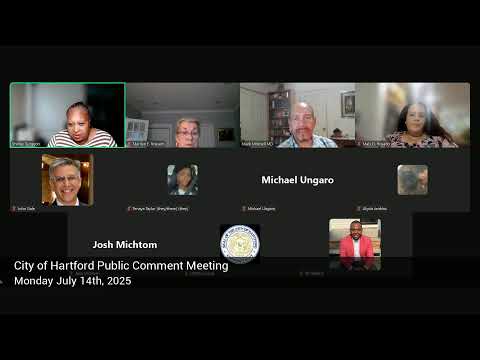
Residents, Sierra Club and Connecticut Coalition for Environmental Justice urged the Hartford City Council on July 14 to press the state Department of Administrative Services for transparency and to pursue a 100% renewable overhaul of the Capital Area System rather than rebuilding it with natural gas.
Hartford residents and environmental advocates told the Hartford City Council on July 14, 2025, that the state-owned Capital Area System should be rebuilt using 100% renewable heating and cooling technologies and not converted back to natural gas.
The comments, delivered during the council's virtual public comment session, asked the council to press the Connecticut Department of Administrative Services (DAS) and the governor's office for a public explanation of the DAS March 2024 study on the Capital Area System and to consider a formal statement urging alternatives such as heat pumps, solar, or network geothermal. Speakers said the system heats and cools up to about 15 state-owned buildings in downtown Hartford, that the state purchased the system in 2022, and that rebuilding it with gas would perpetuate local pollution.
Alicia Jenkins, campaign organizer for Sierra Club Connecticut, said, "I'm here to advocate again for the Capital Area System and its updates and the plan to update the Capital Area System to a 100% renewable energy and have a workforce of Hartford residents attached to this job." Jenkins described the group's push for heat pumps, solar and network geothermal and said activists have circulated a city resolution asking the council to act.
Michael Longaro, a Hartford resident and Sierra Club member, said the DAS study appears to favor gas and urged the council to seek transparency from the state. Longaro said network geothermal and other clean options are being used in other New England municipalities and argued those options would reduce pollution in Hartford over time.
"This is not a city-owned facility. It's a state-owned facility, but it's in our city, and it's been polluting our air for 37 years," Longaro said.
Dr. Mark Mitchell, founder of the Connecticut Coalition for Environmental Justice, invoked the governor's climate guidance and asked the council to request the state present its plan to city residents. "The governor's executive order, 21-3, where he said that any new or upgrades to heating and cooling systems of state buildings will be greenhouse gas free," Mitchell said, citing the order as the basis for asking DAS to explain why the study appears to move toward gas. He and other speakers also criticized the consultant pricing and said purchase-of-credits proposals would not substitute for reducing pollution in Hartford itself.
Tianna (Tania) Taylor, a Hartford resident and organizer with the Capital Area System campaign, described personal and family health impacts that she and others attribute to long-term local pollution and urged the council to "stand with us" in seeking a cleaner solution.
Council President Shirley Serkin said she has reached out through the mayor's office to the governor's office to request a meeting and that she has not yet filed a council resolution in order to try to secure the governor's engagement first. Serkin also said she would notify organizers when a meeting is set and noted the council's next public comment opportunity in August.
Speakers also said they are coordinating support from the Black and Puerto Rican caucus to request a meeting with the governor's office. No formal resolution or vote occurred during the public-comment session.
Why it matters: Advocates said the Capital Area System serves a cluster of state buildings along Capitol Avenue — including the Legislative Office Building and other downtown state facilities — and that decisions about its rebuild will affect local air quality in a neighborhood advocates describe as an environmental justice community.
Next steps cited by participants: speakers asked DAS to present its analysis to the city and for the governor's office to meet with city officials and community members; Council President Serkin said she is seeking to schedule that meeting.