Get Full Government Meeting Transcripts, Videos, & Alerts Forever!
Get email alerts on the Fy26 Budget topic
No spam. Unsubscribe anytime.
Fort Pierce presents balanced FY26 budget; commissioners debate police pay, solid waste rates and capital priorities
Summary
City staff presented a $67.54 million balanced FY26 general fund budget with no change to the 6.9 millage rate. Commissioners pressed for options to address police pay and staffing shortages, discussed a proposed 5% cost-of-living increase for all employees, and asked staff to return with 10% and 15% pay scenarios and revenue options.
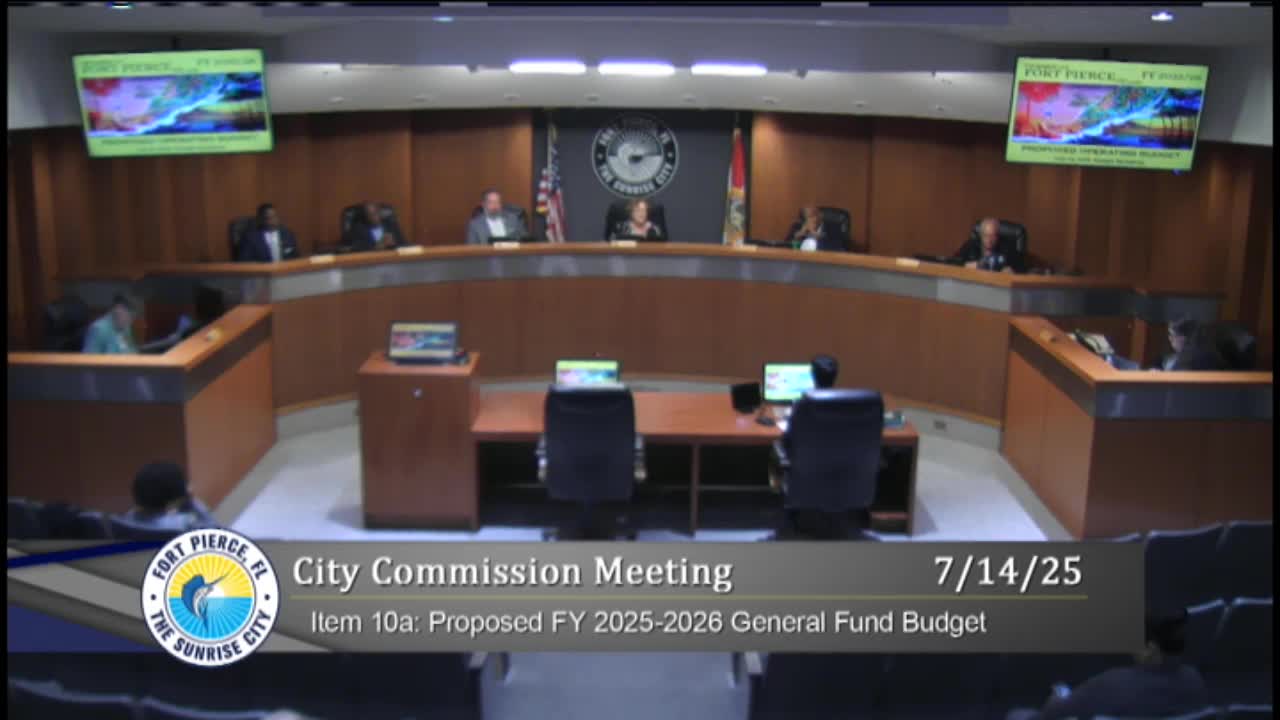
The City of Fort Pierce presented a proposed fiscal year 2025–26 general fund budget of $67,537,211 at a July 14 commission budget workshop. Finance director Morris and city manager Chess described the draft as balanced with no change to the current millage rate (6.9 mills), driven in part by a 10.46% increase in taxable property values that generated an estimated $2,778,920 in additional ad valorem revenue.
Why it matters: Commissioners said public safety and basic services must be funded amid uncertain economic indicators — including a projected probability of recession in the next 12 months cited by staff — and possible state policy changes that could affect local revenue (for example, proposals affecting ad valorem collections or utility/ franchise transfers).
Key numbers and proposals - Proposed general fund total: $67,537,211 (4.4% increase from current year). - Millage rate: no change proposed; remains at 6.9 mills. - Ad valorem/assessed value increase: staff reported a 10.46% rise in taxable property values (estimated $4.88 billion in total assessed value change), producing about $2.78 million more in tax revenue. - Personnel: net eight new full-time positions proposed in the general fund (city manager’s office, IT/network administrator, two public-safety positions, public works engineer among additions). Police net additions were clarified as two positions overall. - Cost-of-living: the draft budget includes a 5% across-the-board COLA for bargaining and nonbargaining employees; the draft also includes a 5% COLA for commissioners (to be removed if commissioners so direct). - Police budget: $20.748 million (about 30.7% of the proposed general fund). Staff adjusted projected sworn personnel costs downward relative to the current year to reflect vacancies and midpoint salary budgeting for anticipated hires; operating and capital lines rise because of technology needs and a planned capital purchase. - Axon contract: staff identified a vendor/platform (Axon) renewal that would carry a first-year cost of about $767,000 as part of capital/operating technology purchases for patrol-car cameras, body-worn cameras, evidence storage and related systems. The vendor roll-out and procurement path will require coordinated procurement and possibly an RFP. - Solid waste: Public Works director Jason Atkinson described plans to replace aging collection vehicles through five-year leases and to fund expanded grapple/collection services. The budget shows an increase in solid waste enterprise revenues tied to proposed rate adjustments that would be largely earmarked to cover vehicle lease payments, new personnel for collection, and operational changes; staff said the projected revenue increase is intended to be revenue-neutral for the general fund and to match projected enterprise expenditures. - Capital projects: the proposed FY26 budget and newly drafted FY26–30 capital improvement plan include restricted capital of $600,000 set aside for coming-year projects; specific projects discussed included street resurfacing financed through surtax programs, FDOT Sun Trail multiuse-path funding, ERP and chamber upgrades, and marina/stormwater engineering.
Police staffing and pay: immediate concern Commissioners pressed staff on police recruitment and retention. The city currently carries a substantial number of sworn vacancies; the chief reported the department needs the positions but is losing officers after several years of service because nearby agencies offer higher pay. Commissioners discussed possible remedies: an across-the-board pay increase for all departments, a department-specific raise for police, or revenue-side options (millage increase or new impact/assessment). City clerk Cox clarified that impact fees for capital cannot legally be used to fund salaries; they can be used for capital needs.
Scenarios requested Commissioners asked staff to return with concrete fiscal scenarios at a follow-up meeting next week. Specific direction included: - Run pay models that show costs for step adjustments plus either a 10% or a 15% market adjustment for sworn officers (and show the city-wide cost implications). City staff noted prior work modeling a 10% option during budget preparations; commissioners asked for both 10% and 15% scenario runs. - Identify recurring versus one-time revenue sources and where proposed recurring personnel costs would be funded. - Identify line-item reductions, vacancy-based savings and other expenditure adjustments that could help offset payroll increases if the commission wishes to avoid a millage increase.
Other budget items discussed - FPRA and marina: FPRA representatives discussed multi-year redevelopment and infrastructure projects (Depot Drive enhancements, Indian River Drive improvements under a state job-growth appropriation, and Harbor Point boat-ramp support); marina director Dean Kubicak described an immediate need for dredging and consultants to scope dredging and a potential marina expansion to improve basin resiliency and navigation. Commissioners discussed coordinating grants to offset some project costs. - Debt and surtax: Finance director Morris highlighted recent debt reduction and available borrowing capacity; commissioners discussed the importance of surtax-funded roadwork and the need to maintain a public campaign to preserve surtax funding when it next goes before voters. - Grants and CDBG/SHIP: staff described reallocation of unspent CDBG funds toward parks and infrastructure projects and reminded commissioners that grant-funded projects carry compliance and timeliness constraints.
Next steps Commissioners directed staff to return with the requested pay/compensation scenarios, revenue options (including the fiscal impact of small millage increases), and proposed expenditure adjustments at a working session next week so the commission can refine direction for the final FY26 budget. Staff advised the commission of a deadline to certify a preliminary (TRIM) rate and materials; the mayor and commissioners asked for follow-up modelling in advance of that submittal.
What the commission did not decide No final decision was made at the July 14 workshop on police pay, a millage change, or solid waste user-fee adoption; staff were instructed to prepare scenarios and additional background to inform those decisions.