Get Full Government Meeting Transcripts, Videos, & Alerts Forever!
Get email alerts on the Data Centers topic
No spam. Unsubscribe anytime.
Fredericksburg planning commission recommends denial of 1500 Gateway data center rezoning and special-use permit
Summary
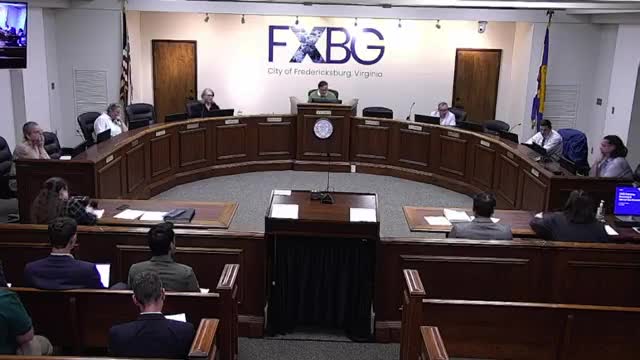
After hours of testimony and technical questions about water, power and environmental impacts, the City of Fredericksburg Planning Commission voted 7-0 to recommend denial of a rezoning and special-use permit for a proposed 2.1 million-square-foot data center at 1500 Gateway.
The City of Fredericksburg Planning Commission voted 7-0 on July 9 to recommend denial of a rezoning and associated special-use permit for a proposed data center at 1500 Gateway.
The proposal from 1500 Gateway Venture LLC (Penzance Development/1500 Gateway Venture) would rezone about 83.5 acres from Planned Development Medical Center (PDMC) to Industrial-2 and allow up to 2,100,000 gross square feet of data center space in four buildings, a substation and related utility infrastructure. The applicant asked for a special-use permit to exceed the 50-foot I-2 height limit up to 90 feet and for water-based cooling for data center equipment.
Why it matters: Commissioners and members of the public raised unresolved questions about long-term water supply for cooling, the siting and routing of high-voltage transmission facilities, potential effects on nearby environmentally sensitive areas and historic resources, and whether the project conforms to transect and land-use policies in the city’s newly adopted comprehensive plan. The planning commission’s recommendation will go to city council for final action.
Staff presentation and applicant case Kelly Machen, planning staff, walked commissioners through the application, explaining the site lies between Route 3 and I-95, is about 83.5 acres, and was rezoned previously for a VA medical clinic that later located elsewhere. Machen said the applicant proposes a water-based cooling system and a substation and that a 2232-style comprehensive-plan conformance review is required for the substation. She outlined the comprehensive plan transects that cross the site (T1 preserved open space, T4 general urban and T5 workplace) and noted the data center would not provide the residential components expected in parts of the transected area.
Charlie Payne, attorney for the applicant, said the project is intended to follow many of the Transit-Oriented Development (TOD) standards even though the site is not in the TOD district. Payne emphasized the economic benefit, transportation improvements (two of four planned lanes of Gateway Boulevard to be built by the developer and a proposed traffic signal at Cowen Boulevard), and increased open space compared with previous proposals. Payne and applicant Faizan Qureshi (Penzance Development) said the developer is in advanced talks with at least one large hyperscaler and that the rezoning and clarity on power timing influence user interest.
Key technical and regulatory issues discussed - Water and cooling: The applicant’s proffers and materials described reuse-water cooling, closed-loop systems and the possibility — if public works and council approved — of potable-water bridging during temporary stages. Staff and several commissioners emphasized uncertainty about the long-term water demand for cooling. Earlier submissions cited a figure of about 300,000 gallons per day for cooling; the applicant also supplied an operational potable-water estimate of roughly 5,700 gallons per day for domestic/fire flow. Staff noted the city’s water and sewer master plan is underway, with pro rata information possible in the fall.
- Power and transmission routing: The project requires new transmission capacity and a substation. Commissioners heard from consultant Roya Smith (routing consultant) that Dominion Energy and the Virginia State Corporation Commission (SCC) will conduct a 12- to 18-month public routing process; Dominion selects routes and the SCC grants final approval for new high-voltage lines. The applicant preferred an alignment along Cowen Boulevard, but staff and the consultant described alternatives that could cross wooded parcels, Smith Run resource-protection areas and historic conservation easements (including parcels associated with the Vermont Ridge battlefield conservation area).
- Environmental, historic and stormwater concerns: Staff said the project proposes roughly 23% on-site open space (about 19.6 acres) and additional stormwater attenuation to mitigate impacts to downstream Pond D. Commissioners asked about 100-year and rarer storm-event planning; the applicant said the design addresses the 100-year peak but agreed a 500-year analysis had not been performed. Staff noted an archaeological ordinance and prior archaeological work on this site; the applicant said artifacts previously identified were removed with DHR approval and that the site will follow the city’s archaeological requirements.
- Noise and operational impacts: The applicant proffered compliance with noise standards similar to the TOD (staff stated 60 dBA daytime and 55 dBA at night as proffered limits). The applicant submitted noise studies showing scenarios for air- and water-cooled systems; some modelled operations during generator use can exceed TOD limits and would require attenuation measures. The applicant said they had flipped generator yards to the west (toward I-95) to reduce noise impacts on the Great Oaks neighborhood.
Public comment and written input Members of the public voiced concerns about tree canopy loss, noise, visual impacts, proximity to schools, water and air pollution risks tied to backup power, and the potential for transmission lines and easements to fragment conserved land. David Corbin, a nearby resident, testified about the visual scale of comparable facilities in Northern Virginia and urged robust screening and landscaping. Several written comments, read into the record, asked for greater study of electricity rate impacts, clear commitments on potable-water use, transmission-line routing visuals and consideration of preservation or lower-impact alternatives.
Staff recommendation and deliberations Staff did not make a definitive recommendation for approval or denial. In the staff report and presentation planners catalogued potential benefits (tax revenue, transportation improvements and some employment) and concerns (loss of housing potential in the T4 area, uncertainties over transmission routing and environmental impacts, and ambiguity about long-term potable-water use). Commissioners probed the applicant on proffer math (the developer and staff clarified the cash proffer amount), water-service agreement public hearing requirements and whether the substation shown on the GDP matched the comp plan maps.
Vote and formal action Following public comment and deliberation, the planning commission voted 7-0 to recommend denial of ZMA 24-10-005 (rezoning) and SUP 24-11-007 (special-use permit) and, in the same motion, to recommend denial on the 2232-style comprehensive plan conformance review for the proposed substation. The roll call recorded yes votes from Commissioners Thomas Johnson, Joseph Winter, Duke Caswell, Jane McDonald, Mary Margaret Marshall, Carrie Whitehead and Chair David Durham.
What happens next The planning commission’s recommendation will be transmitted to Fredericksburg City Council. City council will consider the rezoning, special-use permit and the 2232-style review in a future public hearing and vote. Any future substation/transmission routing will also be subject to Dominion’s routing process and SCC review, a separate state process that includes its own public hearings.
Ending note Commissioners said the application raised legitimate economic-development opportunities but that unresolved questions about utilities, transmission routing, environmental and historic impacts, and compatibility with parts of the comprehensive plan left insufficient basis to recommend approval at this time.