Get Full Government Meeting Transcripts, Videos, & Alerts Forever!
Get email alerts on the Small Business topic
No spam. Unsubscribe anytime.
San Diego entrepreneurs and advocates press Sacramento for more technical assistance, targeted relief and permitting fixes
Summary
Small-business owners and advocacy groups told an Assembly committee that access to capital, tariffs, permitting and culturally tailored technical assistance are pressing barriers; they urged state funding routed through local providers and pilot affordability zones to retain legacy and immigrant-owned firms.
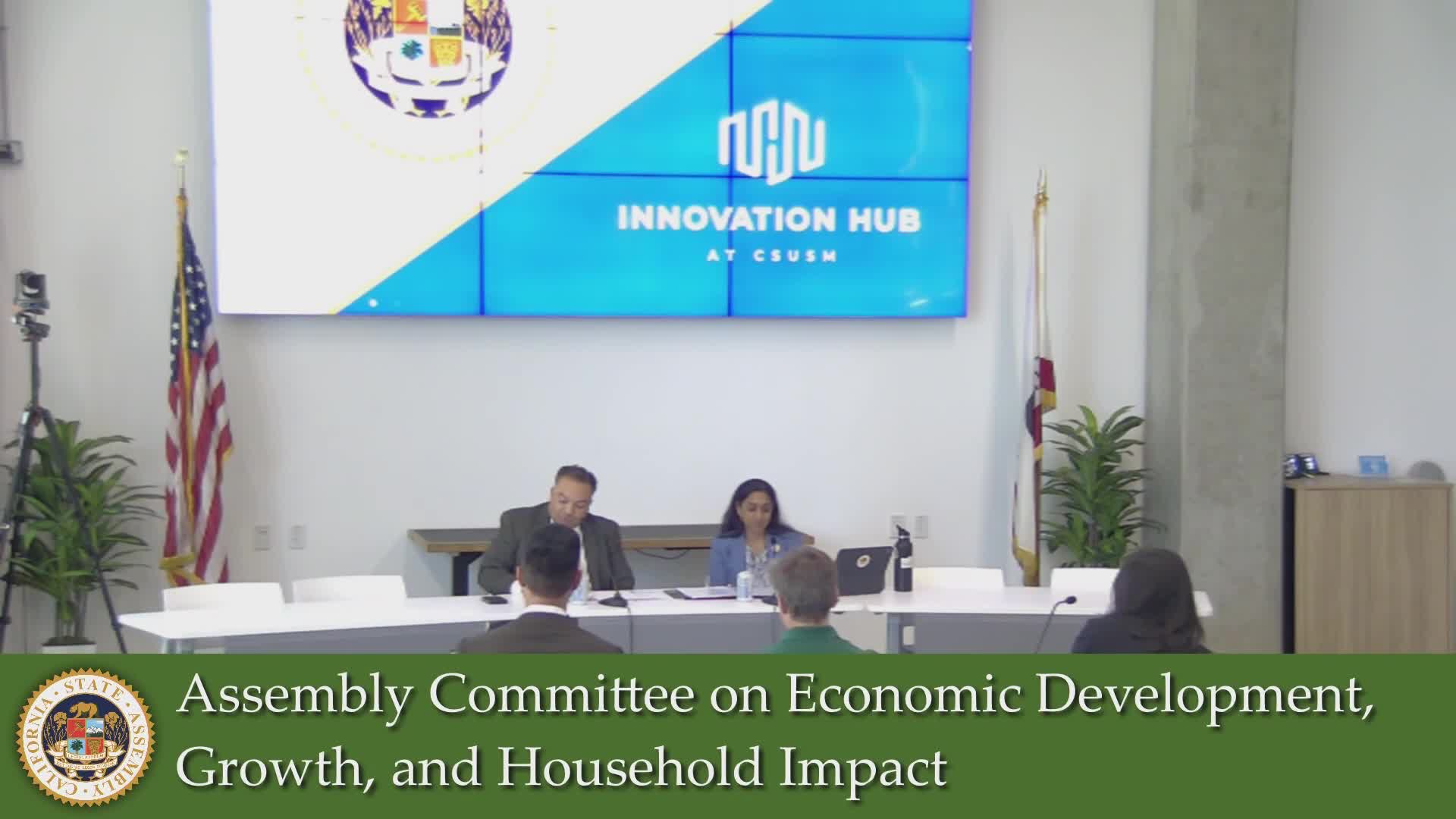
A panel of San Diego entrepreneurs and small-business advocates told the Assembly committee the region’s microbusinesses need faster, localized support and simpler application processes to survive rising costs and global supply-chain pressure.
Dr. Debbie Chen, founder and CEO of HydroStasis, described building a hydration-monitoring wearable and the capital barriers women founders routinely face. “Seventy-five percent of U.S. adults are chronically dehydrated,” Chen said as she explained the market need that led to her company’s Gecko Watch. She told lawmakers her company has secured non-dilutive grants and about $5 million in private investment, three U.S. patents, and public‑sector partnerships that helped move the product to market; she urged more accessible early-stage capital and mentoring programs for women and founders of color.
Sven Davison, co‑founder and COO of Amai Inc., described developing edible cups from upcycled spent grain and the manufacturing pivot caused by tariffs and global supply issues. Davison said a custom manufacturing machine he licensed was subject to layered tariffs that reached “210%,” forcing his firm to alter its production and licensing strategy.
Jason Paguio, president and CEO of the Asian Business Association of San Diego, presented survey findings showing that many local businesses are considering relocation and that hiring remains a top constraint. He urged expanded outreach through trusted local intermediaries such as the SBDC and recommended three state actions: (1) streamline and expand technical assistance funding, (2) adopt a regional cost-of-living adjustment for program eligibility, and (3) pilot small-business affordability zones that target rent stabilization, tax credits or child-care subsidies to preserve legacy and culturally significant businesses.
In public comment, Juan Carlos Hernandez of the California Southern Small Business Development Corporation said the state received about $366 million in loan‑guarantee requests last fiscal year and highlighted the challenge of financing smaller loans under $100,000. Panelists asked the legislature to route funding through established local providers rather than creating new statewide bureaucracies.
Panelists did not propose specific bill text in the hearing; they requested that lawmakers consider changes described above when crafting budget and regulatory proposals.