Get Full Government Meeting Transcripts, Videos, & Alerts Forever!
Get email alerts on the Economic Clusters topic
No spam. Unsubscribe anytime.
San Diego EDC: defense, life sciences and cleantech strong — permitting, housing and federal cuts threaten growth
Summary
The San Diego Regional Economic Development Corporation told an Assembly committee the region is a national leader in life sciences, aerospace and high-tech but faces headwinds from permitting delays, housing costs and potential federal research cutbacks.
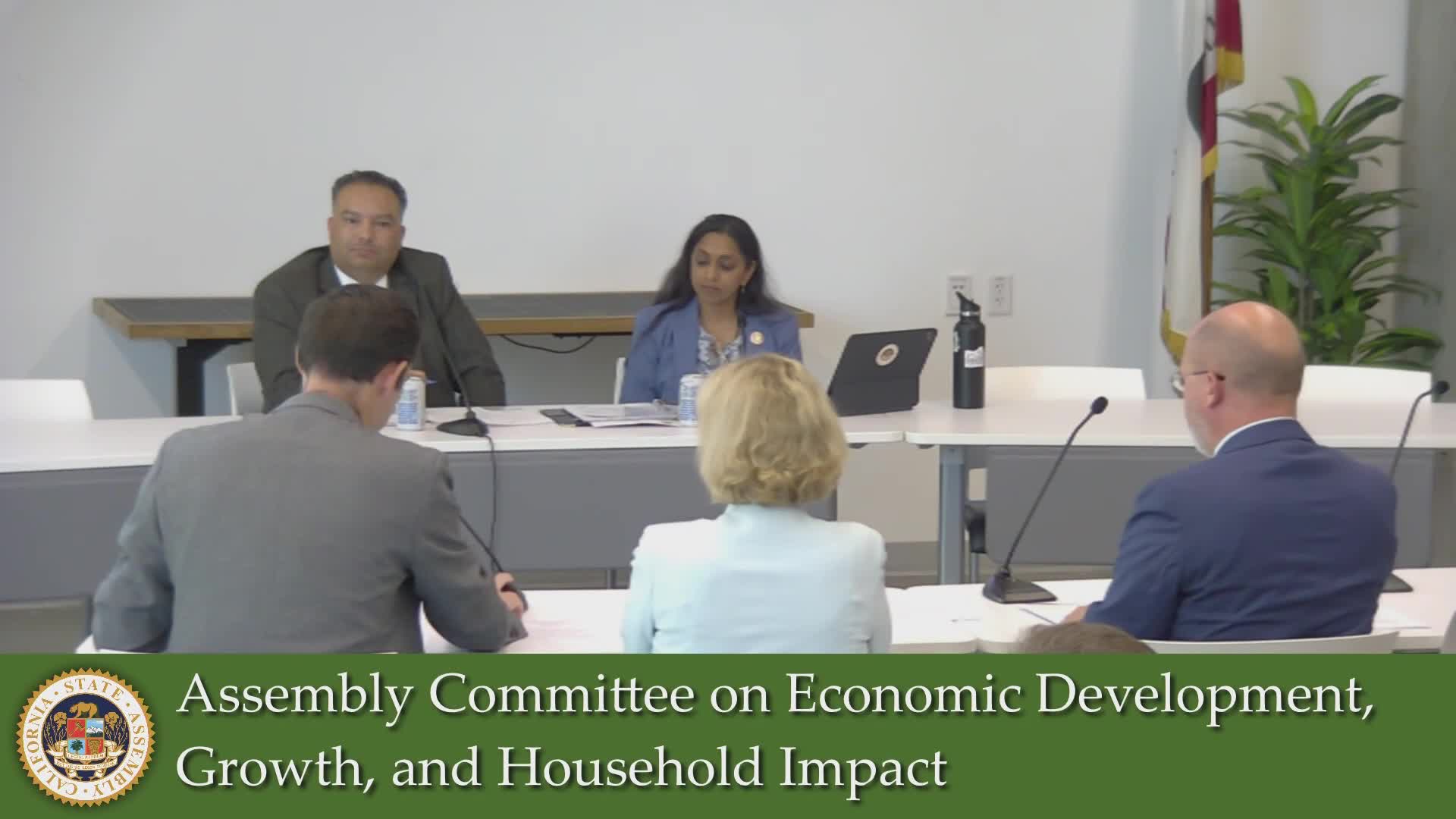
Eduardo Velasquez, senior director of research and development at the San Diego Regional Economic Development Corporation, told the Assembly committee that San Diego is a “powerhouse of innovation” but faces structural barriers to growth.
Velasquez detailed the region’s major industry clusters and scale: he told the committee there were roughly 60,000 jobs tied to life sciences in the region, that the area received about $1.2 billion in technology venture capital in 2024 and that more than $27 billion in Department of Defense contracts flowed into the region in the last fiscal year. He said advanced manufacturing employs more than 240,000 people locally and stressed the region’s binational ties with Baja California as an asset for supply chains.
At the same time, Velasquez highlighted risks. He said proposed federal cuts to research indirect rates and broader budget reductions could produce an estimated $500 million negative impact in the region’s economy. He described permitting and time-to-market as a recurring complaint from firms and urged the state to partner with local governments on process reforms, including experimental regulatory sandboxes to test faster approvals without creating unintended consequences. Velasquez also cited housing affordability as the primary constraint on attracting and keeping talent and noted San Diego’s median home price places homeownership out of reach for most residents.
Velasquez urged state support in these areas — stabilizing research investment, supporting cross-border trade and mobility, investing in local training pipelines and addressing housing affordability — and said the region had submitted ideas through the state’s Jobs First initiative. The panel’s testimony was informational and lawmakers did not propose or vote on specific legislation during the hearing.