Get Full Government Meeting Transcripts, Videos, & Alerts Forever!
Get email alerts on the Higher Education topic
No spam. Unsubscribe anytime.
Cal State San Marcos describes expansion plans to boost regional degree output, housing and career pathways
Summary
Cal State San Marcos officials told an Assembly committee the campus is expanding academic programs and housing capacity to supply graduates for San Diego-area industries, highlighting dual-enrollment pathways, engineering and a new wellness degree aimed at high-demand health fields.
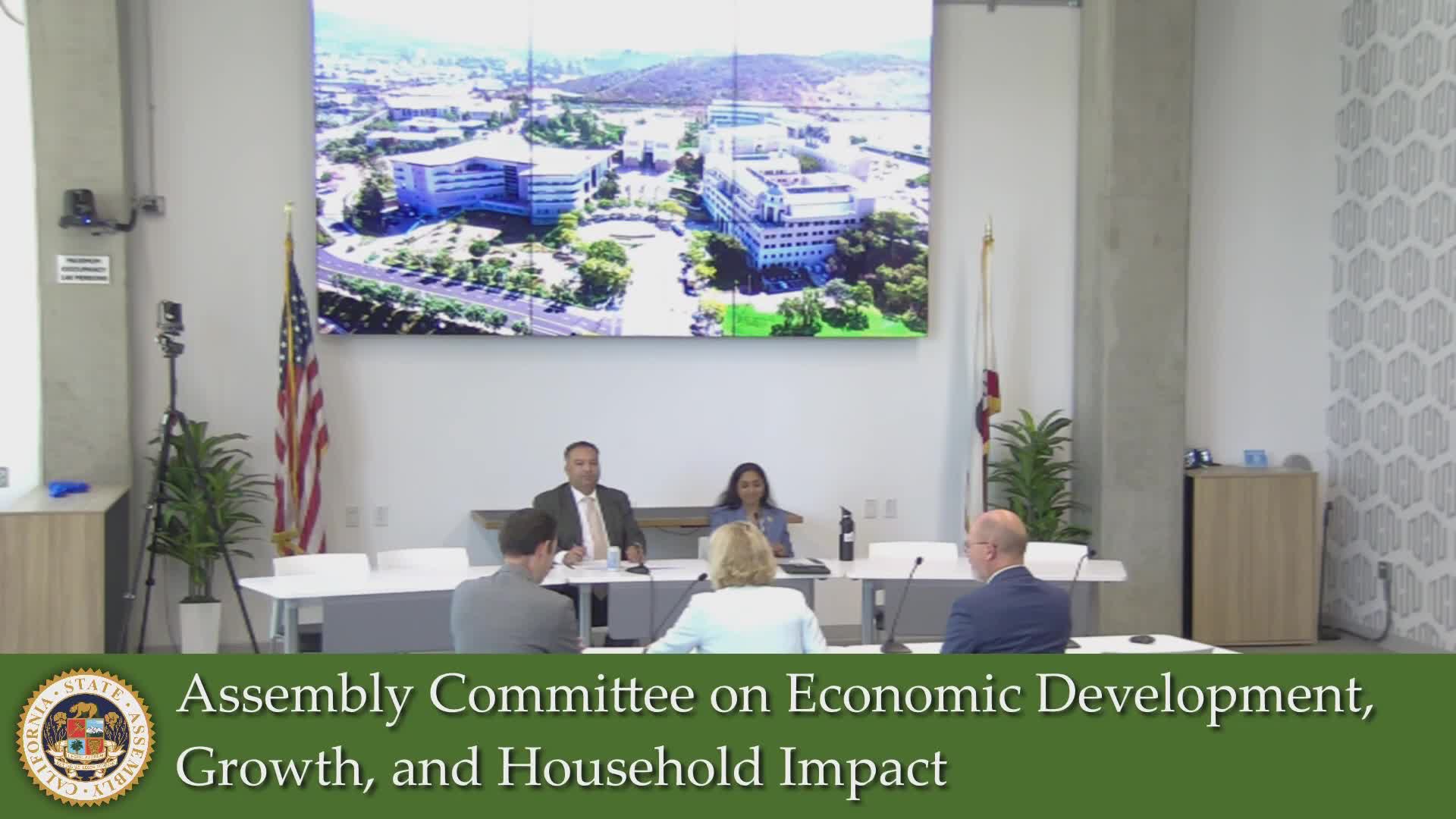
California State University San Marcos leaders told the Assembly Committee on Economic Development that the campus is scaling programs and housing to help meet regional workforce needs.
“ We were founded only 35 years ago,” Dr. Ellen Neufeld, president of California State University San Marcos, said as she described the campus’s rapid growth and mission of social mobility. Neufeld said the university enrolls nearly 17,000 students, houses roughly 2,200 people on campus and expects to open about 550 additional student beds next year through state-supported affordable housing funding; she said roughly two-thirds of that new capacity will be designated affordable.
Neufeld and Dr. Carl Kemnitz, provost and vice president for academic affairs, emphasized partnerships with industry and community colleges to accelerate credential attainment. Kemnitz described the Innovation Hub and Affinity Lab as campus spaces that integrate students with startups and local R&D. The campus said 65% of students graduate with no debt and that the average debt for those who borrow is under $15,000, figures Neufeld cited while arguing for the long-term economic return of bachelor’s degrees.
Officials discussed targeted programs designed to produce graduates for high-demand fields. Neufeld highlighted an engineering program co-developed with industry partners that grew from about 300 engineering majors to plans supporting up to 2,000, and a three‑year Scholars, Wellness and Innovation Fast Track (SWIFT) program that combines dual enrollment, internships and embedded certificates to accelerate completion in mental-health fields. Kemnitz said that each startup renting space in the Infinity Lab is required to involve students as interns or research assistants to ensure learning aligns with regional employer needs.
University officials framed their work as regional workforce development: Neufeld said about eight in ten of their graduates stay in the region, and speakers tied expanded degree production to the EDC’s projection that the region must double postsecondary completions by 2030 to meet workforce demand.
The university did not request specific legislation during the hearing but described several partnership and funding priorities to sustain program growth and student access, including continued state investment in campus housing and workforce-aligned program development.