Get Full Government Meeting Transcripts, Videos, & Alerts Forever!
Get email alerts on the Budget Organizational Reform topic
No spam. Unsubscribe anytime.
Temple City Manager outlines FY2026 business plan: proposed 'pod' reorganization, new assistant city manager and $600M+ capital needs
Summary
City staff presented an expanded six‑year business plan on July 11 that proposes a third assistant city manager, four management "pods" aligned to five strategic focus areas, dozens of new and reclassified positions, and capital programs totaling roughly $600 million across projects for roads, utilities and facilities.
City Manager staff presented the City of Temple’s proposed FY2026 business plan during a July 11 special meeting, outlining an organizational rework, a long list of new and retitled positions, and a multi‑hundred‑million‑dollar capital program to support rapid population and economic growth.
The presentation framed the recommendations around two broad themes: “structuring for success” (reorganizing operations and management to improve service delivery) and “scaling with growth” (adding staff and capital to serve a city that crossed 100,000 residents). The manager said the existing six‑year planning framework adopted in 2019 had helped Temple respond to rapid growth and to shocks such as the pandemic and last year’s tornado, but staff now recommend refinements to support the next phase of expansion.
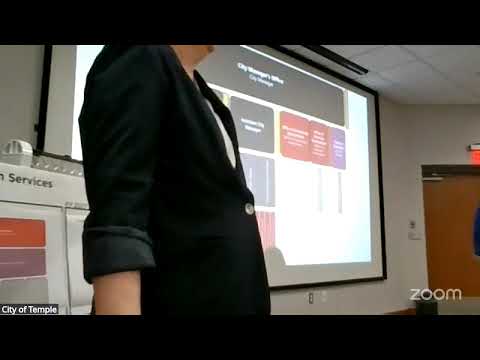
Key organizational proposals - Third assistant city manager: staff proposed adding one Assistant City Manager focused on public safety, information technology and people operations to better align management capacity with the city’s five strategic focus areas. - Management “pods”: departments would be grouped into management pods aligned with five focus areas (Smart Growth; Places & Spaces; Health & Safety; Community Advancement/Communications; and High‑Performing Organization). Each pod would have an integrated support team for finance, legal, purchasing, information technology and human resources to streamline projects and service delivery. - Program‑based structure: staff proposed standardizing how departments define divisions, programs, teams and individual contributors so service responsibilities are clearer, easier to manage and easier to scale.
Staffing and service delivery Staff presented dozens of proposed changes and new positions phased over the six‑year plan. Highlights included: - Customer service: expansion of a consolidated customer‑care function (311/311‑style intake) with additional solution specialists and a service delivery support function that would coordinate work between customer care and operating crews. - Strategy and innovation: a new team to lead process improvement, data analysis and legislative monitoring tied to policy and service‑level mapping. - Facilities and general services: additional maintenance technicians, custodial staff and trades specialists to manage roughly 600,000 square feet of city buildings and to oversee facility capital projects. - Parks, recreation and libraries: new program managers, maintenance crews and a proposed park ranger program to increase presence and inspection of park assets. - Public safety facilities: while Fire Station 2 was discussed separately, the plan proposes upgrading stations for multigender restrooms, private sleeping quarters and storm‑shelter capabilities. - Utilities and water/wastewater: staff proposed multi‑year investments and a planning group to coordinate groundwater, ASR (aquifer storage and recovery), treatment expansions and trunk‑sewer rehabilitation; the water/wastewater program in the plan totals in the low hundreds of millions of dollars. - Fleet and solid waste: a second shift for vehicle maintenance (night mechanics), fleet‑sharing coordination, and additional solid‑waste routes and supervisors to match growth.
Capital and revenue context Staff showed a draft capital program and revenue pressures tied to rapid population growth and state programs. Notable figures presented by staff: - A capital improvement program of roughly $600 million across multiple categories over the plan horizon. - Mobility (streets, sidewalks, trails) projects totaling about $187 million included reconstructed corridors, extensions and right‑of‑way purchases. - Utilities and water/wastewater projects (including treatment, storage and trunk‑sewer upgrades) in excess of $250 million; staff also referenced a water/waste figure used in planning of approximately $317.5 million across specific projects and basins. - A state‑level disabled‑veterans property‑tax exemption program that reduces local tax rolls; staff noted the state reimbursement formula covers a fraction of the city’s lost revenue (historically about $0.15 on the dollar in earlier guidance) and that undercurrent underfunding adds pressure on local rates and budgets.
Staff emphasized the city will continue the six‑year business plan and annual budget cycle, but requested council direction about the level of resources it wants to commit to hiring, capital and service levels. The manager said staff will return with refined costings linked to any council guidance about tax‑rate or fee tradeoffs.
Quotations “If you don’t know where you’re going, any which way will get you there,” the City Manager said, using an analogy to explain why the city needs a strategic, multi‑year framework to allocate resources to priorities.
Council questions and next steps Council members asked for more detail on timelines, which positions are immediately needed versus phased, and how proposed changes would affect service levels and the tax rate. Staff said they would produce cost–service tradeoff models and bring back specific purchase or job‑classification items as formal agenda items. Staff also noted several items that will require future council action: the third assistant city manager position, new job classifications, and capital bond timing tied to the council’s direction on tax rates.