Get Full Government Meeting Transcripts, Videos, & Alerts Forever!
Get email alerts on the Parking And Downtown Parking Policy topic
No spam. Unsubscribe anytime.
Leesburg planning commission debates downtown parking rules and payment-in-lieu provisions
Summary
At a July 10 work session on a zoning rewrite, the Leesburg Planning Commission focused on downtown parking rules, the town's payment-in-lieu (PIL) program for the H-1 Old Historic District and residential exceptions that let some properties buy parking rather than supply it on-site.
The Leesburg Planning Commission on July 10 spent the bulk of a work session on a proposed zoning rewrite discussing downtown parking requirements, the town's payment-in-lieu program and exceptions that allow some residential projects to buy parking rather than provide it onsite.
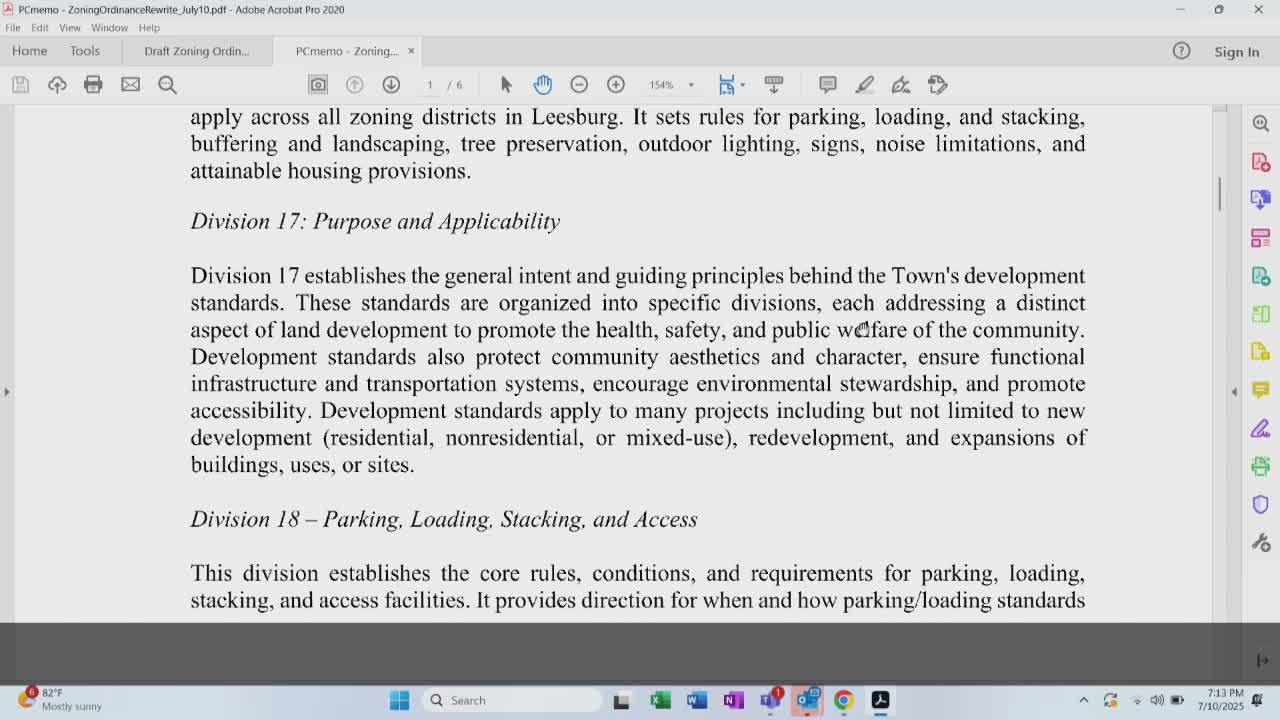
Commissioners heard staff review a raft of changes to development standards, including a new approach to parking that adds a ratio for more uses and, for the first time in the town's rewrite, both minimums and maximums for some land uses. Mike Watkins of the town staff said the draft retains a payment-in-lieu option limited to the H-1 Old Historic District and that the commission could provide direction on whether to keep it.
Why this matters: the payment-in-lieu (PIL) provision has long been used as a tool to encourage investment in Leesburg's historic downtown by letting some developers buy credits instead of demolishing buildings or providing on-site parking. Commissioners said the provision affects redevelopment, downtown character and whether the town will need new public parking structures in the future.
Staff described the current PIL rule and its limits. Under the draft zoning language staff showed, payment in lieu is limited to the H-1 Old Historic District and generally applies to projects within 500 feet of the town's downtown parking facility. "The payment in lieu is a one-time fee per parking space," staff told the commission, and the draft continues to prohibit the PIL for most residential uses while keeping some narrow residential exceptions for small lots or limited multifamily projects.
Participants reviewed data and history. Brian Boucher (staff) said the council asked staff to keep the PIL in the ordinance; he summarized prior council review and explained that while staff proposed raising the fee, the council did not increase it. Boucher and other staff estimated the cost of structured public parking at roughly $30 million for a roughly 400-space deck, and they said the town has collected about $400,000 in PIL revenue since the program began, which buys relatively few parking spaces at current construction costs.
Commissioners pressed for clearer objectives and better data before deciding on policy changes. Several commissioners asked the staff to clarify the PIL's purpose (for example, to preserve historic buildings or to fund new structured parking) and to provide data on how often the PIL has been used, how the fund has been spent and whether the current fee approximates half the actual parking cost. Staff said they could circulate a report with purchase history and costs.
Key constraints and clarifications discussed - The PIL is confined to the H-1 Old Historic District and generally applies within 500 feet of the town parking facility. - Residential uses are generally not eligible for PIL, with narrow exceptions: lots 4,000 square feet or smaller in specific blocks, and multifamily projects within 500 feet can purchase up to 10 spaces under current rules. - Staff said the PIL has been used only a limited number of times historically and that many downtown businesses keep their on-site parking for convenience despite eligibility to buy credits.
Costs and scale mentioned in discussion - Staff cited a prior staff estimate of roughly $30 million for a 400-space parking garage. - The commission heard that the town's PIL receipts total about $400,000 to date; at current garage-construction prices that buys a small number of spaces. - Staff and consultants previously examined raising the fee from about $8,000 per space to $16,000; council deferred raising the fee during recent discussions.
Commissioners sought policy alternatives. Some commissioners argued for keeping the PIL as a flexible tool for downtown redevelopment, others said it should be removed (especially for residential projects) to protect homeowners and ensure new housing includes parking. Commissioners discussed alternatives including: maintaining the PIL for commercial projects only, tightening or removing the residential exception, using PIL revenue more strictly for structured parking, or creating clearer review processes (for example, a minor special-exception review) for buyouts.
Informal straw poll. The commission took an informal straw poll on whether to keep the PIL "as written" in the draft. The poll favored leaving the provision in place by an informal margin of 3-to-1; commissioners noted this was not a binding vote but direction for staff to continue work and provide more data.
Next steps. Staff said it would provide additional information to the commission, including historic PIL purchases, cost estimates, comparisons to other jurisdictions, and clarification of where residential exceptions apply. Several commissioners asked staff to coordinate with the council about whether the town wants to pursue structured parking for downtown and how the PIL fund should be used if retained.
The conversation was part of a broader work-session review of Article 4 of the zoning rewrite; commissioners also discussed parking tables, shared and joint parking rules, and changes to maximums and minimums in the draft ordinance. Staff and commissioners agreed to continue the topic at future meetings and to provide supplemental materials to inform policy choices.