Get Full Government Meeting Transcripts, Videos, & Alerts Forever!
Get email alerts on the Land Use Conditional Use Go Kart topic
No spam. Unsubscribe anytime.
Howard County hearing continues on conditional-use request for go‑kart racetrack; board admits evidence, sets written briefs and July 31 deliberation
Summary
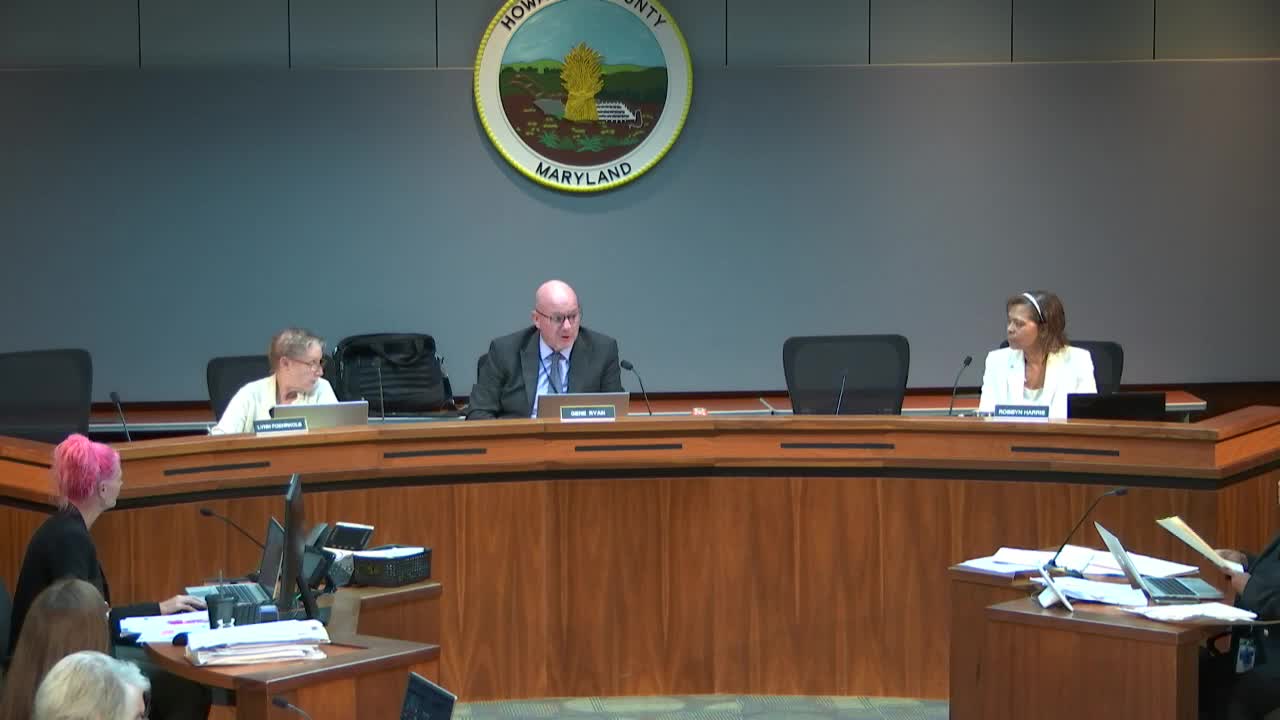
The Howard County Board of Appeals continued its public hearing on case BA 24022C on July 10, 2025, considering a petition to allow a paved go‑kart racetrack on property on the east side of Mink Hollow Road.
The Howard County Board of Appeals continued its public hearing on case BA 24022C on July 10, 2025, considering a petition to allow a paved go‑kart racetrack on property on the east side of Mink Hollow Road. No final decision was reached; the board admitted opposition exhibits and scientific articles into the record, set a deadline for written closing memoranda and scheduled deliberation for July 31, 2025.
The board, chaired by Jean Ryan, approved routine meeting minutes for June 26, 2025, before taking testimony on the conditional‑use application. The hearing record includes testimony from residents, a technical witness on stormwater and wetlands, an experienced race driver, and multiple neighbors who said they could see or hear the existing, unpermitted track that was constructed in 2024.
Why it matters: Neighbors pressed the board on environmental and quality‑of‑life issues they said are specific to this valley location — wetlands and stream buffers, the slope and runoff path toward a stream and private wells, the potential for fine tire‑wear particles to reach soils and water, and the risk that competitive driving would produce sustained noise that could affect wildlife and residents. Petitioners have not yet obtained a final decision; the board restricted additional factual submissions to the written memoranda and will deliberate in public on July 31.
Testimony and evidence - Stormwater and wetlands: Dr. Tara Goldberg, described in the hearing record as an environmental policy expert, told the board she assesses stormwater plans for resilience to extreme weather events and reviewed Maryland Department of the Environment (MDE) material submitted about the site. Goldberg said the updated design appeared outside the 100‑foot stream buffer but that the MDE report called for further wetland delineation; she testified she had “no evidence to prove” the plan encroached on wetlands but that the MDE report “specifically calls for further testing.”
- Noise and safety: Theodore (Ted) Giovannis, who identified himself as a professional race driver, testified about track safety practices and said typical go‑kart facilities place linked plastic or modular perimeter barriers at the track edge; on a narrow, fast course those barriers or berms can fall within stream buffers depending on track siting. Several neighbors described hearing a single test lap in September 2024 from inside their houses and said they were concerned about repeated, competitive use and tire squeal. Resident witnesses asked whether multiple karts operating simultaneously could produce additive noise above the county standard.
- Microplastics and health concerns: Resident and systems engineer Natalie Barrett said she had reviewed scientific literature about tire‑wear particles and microplastics and identified a concern that an electric, high‑performance kart could generate a high volume of ultra‑fine tire particles at each turn. Barrett and other residents told the board their homes rely on private wells and that stormwater or particulate transport into the valley’s wetlands and streambed could pose a risk; the board admitted articles referenced by Barrett as demonstrative exhibits but limited witness reliance on them to summary and opinion rather than direct expert deposition.
- Property and use impacts: Multiple neighbors, including Michael Mulcare, Kelly Rudden, Judy Raddis, Anne Cristaldi and Angela Bruce, testified they oppose the conditional use because they said the racetrack would diminish the rural character, disturb wildlife and livestock, and could depress resale values. Mulcare told the board he is "strongly opposed to it," and several witnesses emphasized the site’s bowl‑shaped topography and proximity of about 500–700 feet from some houses to the proposed track.
Evidence and exhibits The board admitted opposition exhibits labeled in the hearing as Opposition 18–21 (photographs and drone imagery taken by nearby residents) and scientific articles the neighbors cited (marked Opposition 22–24). A redacted copy of a covenants and easement document was the subject of a preliminary exchange; the parties agreed to submit a mutually agreed replacement exhibit with the parties’ closing memoranda.
Procedural outcome and next steps No vote was taken on the conditional‑use application at the July 10 session. The board set a schedule for post‑hearing materials: each party may submit a written memorandum (limit 15 pages, including proposed findings of fact and conclusions of law) to the board administrator by 4:30 p.m. on July 24, 2025. The board will reconvene in public for deliberation on July 31, 2025, at 9 a.m.; each side may request up to 10 minutes for an oral closing at that session. The board said it will issue a written decision following its deliberations.
Votes at a glance - Motion to approve meeting minutes for 06/26/2025: Moved by Ms. Fearghoff; seconded by Ms. Harris. Roll call: Chair Jean Ryan — approve; Ms. Fearghoff — approve; Ms. Harris — approve; Ms. Phillips — approve. Outcome: approved.
What the board reserved for its decision Board members expressly limited the record to evidence admitted at the hearing and the written memoranda; they instructed witnesses to avoid repeating cumulative testimony and restricted new exhibits to those already identified at the hearing unless both parties agree. The board signaled it will decide whether the applicant has proven that the proposed use would not cause a greater adverse effect at this particular location than it would elsewhere in the rural residential zone, a standard repeatedly referenced during testimony.
Reporting note: testimony in this article is drawn directly from the hearing transcript; quotes and specific attributions are limited to persons who spoke during the July 10, 2025 Howard County Board of Appeals session.