Get Full Government Meeting Transcripts, Videos, & Alerts Forever!
Get email alerts on the Sheriff Budget topic
No spam. Unsubscribe anytime.
Leavenworth County sheriff cites 911 funding shortfall, rising radio maintenance and staffing gaps in 2026 budget presentation
Summary
Sheriff Andy told commissioners his 2026 budget exceeds the County—s 2.8% target because of a $400,000 transfer to 911, a multi-year jump in a Motorola radio maintenance contract and continued staffing and recruitment pressures. He also described a new K-9 expense line and the county—s approach to animal control.
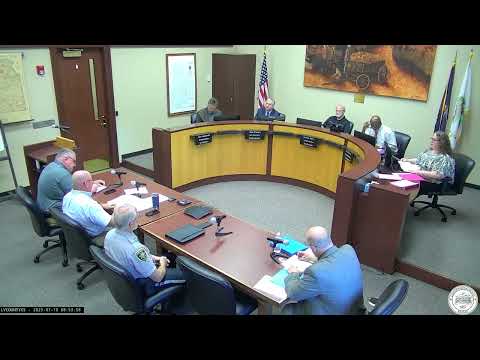
Sheriff Andy, Leavenworth County sheriff, told the County Commission during a budget work session that his 2026 request exceeds the board—s 2.8% guideline because of costs beyond his office—s control, primarily a roughly $400,000 transfer to 9-1-1 and a multi-year increase in a Motorola radio maintenance contract.
The sheriff said the $400,000 transfer is to make up a shortfall created by a change in state funding that affects the county—s 9-1-1 operations. He described the Motorola maintenance contract as a recurring cost that will be about $347,000 next year to keep dispatch and tower equipment operating, and said the county also faces costs to replace equipment that will not interoperate with newer systems.
"So the $400,000 for the 9-1-1 transfer is to make up the shortfall due to the change in funding through the state," the sheriff said. He told commissioners the maintenance contract increase is for continuing operation of towers, dispatch and assorted tower equipment.
The sheriff said he received an unexpected reimbursement to the equipment reserve that lets him reduce his equipment-reserve request from $300,000 to $250,000 for 2026. He also said the department will carry a new, modest line item of $5,000 in 2026 for food, maintenance and medical care for a newly acquired K-9 named Knox; the initial costs were paid by outside sources.
The sheriff described continuing recruitment and retention challenges across the department, including patrol, jail and communications positions. He said vacancies are spread across divisions, and that pay differentials with neighboring Johnson County agencies and federal employers have contributed to departures. "It becomes a financial decision for them and their family," he said of departing deputies.
On staffing levels, the sheriff said the county should aim to have at least five patrol deputies on duty as a minimum and ideally seven or eight. "To answer your question, no. I think a county this size—s minimum amount of patrol deputies I have at any given time would be 5. Ideally, it's 7 or 8," he said.
The sheriff reviewed the county—s animal-control practice and history in response to commissioners— questions. He said state statute makes the sheriff—s office responsible for animal-control duties where cities do not provide the service, and that the office focuses on vicious animals, cruelty and other criminal animal matters rather than picking up every loose pet in rural areas. He recounted a prior contract with a local shelter, later switching to a different shelter under similar terms, and said the county has a part-time staff member whose duties are to handle animal complaints and who has been in place about six years. He said current county resolutions and overlapping state language about animal control are being reviewed and that the county may consolidate older resolutions into a single, updated document.
Commissioners questioned costs tied to building security and to 9-1-1. In budget discussion later in the meeting they debated whether to maintain two deputies staffing the courthouse entrances and two metal-detector screening points. Several commissioners and the sheriff recounted incidents and risks that, they said, supported continuing on-site sworn coverage.
The sheriff also addressed operational details including psychological evaluations ("It can be anywhere from 5 to 10 a year"), volunteer insurance used by emergency management volunteers, vetting and fit-for-duty evaluations, and the office—s use of donated microchip readers to reunite animals with owners.
Why it matters: The sheriff—s presentation ties a large portion of any 2026 county budget increase to mandated or contract-driven costs outside the sheriff—s direct policy control—chiefly 9-1-1 funding shifts and a multi-year maintenance agreement for critical radio infrastructure. Commissioners will weigh that context while deciding how or whether to offset the request with cuts elsewhere in the county budget.
The meeting closed with commissioners asking County Administrator Mark to prepare budget options and scenario detail, including alternatives to avoid employee pay reductions tied to an impending change in the county—s health insurance plan.