Get Full Government Meeting Transcripts, Videos, & Alerts Forever!
Get email alerts on the Olympics Lax 2028 topic
No spam. Unsubscribe anytime.
California senators press agencies on LA28 readiness, spotlight security, transportation and local-hire plans
Summary
A California State Senate special committee hearing in Sacramento brought state, regional and Games officials together to outline preparations for the Los Angeles 2028 Olympic and Paralympic Games, emphasizing security funding, transportation planning, local business procurement and volunteer and legacy programs.
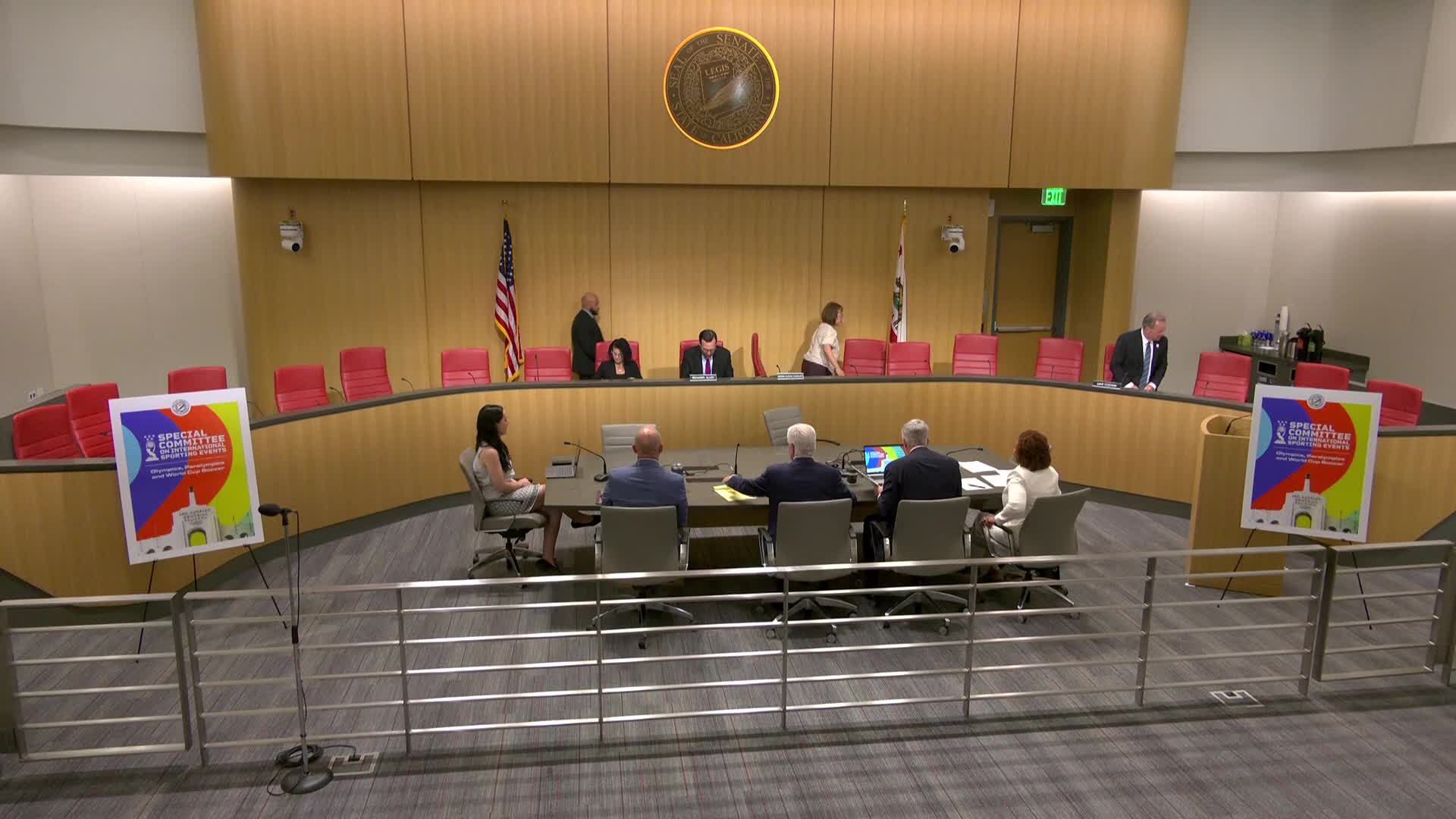
SACRAMENTO, Calif. '14 State lawmakers convened a special committee hearing to review California's preparations for the Los Angeles 2028 Olympic and Paralympic Games, with officials from the LA 28 organizing committee, the City of Los Angeles, Los Angeles County and VISIT California describing progress and flagging outstanding risks.
The committee, chaired by Senator Allen, heard officials describe a largely privately funded organizing committee that plans a $7.1 billion operating budget and forecasted regional impacts including roughly $18 billion in economic output and tens of thousands of jobs. "The organizing committee in LA is strong and getting stronger every day," Reynold Hoover, CEO of LA 28, told the panel.
Why it matters: The games will concentrate major demands on transportation, public safety and local services across Southern California; committee members said they want early, coordinated state planning and funding to protect neighborhoods, allow small businesses to compete and avoid last-minute costs or inequitable outcomes.
Officials outlined the major lines of planning and several unmet needs. Hoover and LA 28 described a no-new permanent-venue approach: most competition will use existing stadiums and facilities, with temporary builds where needed. LA 28 said it is raising sponsorship, ticket and broadcast revenue and expects to sell roughly 13 million tickets; the organizing committee plans tens of thousands of volunteers and a headquarters staff of roughly 4,000 during the Games.
VISIT California's senior vice president for communications and strategy, Ryan Becker, reviewed tourism lessons from Paris 2024 and warned of uneven visitation patterns and shortened booking windows that can stress hospitality staffing and small businesses. "We expect LA 28 to reach over 5 billion global viewers," Becker said, noting Paris saw large numbers of domestic attendees and a decline in tourist visits to major cultural sites during the Games. He outlined a Visit California marketing plan aimed at mitigating displacement, spreading visitors across the state's 12 tourism regions and protecting the state brand.
City and county officials described operational responsibilities and risks. Paul Krekorian, executive director of the City of Los Angeles Office of Major Events, said the city has fiscal and operational exposure as host city and must coordinate right-of-way and venue-approach improvements, enhanced transit capacity and accessibility upgrades. "We are the host city. We are the city that has the most at stake," Krekorian said.
Los Angeles County Chief Executive Baysia Davenport said the county will support safety, public health, economic and community engagement roles and identified three county-owned venues currently selected as Games sites: Whittier Narrows Recreation Area (shotgun events), the Fairplex in Pomona (cricket) and Gloria Molina Grand Park (live site). Davenport warned that undersupplied planning funding and capacity constraints risk leaving nearby low-income neighborhoods exposed to displacement and disruption if steps are not taken now.
Officials emphasized federal coordination on security and visas. The Games have been designated a National Special Security Event (NSSE), led by the U.S. Secret Service with FEMA, FBI and other federal partners; Hoover said the federal government has so far provided some security funding and that organizers are pushing for 100% reimbursement to state and local first responders. He also noted carved-out visa exemptions are being worked with the U.S. Department of State.
On procurement, local hiring and legacy benefits, city and LA 28 speakers described several programs and tools intended to boost small-business access and workforce readiness. The city has launched Grama LA (a centralized procurement portal) and has partnered with the Los Angeles Area Chamber on "Get in the Game" and with USC on "Compete for LA" to register and make local businesses visible to primes and to provide mentorship and certification assistance. LA 28 and the city highlighted PlayLA, a youth-sports subsidy program the city has committed about $160 million to as an early legacy investment.
Senators pressed for specifics. Committee members asked for a consolidated, regularly updated document detailing funding asks and timelines for state, county and city needs. They also sought plans for equitable ticket access, philanthropy to buy ticket blocks for schools and community groups, and guarantees that procurement barriers such as bonding and insurance will not exclude smaller firms.
Public safety and human-trafficking risks drew sustained attention. Senators and county staff urged advanced investment to scale multi-agency enforcement and victim services during the event window, pointing to past spikes in exploitation around other major events. Officials said county and city teams are designing human-rights and anti-trafficking strategies; LA 28 reported it has a retired U.S. ambassador advising an emerging human-rights strategy.
What remains unresolved: committee members and agency leaders listed several gaps that they said need additional work or clearer timelines''14streamlining permitting and right-of-way approvals for temporary infrastructure, securing federal security reimbursements, firming up transportation "Games Route Network" enforcement and executing expanded public-health and environmental-health inspection capacity. City and county leaders urged early state budgeting for one-time costs that would enable planning and reduce downstream expense.
The hearing closed with committee members and panelists agreeing to continue oversight and deepen coordination. Senators said they intend to convene follow-up briefings, to consider targeted budget requests and to explore transportation and public-safety legislative tools. "This committee can play a critical role in making sure that level of coordination and transparency exists," public commenter Jerry Olivas said, urging ongoing legislative engagement.
Ending: The committee scheduled continuing hearings and indicated a preference for a consolidated, annotated plan of asks and timelines from the city, county and LA 28 to inform future state review and potential budget or policy action.