Get Full Government Meeting Transcripts, Videos, & Alerts Forever!
Get email alerts on the Private Credit Review topic
No spam. Unsubscribe anytime.
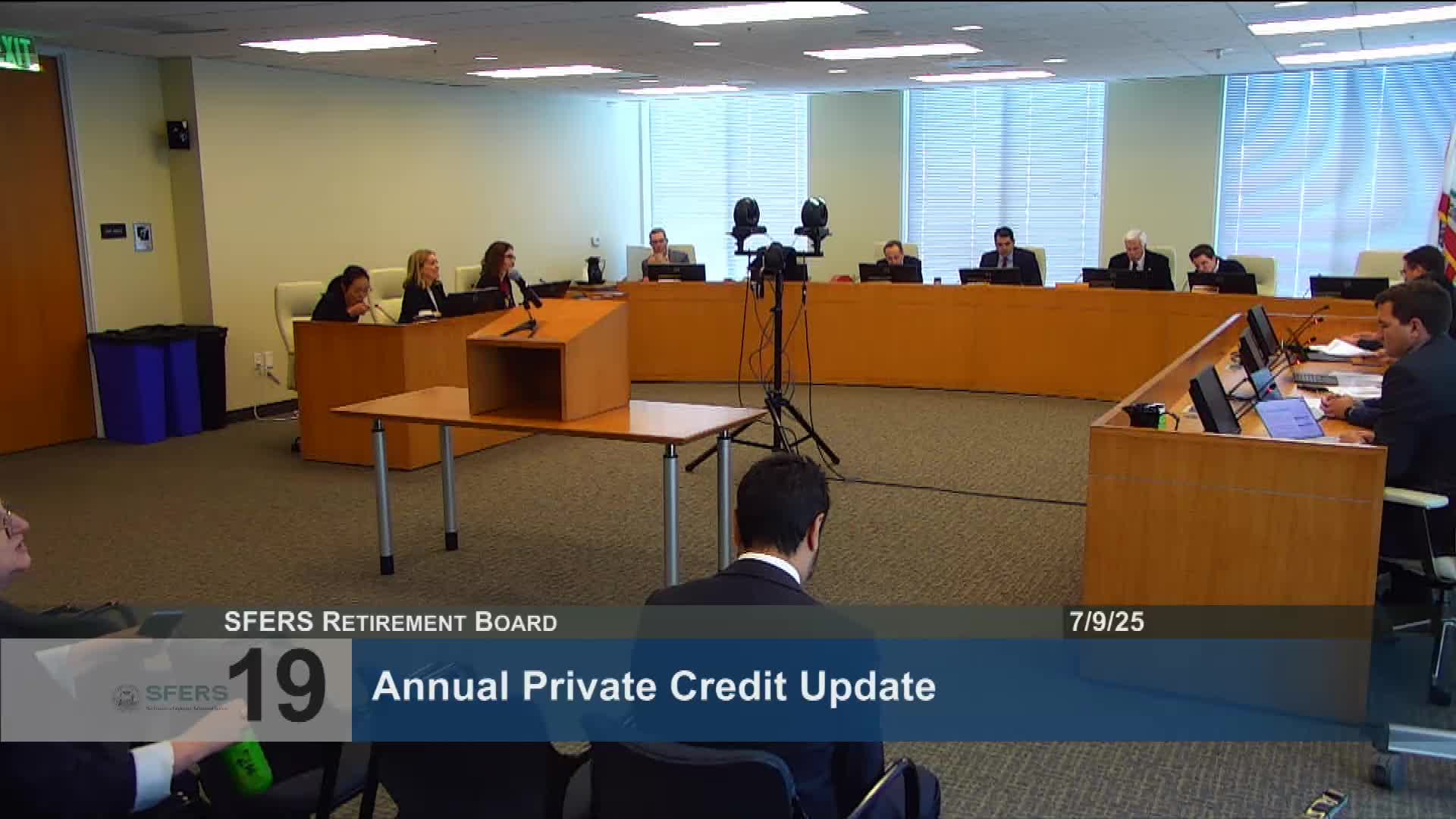
Retirement board hears annual private-credit review; staff says portfolio delivering steady income and nearing 10% target
Summary
Staff and Cambridge Associates presented a detailed annual review of the retirement system’s private credit program, reporting multi-year outperformance, steady distributions, and near-target allocation while cautioning about market competition and manager consolidation.
The San Francisco Retirement Board on June 30 received the annual private credit program review, a detailed presentation from staff and Cambridge Associates that described the program’s performance, exposures and ongoing initiatives.
Kurt (presenting the program overview) told the board the private credit portfolio delivered consistent returns: “In the calendar year, it was up around 9% and has generated a return of 9.7% since inception,” he said, summarizing performance as of the December reporting window. Staff noted the program has committed roughly $6.3 billion across 108 funds, with about $5.2 billion called and a paid-in multiple (TVPI) of approximately 1.3x.
Nut graf: The review framed private credit as an income-oriented strategy that has become an increasingly important source of cash flow for the plan. Staff emphasized ongoing work to manage risk — including closer legal review of manager consolidations and temporary reductions in leverage on separate-account exposures — while monitoring market inflows that have compressed yields in some segments.
The presentation covered strategy-level performance and portfolio construction. Staff said income-focused strategies (senior debt and similar) make up the largest share of NAV while opportunistic strategies are a larger share of unfunded commitments. Eunice McHugh, director of private credit, described a deliberate effort to increase diversification across sub-strategies and geographies, and noted the team has asked separate-account managers to lower leverage targets from the maximum of 1.0x to roughly 0.5x given higher base rates and tight public credit spreads.
Cambridge Associates’ Richard Grama told the board he viewed the portfolio favorably, noting long-term outperformance versus both the policy benchmark (a blend of leveraged loans and high-yield plus 150 basis points) and Cambridge’s private-credit benchmark. He cautioned that growth in direct-lending capital — “the pig in the python,” as he summarized — has increased competition in the upper end of the market and warrants careful manager and strategy selection.
Staff described current pacing and expected commitments: the program has averaged about $665 million of commitments per year over the past five years, had committed roughly $425 million year-to-date, and expects higher activity in 2025 with the possibility some commitments roll into 2026. The team also highlighted initiatives including tighter diligence on legal terms after manager consolidation events, continued attention to relative value and risk-adjusted returns, and improvements to monitoring systems.
Ending: Commissioners asked about readiness for distressed opportunities; staff said an estimated 15% of unfunded exposure sits in distressed-style vehicles available to act if market dislocations arise. Board members praised staff for the program’s long-term results and emphasized the importance of maintaining in-house expertise to underwrite and monitor this resource-intensive asset class.