Get Full Government Meeting Transcripts, Videos, & Alerts Forever!
Get email alerts on the Audit Financial Controls topic
No spam. Unsubscribe anytime.
Consultants find $2.9 million in potential disallowed Section 8 costs; recommend tighter controls
Summary
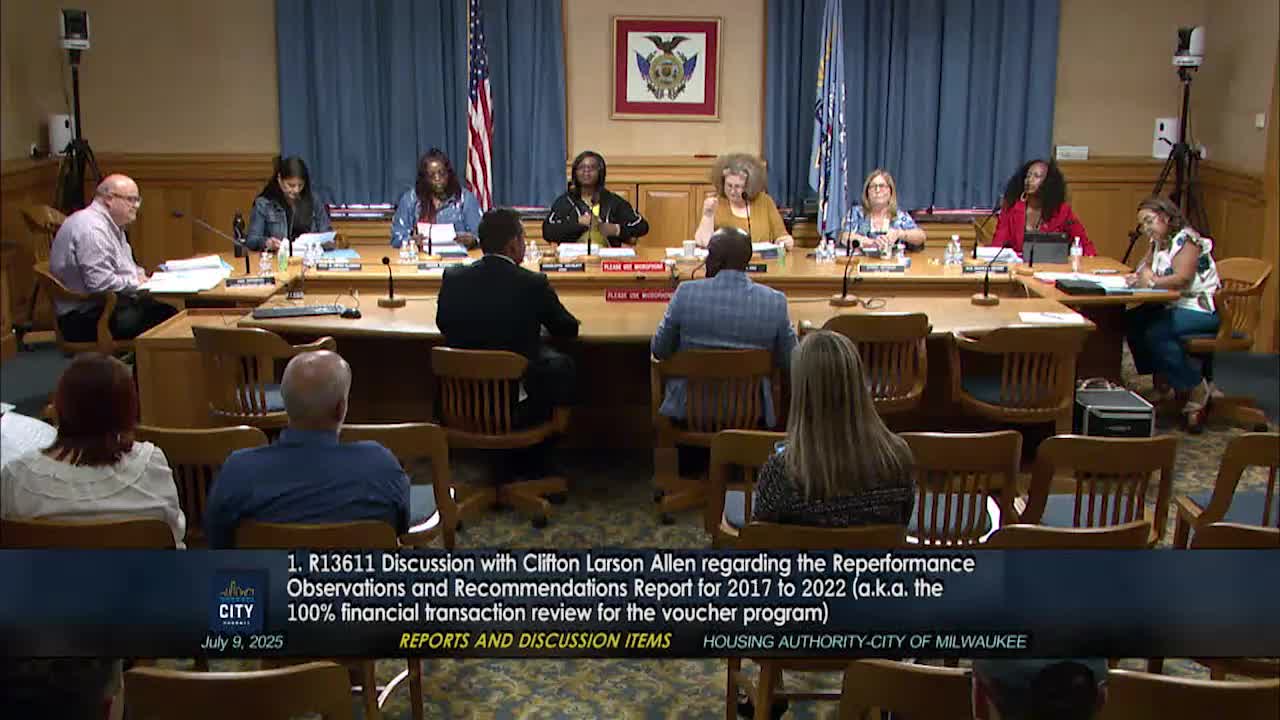
Jordan Boehm, a principal with CliftonLarsonAllen, told the Housing Authority of the City of Milwaukee on July 9 that a 100% reperformance of Section 8 transactions from 2017–2022 identified $2,911,712.07 in potential disallowed costs, largely tied to transfers of Section 8 cash to other authority accounts.
Jordan Boehm, a principal with CliftonLarsonAllen (CLA), told the Housing Authority of the City of Milwaukee on July 9 that a 100% reperformance of Section 8 transactions for Jan. 1, 2017–Dec. 31, 2022 identified $2,911,712.07 in potential disallowed costs.
Booth said the bulk of that total — roughly 98% of the amount CLA flagged — resulted from cash that had been moved from Section 8 accounts into the authority’s corporate accounts (COCC) and used to pay other expenses. “The total disallowed costs observed for this period was $2,911,712.07,” Boehm said, adding that CLA’s role is to identify items that HUD will ultimately review and determine as disallowed or not.
The finding prompted a lengthy discussion with commissioners and staff about causes and remedies. CLA listed nine observations and recommendations tied to internal control weaknesses: inconsistent documentation of review and approval, outdated or improperly maintained cost-allocation plans, supporting documentation that was not “readily available,” unsupported small-dollar transactions, errors in calculating unrestricted versus restricted net position, weak controls over manual journal entries, delayed posting after month end, and inconsistent payroll reconciliations.
Brad Leek, HACM’s chief financial officer, and staff members were credited by CLA for providing materials that made the review possible. Leek told the board the agency had implemented some workflow and technology changes in 2025 (including procure-to-pay in Yardi) that aim to tighten approvals and create digital approval trails.
Commissioners asked practical oversight questions. Commissioner Moore pressed CLA for what prior governance should have asked or monitored; Boehm said the practices CLA flagged would likely have continued had the QAD reperformance not required review. CLA recommended the authority segregate Section 8 cash into stand-alone accounts, revisit the cost-allocation plan annually, require consistent reviewer signoffs on invoices and journal entries, and consider an internal-audit function or an assigned board reviewer specifically tasked with monthly review of bank reconciliations and interfund transfers.
CLA and HACM staff also discussed next steps with HUD. Boehm noted that CLA identifies “potential disallowed” items but HUD will make the final determination and, if HUD confirms disallowance, the debt would move to federal debt collection with a repayment schedule. CLA reiterated that federal funds cannot be used to repay federal funds: repayments must come from non‑federal sources.
Helpful details provided at the meeting: CLA’s reperformance covered roughly 10,000 individual transactions across the five-year period; the largest flagged items were transfers of Section 8 cash to COCC; some attempts at repayment in later years reduced the net disallowance for certain years (2021 showed a negative disallowance due to repayments). CLA urged regularized reporting to the board of interfund transfers and older “deposits in transit” that do not clear within normal timing as red flags.
The board did not take formal action on this item during the meeting; the discussion and recommendations will be part of HACM’s corrective-action work with HUD.
Ending: CLA urged the authority to prioritize segregation of restricted program cash, stronger documentation and approval trails, and closer, periodic board review (including private meetings with auditors) so HUD and the authority can be confident financial records match program restrictions.