Get Full Government Meeting Transcripts, Videos, & Alerts Forever!
Get email alerts on the Municipal Legislation topic
No spam. Unsubscribe anytime.
Carlsbad officials present 2025 legislative platform and housing priorities to Housing Commission
Summary
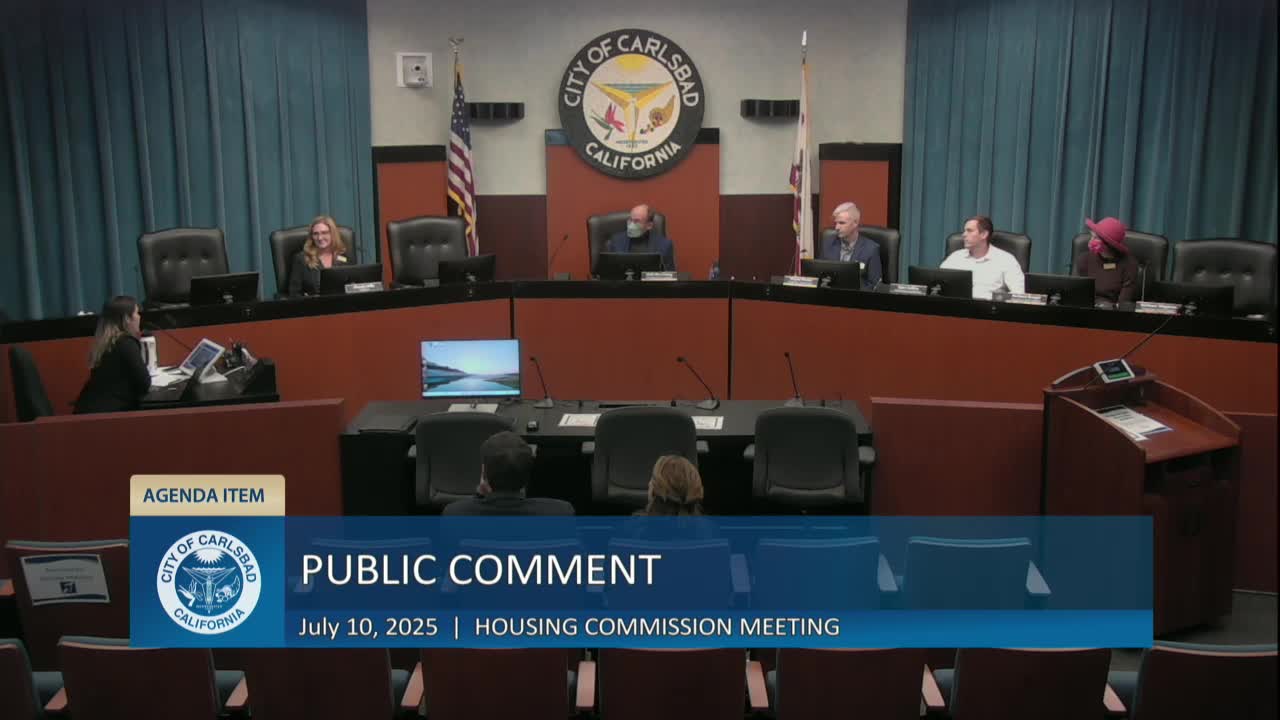
Carlsbad City Councilmember Teresa Acosta and Jason Haber, the city's intergovernmental affairs director, briefed the Carlsbad Housing Commission on July 10 on the city's 2025 legislative platform, recent city-sponsored bills and priority state and federal funding requests.
Carlsbad City Councilmember Teresa Acosta and Jason Haber, the city's intergovernmental affairs director, briefed the Carlsbad Housing Commission on July 10 on the city's 2025 legislative platform, recent city-sponsored bills and the city's priority state and federal funding requests.
The presentation outlined how the city develops policy positions through a council legislative subcommittee, coordinates with the League of California Cities and the National League of Cities, uses contract lobbyists and a grant writer, and monitors roughly 2,500'3,000 bills each year at the state level — about 200'300 of which the city considers relevant to municipal operations. "We are very engaged and we are actively advocating for Carlsbad and for our region," Acosta said, introducing the overview and explaining the city's practice of taking positions (support, oppose, watch) and sponsoring bills.
Why it matters: The update spells out the city's priorities that could shape state legislation and funding that affect local housing, homelessness services, land use and infrastructure. Several platform positions discussed would directly affect local housing policy if adopted at the state level, including proposals on CEQA exemptions for 100% affordable projects, RHNA allocation methodology and rules tied to density bonuses.
Key points from the presentation
- Legislative program and process: Haber said the city's intergovernmental program was established by city council policy and a 2018 council resolution and is run in part through a two-member legislative subcommittee. The city uses membership in Cal Cities (League of California Cities) and the National League of Cities, contract lobbyists and interdepartmental staff input to develop positions and advocate on bills.
- Track record on sponsored bills: Acosta and Haber said Carlsbad has sponsored five bills in recent years that were signed into law, covering matters from ebike safety to cybersecurity exceptions to closed-session discussions. "We have been so very successful. All five of these bills that we've sponsored in the last five years all have made it through the process and been signed into law," Acosta said.
- 2025 priorities and positions relevant to housing and homelessness: The city identified four housing/homeless concepts the council approved to pursue this year. Platform statements the presenters highlighted include: preserving local control and opposing unfunded mandates; supporting incentives and funding for affordable housing and rehabilitation; supporting a formula-based RHNA (Regional Housing Needs Allocation) methodology that reflects local carrying capacity; support for exempting 100% affordable housing projects from CEQA while maintaining mitigation for public health and safety hazards; and seeking expanded funding for outreach, case management, and housing and treatment beds (including interest in expanding eligibility for certain beds at the La Posada shelter through regulatory rather than legislative changes.
- Themes the city is watching at the state level: Haber singled out transit-oriented development bills that increase heights/densities and streamline review, CEQA exemptions and budget provisions that have adopted CEQA-related reforms, proposals limiting municipal building standards above the state code for six years, and permit-streamlining measures that could limit local discretion. He also noted a proposal to tie planning for extremely low-income housing to eligibility for certain funding and said the city is monitoring that closely.
Commissioner questions and staff responses
- RHNA: Commissioner Ty Collins asked how the city's position on RHNA reform would affect actual RHNA numbers. Haber and Acosta said the platform statement is intended to allow the city to support reforms that account for local carrying capacity and constraints; they deferred technical specifics to housing staff and outside experts. "This statement is flexible enough to allow us to say we support RHNA reform," Acosta said.
- Transparency on league votes: Collins asked whether it would benefit Carlsbad residents to know how council members vote in League of California Cities forums; Acosta said members are welcome to ask her about her votes and implied transparency is possible.
- Effort to sponsor bills: Commissioners asked about the staff effort required to sponsor and shepherd bills. Haber said it is a significant lift involving staff, contract lobbyists and legislative staff, and that bills often require amendments or multi-year timelines because of legal or political issues.
Announcements from Housing and Homeless Services staff
Housing staff (Ms. Mills) announced open waiting lists for two projects: a development identified in the record as "Lucia" at Aviara will offer 12 moderate-income units and will accept the first 100 applicants starting July 17; and a project called Tower 24 in the southwestern part of the city will have 86 total units with 13 income-restricted units (two-, three- and four-bedroom) and will determine applicants by lottery in early August. Mills said more project details and application links are posted on the city's affordable housing list on the city website.
Votes at a glance
- Motion to approve minutes of the June 12, 2025 Housing Commission meeting: passed, tally 4 yes, 0 no, 0 abstain; Commissioner Eddy Goras absent. The transcript records a motion and a second and reports a four-vote yes outcome; mover and seconder are not specified by name in the transcript.
What did not change or conclude tonight
No new legislation was formally introduced by the commission and no binding direction to change city policy was adopted at this meeting. Presenters encouraged commissioners and staff to notify the intergovernmental affairs director about legislative or regulatory issues that may affect housing work so the city can respond during the session.
Ending: The presentation closed after commissioner questions and staff follow-up; the item was marked closed and the commission moved to commissioner commentary. The Housing Commission adjourned at 4:54 p.m.