Get Full Government Meeting Transcripts, Videos, & Alerts Forever!
Get email alerts on the Water Supply Reservoir topic
No spam. Unsubscribe anytime.
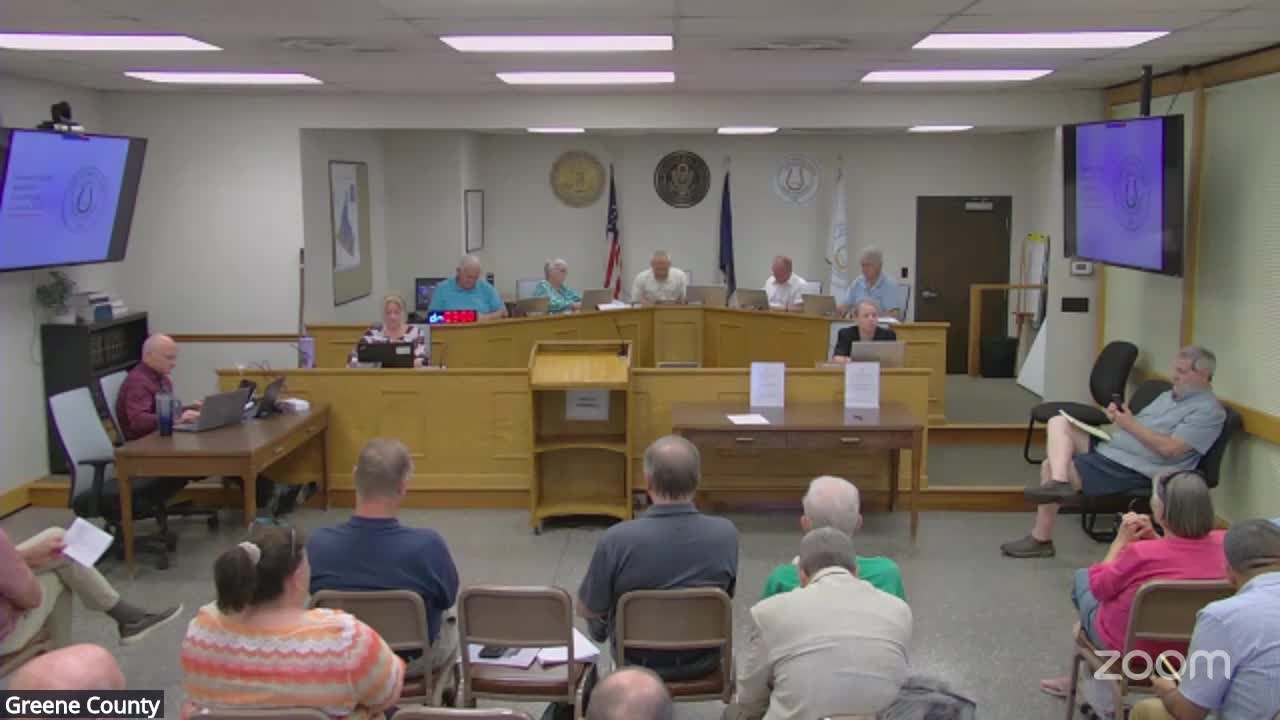
Greene County board approves scaled-down reservoir and treatment plan, 4-1
Summary
The Greene County Board of Supervisors voted 4-1 to adopt a revised water supply plan that reduces reservoir and treatment-plant capacity to lower initial cost and unlock grant funding, after a lengthy public comment period about costs and emergency services.
The Greene County Board of Supervisors voted 4-1 Tuesday to adopt a revised water supply and treatment plan that reduces the initial size of the proposed reservoir and water-treatment plant while preserving a staged path for future expansion.
The vote authorizes county staff to proceed with value-engineering revisions to the project as presented by WW Associates and to pursue permitting and funding opportunities for the reduced-scope design.
Consultant Herb White of WW Associates told the board the value-engineered alternative cuts the reservoir volume from 900,000,000 gallons to 600,000,000 gallons, lowers the initial treatment-plant capacity from 3,000,000 gallons per day to 2,000,000 gpd (with an ultimate expansion to 4,000,000 gpd), reduces the raw-water pump station capacity from 10,000,000 gpd to 8,000,000 gpd, and specifies a 24-inch raw-water main instead of 30 inches. White said those reductions substantially reduce earthwork and plant construction costs and that the firm’s estimate places the scaled plan at about $65,000,000 versus roughly $87,000,000 for the larger alternative.
"It took us from 1960 to 2025 to make the first million," White said, describing the county's historical pace of growth and defending the consultant view that a 2,000,000-gpd initial plant would meet demand for several decades while allowing staged expansion.
The presentation noted the county already holds a Corps of Engineers 404 permit that allows an intake and reservoir work, and a DEQ 401 permit that remains valid through March 2028; the Virginia Department of Health and Department of Conservation and Recreation have previously approved elements of the design and will need to review the revised drawings.
Public comment before the vote focused on cost, timing and alternatives. Residents and community groups across political lines urged action but differed about scope and finance. Jennifer Lewis Fowler and others pressed for detailed line-item cost breakdowns and questioned assumptions about future hookups and user-fee revenue; several speakers asked the board to examine additional well drilling as a lower-cost alternative. A combined statement from the Greene County Democratic and Republican committees described concern about unrelated emergency-services issues but urged the board to act on water infrastructure.
Supervisor McQuiggan dissented in the final vote, arguing the county lacked a complete financial plan and that multiple related water and sewer projects and uncertain grant commitments meant the county risked an open-ended expense. "I cannot vote for this project based on a blank check," he said during the discussion.
Supporters said adopting the revised plan is the necessary step to qualify for state and federal grant opportunities that the county cannot access without an approved project. The motion to adopt the resolution passed on roll call: Supervisors Lamb, Durrer, Goolsby and the chair voted aye; Supervisor McQuiggan voted no.
The resolution directs staff to pursue procurement steps, permit revisions, and funding opportunities for the value-engineered design. The consultant and county staff said contractor bids and final cost estimates would be returned to the board for later decisions on construction contracts and phasing.
Board members and the consultant discussed phasing to attract smaller, local contractors and to manage escalation in construction prices. White said engineering estimates will be followed by contractor bids and that the county will need agency approvals for revised reservoir and plant designs.
The board’s action does not authorize construction contracts; it approves the project concept and the next procurement and permitting steps for the reduced-scope plan.
Looking ahead, staff said the county will return with refined cost estimates, permit filings and a recommended phasing schedule. Several supervisors also requested additional workshops on financing options and a review of ordinances relating to public water and sewer to reduce confusion in the public discussion.