Get Full Government Meeting Transcripts, Videos, & Alerts Forever!
Get email alerts on the County Budget topic
No spam. Unsubscribe anytime.
Marathon County staff present 2026 budget assumptions, urge direction on compensation, fees and facilities
Summary
County administrators outlined revenue and expenditure assumptions for the 2026 budget, asked supervisors for policy direction on compensation, fee recovery and building consolidation, and flagged several cost drivers including health insurance, retirement, utilities and one-time capital needs.
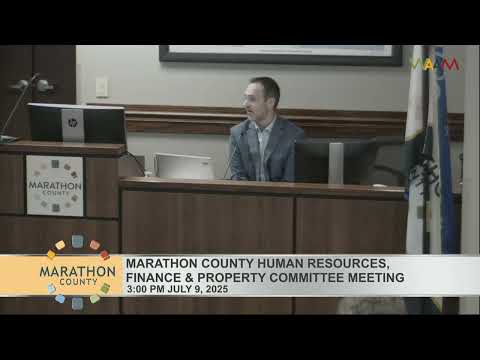
Marathon County administrators presented draft assumptions and policy questions for the 2026 budget at the Resources, Finance and Property Committee, asking supervisors to give early direction on priorities including employee compensation, rates and fees, and potential facility disposals.
Administrator Leonard and staff framed three core policy questions for committees: which programs/services the county should provide within limits of state statute; the desired level of service (quality and timeliness); and how much of the cost should be recovered through fees versus county taxes. Leonard said the county uses a mandatory/discretionary program document to show which services are required by statute and which have fee flexibility.
The packet shows a countywide operating budget of approximately $200,000,000, with roughly $55,000,000 funded by the property tax levy and the remainder from other sources including sales tax, fees and grants. Staff recommended initial revenue assumptions that include a net new construction placeholder of 1.75% (final Department of Revenue number expected August 1), a sales tax budget of $16,300,000, a shared revenue increase of about 4.9 (roughly $261,000), and a utility tax estimate of $2,170,000. Staff noted transportation aids and other intergovernmental revenues remain uncertain and are generally budgeted conservatively.
On expenditures, staff described major cost pressures: a needed update to the county compensation grid (consultant work indicates a roughly 10% shift of minimums and pay points is needed to align with market), a recommended health insurance budgeting assumption of about 6.5% (while other markets have quoted higher), a Wisconsin Retirement System (WRS) employer rate change that produces a weighted increase near 2.08%, and an insurance (property and casualty) exposure that staff preliminarily estimated could add roughly $100,000 (a roughly 16% increase). Leonard told the committee the compensation decision will be a policy choice for the Board and that staff will return with detailed costings and benchmarking options.
Committee members raised several priorities and clarifying requests. Vice Chair Marshall asked that discretionary program listings include FTE and significant contract service counts so supervisors can attach dollars to programs; staff said they will attempt to roll up funding streams and provide personnel/contract detail where possible but cautioned that line-item budgeting limits precise program-level FTE attribution. Supervisor Poole said he wants “property taxes neutral” to be considered early in the process; Chair Gibbs and others warned holding the levy flat would likely require using reserves or cutting services and noted prior reliance on one-time reserves created timing and sustainability issues.
Staff highlighted recent committee direction to develop a maintenance fee for the county’s on-site wastewater maintenance program. The environmental resources committee signaled support for full cost recovery via a maintenance fee of roughly $6 charged to affected property owners; staff will research whether that fee can be implemented in this budget year or next based on legal constraints.
Administrators also discussed operational savings opportunities including consolidated procurement (a centralized procurement officer/service to review contracts and RFPs), energy-use reductions tied to reducing building footprint, and accelerating planned building disposals (Thomas Street and River Drive were discussed) to lower holding costs and insurance exposures. Staff said schematic-design work and RFPs for a potential highway facility relocation are being prepared and will require budget amendments when funded.
Why it matters: supervisors must decide early priorities that will shape levy size, fee schedules, service levels and whether one-time funds should be used for ongoing expenses. Staff repeatedly emphasized that decisions on compensation, fees and reserves are interdependent: lower levy growth or higher fee recovery will affect program funding and staff retention.
Staff requested the committee provide direction on the compensation approach and fee adjustments, and asked supervisors to send specific program questions to the chair so staff can bring targeted information back in later meetings.
Ending: Staff will bring updated detailed cost projections for compensation, a finalized Department of Revenue net new construction estimate (expected August 1), and follow-up material on procurement, utilities and building holding costs to future committee meetings.