Get Full Government Meeting Transcripts, Videos, & Alerts Forever!
Get email alerts on the Economic Crime Unit topic
No spam. Unsubscribe anytime.
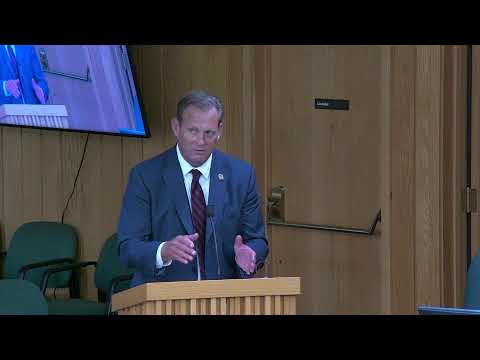
Eaton County prosecutor details economic crime unit workload, diversion program and revenue return
Summary
Eaton County Prosecutor Doug Lloyd told the Board of Commissioners that his office had 7,491 open cases and that the county's economic crime unit typically handles about 2,000 active matters at a time.
Eaton County Prosecutor Doug Lloyd told the Board of Commissioners on June that his office is managing a persistent caseload and that the county's economic crime unit handles a substantial volume of diversion and enforcement work.
Lloyd said his office had 7,491 open cases when he reported to the commission this month, up from the 7,401 cases he cited at an earlier meeting. He said the economic crime unit typically has about 2,000 active cases at any time and is staffed by four people: an attorney (Kelly Fletcher), two legal assistants (Marlena and Diana) and an investigator (Rod Beals).
The unit, Lloyd said, was created in 2002 to give local merchants and agencies an efficient avenue to recover losses from bad checks, retail fraud, welfare fraud and similar consumer offenses. He described a diversion model in which eligible people may pay restitution, a diversion fee and complete educational or restorative requirements in exchange for dismissal of criminal charges; those who decline can be prosecuted.
"Have you ever been in a pool or a lake and got tired and all you could do is just try to tread water?" Lloyd said, using the analogy to describe staffing limits. "The numbers of 7,000 cases ... haven't changed because, one, I only have a certain amount of people." He added that bringing in more arrests and police reports increases the caseload the prosecutor's office must review.
Lloyd said the economic crime unit has returned money to businesses and agencies since 2003 and that the unit has been largely self-sustaining through diversion fees; he said the total returned is "about $10,000,000." He described work the unit has done for the Secretary of State, the Michigan Department of Health and Human Services (DHHS), and neighboring counties, and said the unit began by focusing on bad checks and expanded to retail fraud, rental-property returns and contractor fraud.
Controller staff present confirmed the unit was originally grant-funded, later moved into a general-fund arrangement, and is reviewed annually during county audits. Commissioners asked about compensation and program mechanics; Lloyd said diversion fees are the unit's operating revenue and described typical timelines, which vary by case type (retail and bad-check cases are typically faster; some welfare-fraud matters can take months or years).
Lloyd also described the unit's approach to cases: a business provides a standardized packet of documents; the office screens cases to determine prosecutorial merit; participants who enter diversion pay set fees and meet program requirements; those who do not are subject to criminal charges.
Commissioners and county staff questioned Lloyd about staffing and case processing; Lloyd said many attorneys in his office carry heavy caseloads, and that courtroom obligations and limited staff constrain how quickly cases close. He urged commissioners to consider staffing when evaluating county resources.
The prosecutor did not propose new legislation or ask the board to take action during the report; his remarks were informational and followed by commissioners' questions.