Get Full Government Meeting Transcripts, Videos, & Alerts Forever!
Get email alerts on the Downtown Improvement District Renewal topic
No spam. Unsubscribe anytime.
Harlingen downtown improvement district reviews five‑year renewal, funding and board compliance
Summary
City staff presented a five‑year service‑plan renewal for Harlingen’s Downtown Improvement District, reviewed recent grants and projects, outlined a $50,000–$60,000 solar‑lighting proposal and flagged board composition and statutory compliance issues that must be resolved before renewal or a transfer of responsibilities to the EDC.
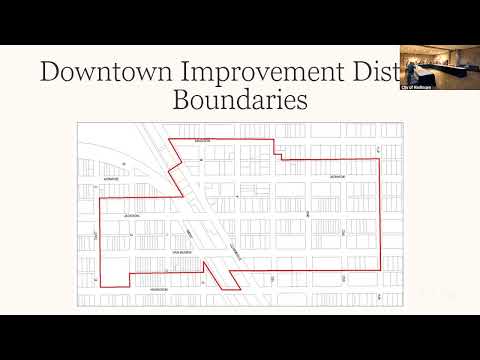
At a joint workshop in Harlingen, staff reviewed the Downtown Improvement District’s (DID) five‑year service plan, recent grant activity and capital projects while discussing whether to renew the district or move downtown improvement responsibilities to the Economic Development Corporation (EDC).
Alexis, Downtown Improvement District director, told attendees that “a public improvement district is a designated premium where property owners agree to pay an additional assessment to fund enhanced public improvements or services that directly benefit property within the district.” She said the district’s current assessment rate is $0.15 per $100 in valuation with a maximum annual assessment cap of $5,000 per property and that the district’s current annual assessment revenue is $40,000.
The director presented accomplishments from the prior five‑year service plan, including façade and signage grants, public‑facing events and maintenance. Staff reported 23 signage grants totaling $26,655.81 and 26 façade grants totaling $67,021.25 during the 2020–2023 service plan period. The district also highlighted cultural projects: the Baxter Building (constructed 1927) has been renovated into 24 apartment units with two vacancies reported, and Lozano Plaza — destroyed by fire in 2004 — is now maintained as a green community gathering space and event site.
Staff proposed a Phase 1 solar lighting project for key downtown blocks, including three new solar lights and retrofits in a public parking lot, two new solar lights at Lozano Plaza and several retrofits of commercial up‑lighting. The project was estimated in the workshop at roughly $50,000–$60,000.
Renewal projections presented to the group showed the district’s annual assessment rising from $40,000 to $44,000 based on the 2024 Cameron County certified tax roll; meeting remarks included some conflicting percentage characterizations, which staff said they would clarify in written materials. Grants administered by the DID are generally 50/50 matching awards; staff described an emergency window‑replacement subsidy available to businesses that submit receipts for qualifying break‑in repairs.
A central issue in the discussion was statutory compliance for the DID’s board composition and petition thresholds. Staff reported the district had been recorded as out of compliance in 2022 for not meeting statutory membership or petition requirements. The meeting included discussion of the petition process for renewal, the requirement that petitions reflect owners holding a threshold share of valuation (commonly expressed as 51% by valuation), and the need to secure signatures from key commercial property owners. Staff said they had been working to recruit qualifying property owners and to coordinate notification and paperwork with the county tax roll.
Several elected officials and board members voiced concern about administrative workload and the most efficient structure to deliver downtown services. Speakers proposed options including empowering staff to approve routine grant applications administratively, preserving the DID’s grant programs under current administration, or transferring downtown grant administration and some funding responsibilities to the EDC, which already runs small‑business programs and has administrative infrastructure. One participant said the current board “will dissolve” on Dec. 5 was mentioned during the meeting as a timeline for changing governance, though no formal vote or ordinance adopting dissolution was recorded during the workshop.
Participants repeatedly emphasized the importance of continuing façade and public‑space investments — murals, lighting, trash‑receptacle and bench maintenance, seasonal trimming and event promotion — while reducing board time spent on routine administrative approvals. Staff and commissioners said they want to preserve grant programs that support building reinvestment and upper‑floor housing as part of a broader downtown revitalization strategy.
No formal motions or votes were recorded in the transcript of the workshop. Staff were directed in discussion to (1) confirm the statutory membership and petition requirements for renewal in writing, (2) prepare clarified budget and percentage calculations for the proposed renewal, and (3) present options and timelines, including an administrative delegation model and an EDC transfer model, at a future meeting.
The workshop combined operational updates, program statistics and legal/compliance questions that city staff and board members must resolve before the DID can be renewed or restructured. The city’s next formal steps described in the meeting are to document compliance obligations, finalize the petitioner outreach plan and return to council/board with clarified cost and governance options for a decision.