Get Full Government Meeting Transcripts, Videos, & Alerts Forever!
Senate committee advances a package of bills on wildfire water systems, solar on farmland, restaurant permits and housing rules; several bills pass to next-door
Summary
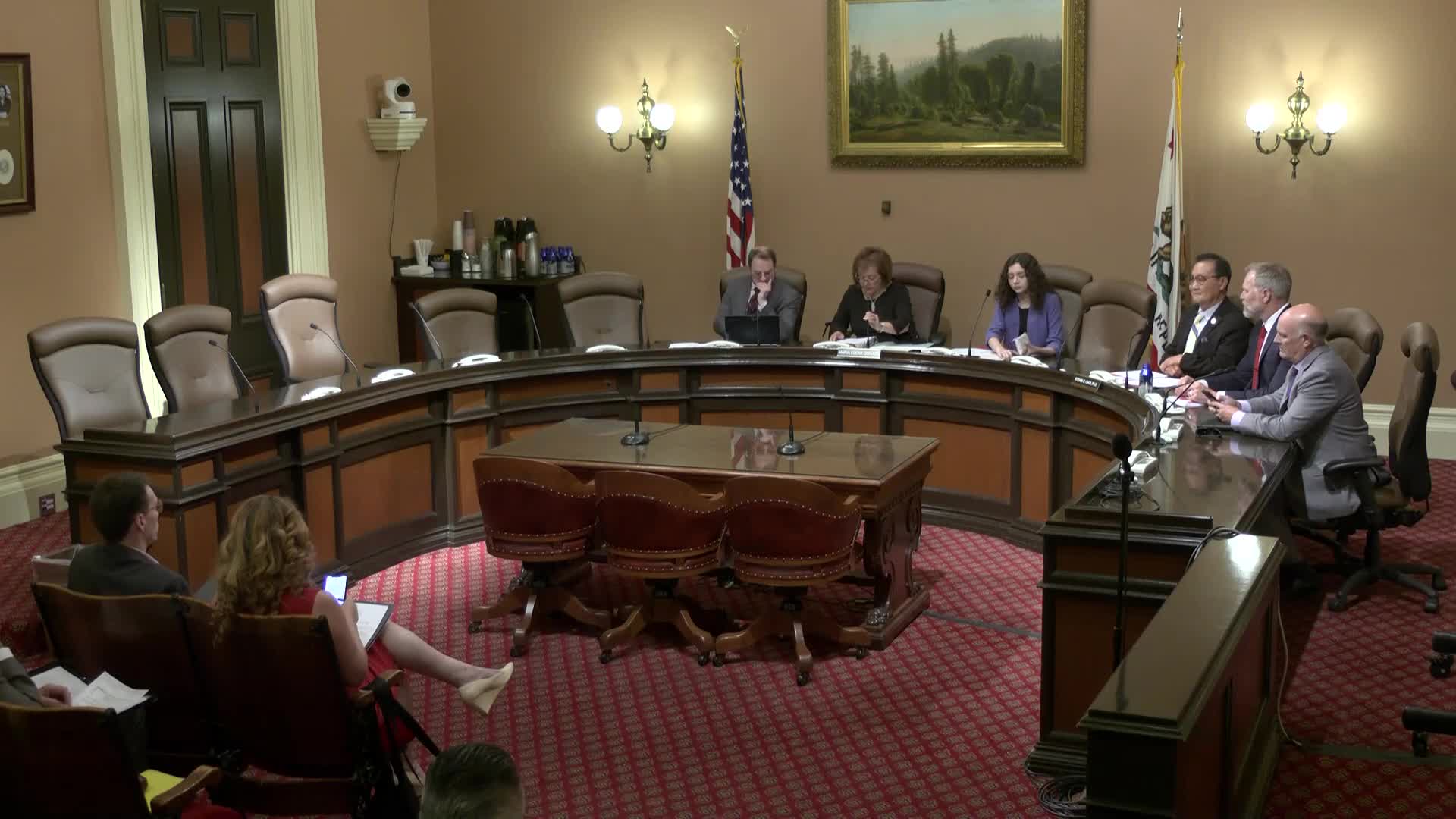
A California State Senate committee hearing covered ten bills ranging from wildfire-related water infrastructure to solar on Williamson Act land, restaurant permitting, ADU/JDU rules and housing-permitting reforms; most measures were advanced to subsequent committees, with several drawing sustained public testimony about cost, farmland protection and local implementation.
A California State Senate committee hearing covered ten bills ranging from wildfire-related water system upgrades in Ventura County to new pathways for solar projects on land under Williamson Act contracts, streamlined permitting for restaurant openings, and changes to accessory-dwelling and housing-permitting rules.
Why it matters: The package raises trade-offs that recur across California policy debates — resilience and public safety versus cost to local utilities and ratepayers; farm protection versus sites for large-scale renewable energy; faster permitting for small businesses and housing versus local review and public-health safeguards. Committee members moved most bills forward, while some drew opposition and requests for further amendments.
Key debates
AB 367 (Ventura County water-system minimums and backup power): Assemblymember Bennett presented a district bill responding to past wildfires in Ventura County where fire hydrants and tanked water supplies failed during fires. The author described three technical fixes: (1) require water tanks to maintain minimum usable levels during red-flag conditions, (2) require backup power (stationary or mobile generators) so tanks can be refilled when electricity is shut off, and (3) harden small facilities (for example, pump houses and generator enclosures). Supporters included Ventura County officials. Opposition testimony from Association of California Water Agencies (ACWA) and city water utilities said the bill would impose high, unfunded costs on many small suppliers, risk litigation if assessments are misinterpreted, and require longer timelines than the bill’s compliance window allows. Witnesses quantified potential local costs: Thousand Oaks estimated roughly $16,000,000 in capital upgrades for its system, which it said could translate to roughly $78 per month (about a 47% increase) for a typical customer under Proposition 218 rate procedures; a small district estimated a backup generator at about $300,000. The author pointed to potential funding sources including FEMA mitigation programs and a pending bill to allow wildfire grant funds to be used for water infrastructure. The committee voted to pass AB 367 as amended to the Committee on Appropriations (committee vote reported in the hearing record).
AB 11 56 (solar…
Already have an account? Log in
Subscribe to keep reading
Unlock the rest of this article — and every article on Citizen Portal.
- Unlimited articles
- AI-powered breakdowns of topics, speakers, decisions, and budgets
- Instant alerts when your location has a new meeting
- Follow topics and more locations
- 1,000 AI Insights / month, plus AI Chat