Get Full Government Meeting Transcripts, Videos, & Alerts Forever!
Get email alerts on the Committee Hearing Roundup topic
No spam. Unsubscribe anytime.
Senate committee advances a package of bills on wildfire water systems, solar on farmland, restaurant permits and housing rules; several bills pass to next-door
Summary
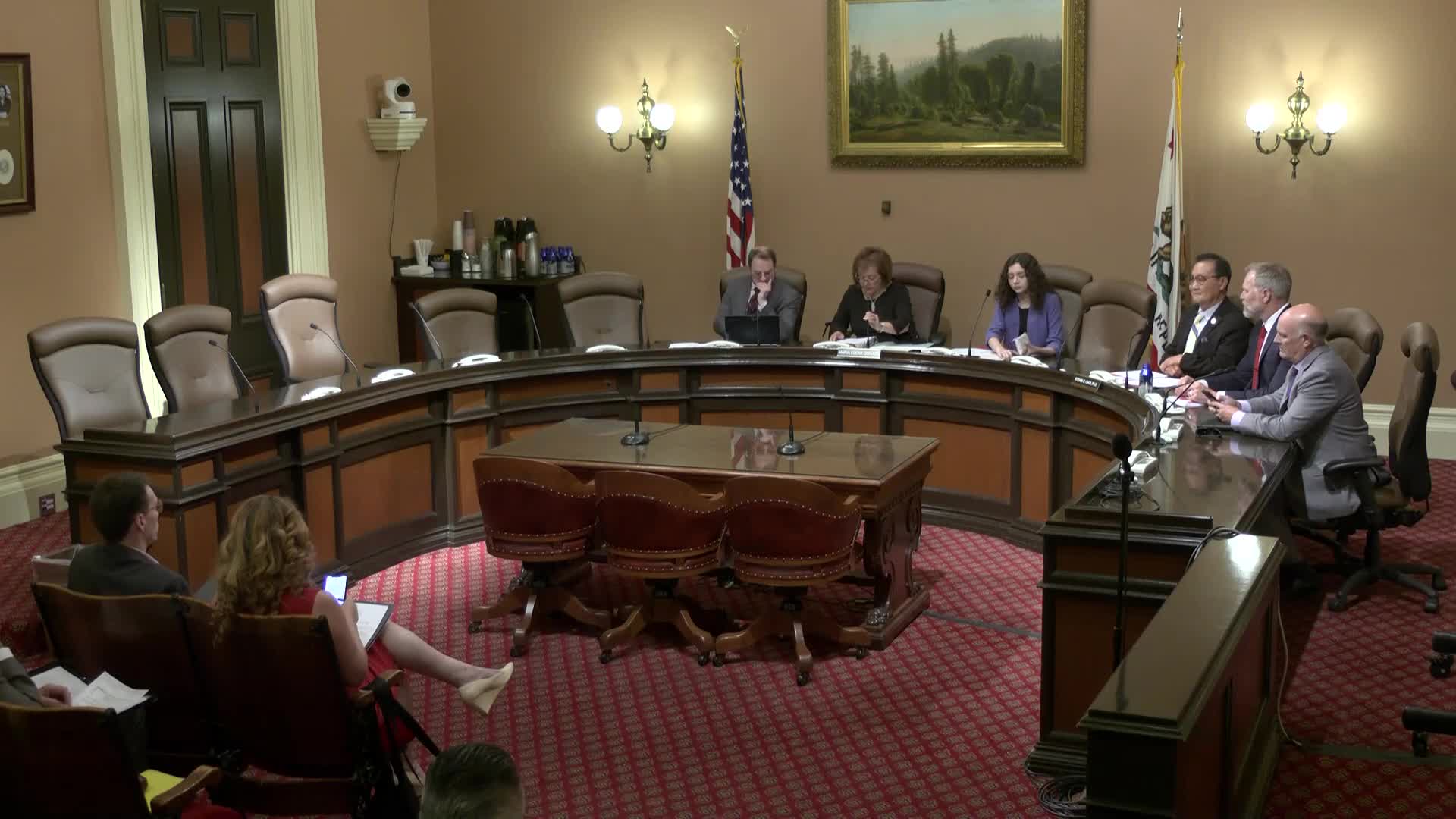
A California State Senate committee hearing covered ten bills ranging from wildfire-related water infrastructure to solar on Williamson Act land, restaurant permitting, ADU/JDU rules and housing-permitting reforms; most measures were advanced to subsequent committees, with several drawing sustained public testimony about cost, farmland protection and local implementation.
A California State Senate committee hearing covered ten bills ranging from wildfire-related water system upgrades in Ventura County to new pathways for solar projects on land under Williamson Act contracts, streamlined permitting for restaurant openings, and changes to accessory-dwelling and housing-permitting rules.
Why it matters: The package raises trade-offs that recur across California policy debates — resilience and public safety versus cost to local utilities and ratepayers; farm protection versus sites for large-scale renewable energy; faster permitting for small businesses and housing versus local review and public-health safeguards. Committee members moved most bills forward, while some drew opposition and requests for further amendments.
Key debates
AB 367 (Ventura County water-system minimums and backup power): Assemblymember Bennett presented a district bill responding to past wildfires in Ventura County where fire hydrants and tanked water supplies failed during fires. The author described three technical fixes: (1) require water tanks to maintain minimum usable levels during red-flag conditions, (2) require backup power (stationary or mobile generators) so tanks can be refilled when electricity is shut off, and (3) harden small facilities (for example, pump houses and generator enclosures). Supporters included Ventura County officials. Opposition testimony from Association of California Water Agencies (ACWA) and city water utilities said the bill would impose high, unfunded costs on many small suppliers, risk litigation if assessments are misinterpreted, and require longer timelines than the bill’s compliance window allows. Witnesses quantified potential local costs: Thousand Oaks estimated roughly $16,000,000 in capital upgrades for its system, which it said could translate to roughly $78 per month (about a 47% increase) for a typical customer under Proposition 218 rate procedures; a small district estimated a backup generator at about $300,000. The author pointed to potential funding sources including FEMA mitigation programs and a pending bill to allow wildfire grant funds to be used for water infrastructure. The committee voted to pass AB 367 as amended to the Committee on Appropriations (committee vote reported in the hearing record).
AB 11 56 (solar use easements on Williamson Act land): The author proposed updating the existing solar use-easement statute to create a voluntary, local option to temporarily (suspend rather than cancel) Williamson Act contracts so that water‑constrained farmland could be used for large-scale renewable projects without permanently rescinding agricultural protections. The bill requires full CEQA review, mandatory additional community benefits, and county-level determinations (and a state-level check before prime farmland could be eligible). Supporters—landowners and large-scale solar groups—said the option would provide an economic path for landowners facing likely long-term fallowing and claimed only a small share of Williamson Act acreage would be affected. Opponents (California Farm Bureau, American Farmland Trust and other farm and conservation groups) said the measure risks conversion of prime farmland, reduces required contract-cancellation payments, and uses vague definitions for “insufficient water supply” and “commercial viability.” Committee discussion emphasized the voluntary nature of the tool, bond/ remediation requirements at project end, and continuing negotiations on siting definitions and cancellation payments. The measure was advanced to the committee on Environmental Quality with additional amendments and continuing stakeholder talks.
AB 6 71 (restaurant permitting): The bill would streamline openings for small restaurants by allowing qualified architects and engineers to self-certify plans for tenant improvement projects that convert existing spaces to restaurants, with randomized audits and continued building and health inspections. The bill excludes certifying food-safety plans, allows local governments to set qualification standards for certifiers and bars large chain restaurants from the pathway. Supporters from the California Restaurant Association and local restaurant owners testified about delayed openings and the cost of “dead rent.” The California Association of Environmental Health Administrators asked to remove a 10-business-day resubmittal requirement for local environmental health/f ood-safety reviews (they currently use a 20-day standard) because the shorter trigger could require added staff/fees; the author said the shorter timeline aligns resubmission clocks for building and health departments and promised continued talks. The committee passed the bill to the Committee on Business, Professions and Economic Development.
ADUs/JDUs and owner-occupancy (AB 11 54): The bill would remove owner-occupancy requirements for small accessory dwelling units and certain junior ADUs so homeowners could rent both the primary unit and a JADU when the JADU had its own bath. Supporters (UnidosUS, housing advocates) argued the change increases housing supply and helps homeowners create income; some implementers and nonprofit builders raised safety and code concerns for junior ADUs (fire separation when the interior door is removed) and urged clarifying revisions. The committee advanced the bill to Appropriations.
Housing-permitting and inspections (AB 12 76; AB 13 08 and related bills): Committee members advanced multiple bills intended to reduce permitting delays and increase predictability for housing projects. AB 12 76 extends certain “reasonable person”/vesting protections to state and regional-level review in the housing pipeline (building on prior local reforms) — a broad idea that witnesses said still needs work to avoid creating conflicts with existing state regulatory duties. AB 13 08 (inspection timelines) would require local building departments to conduct final inspections within a short, defined period for small residential projects (1–10 units, up to 40 feet), addressing cases where completed units sit vacant while awaiting sign‑off. Those measures advanced to the next committees with additional amendments requested.
Historic-district exemption to SB 9 (AB 10 61): The bill would narrow the current total prohibition on SB 9 duplexes/lot splits in “historic districts” by allowing SB 9 projects except at individually listed historic landmarks and for contributing structures that would have more than limited exterior demolition. Supporters said the change prevents blanket, off‑site historic designations from being used to block housing; local governments and some cities urged caution to preserve meaningful local historic protections. The committee passed the bill to Appropriations.
Votes at a glance (committee actions recorded in the hearing record)
- AB 87 (density bonus / visitor-serving uses) — passed as amended to the Senate floor (committee vote recorded in the hearing record: unanimous in committee). - AB 367 (Ventura County water-system upgrades / backup power) — motion passed as amended to Appropriations (committee tally reported in the hearing record: majority; hearing record shows 5 yes, 1 no). - AB 671 (restaurant permitting streamlining) — passed to Committee on Business, Professions and Economic Development (committee vote recorded as unanimous). - AB 1156 (solar use easements for Williamson Act land) — passed as amended to the Committee on Environmental Quality (committee action recorded; the record shows majority support with some abstentions and continuing negotiation requested). - AB 735 (follow-up to AB 98 on logistics/warehouses) — passed to the Committee on Judiciary (committee vote recorded in the hearing record). - AB 11 54 (remove owner-occupancy for some ADUs/JDUs) — passed to Appropriations (committee vote recorded as majority). - AB 12 76 (extend housing vesting protections to state/regional review) — passed to Appropriations (committee vote recorded as majority). - AB 10 61 (SB 9 / historic districts) — passed to Appropriations (committee tally recorded as 5–2). - AB 13 08 (final-inspection timelines for small residential projects) — passed to the Committee on Housing (committee vote recorded as unanimous).
What’s next: Most bills were advanced to fiscal or policy committees (Appropriations, Environmental Quality, Judiciary, Business Professions & Economic Development, and Housing) for further review and potential floor action. Several authors and opponents pledged to continue negotiating technical amendments in the interim.
Reporting notes: This summary draws only on statements made in the committee hearing transcript, public testimony entered on the record, and amendments discussed in committee. Where witnesses gave numeric estimates (local upgrade costs, generator prices, or lost sales), those figures are reported as testimony rather than independently verified facts.
Ending: Committee members repeatedly asked authors to continue stakeholder negotiations — particularly on definitions, funding sources, timelines and safety rules — before the bills move further down the process. Several measures remain contingent on future appropriations or clarifying amendments.