Get Full Government Meeting Transcripts, Videos, & Alerts Forever!
Get email alerts on the Open Government topic
No spam. Unsubscribe anytime.
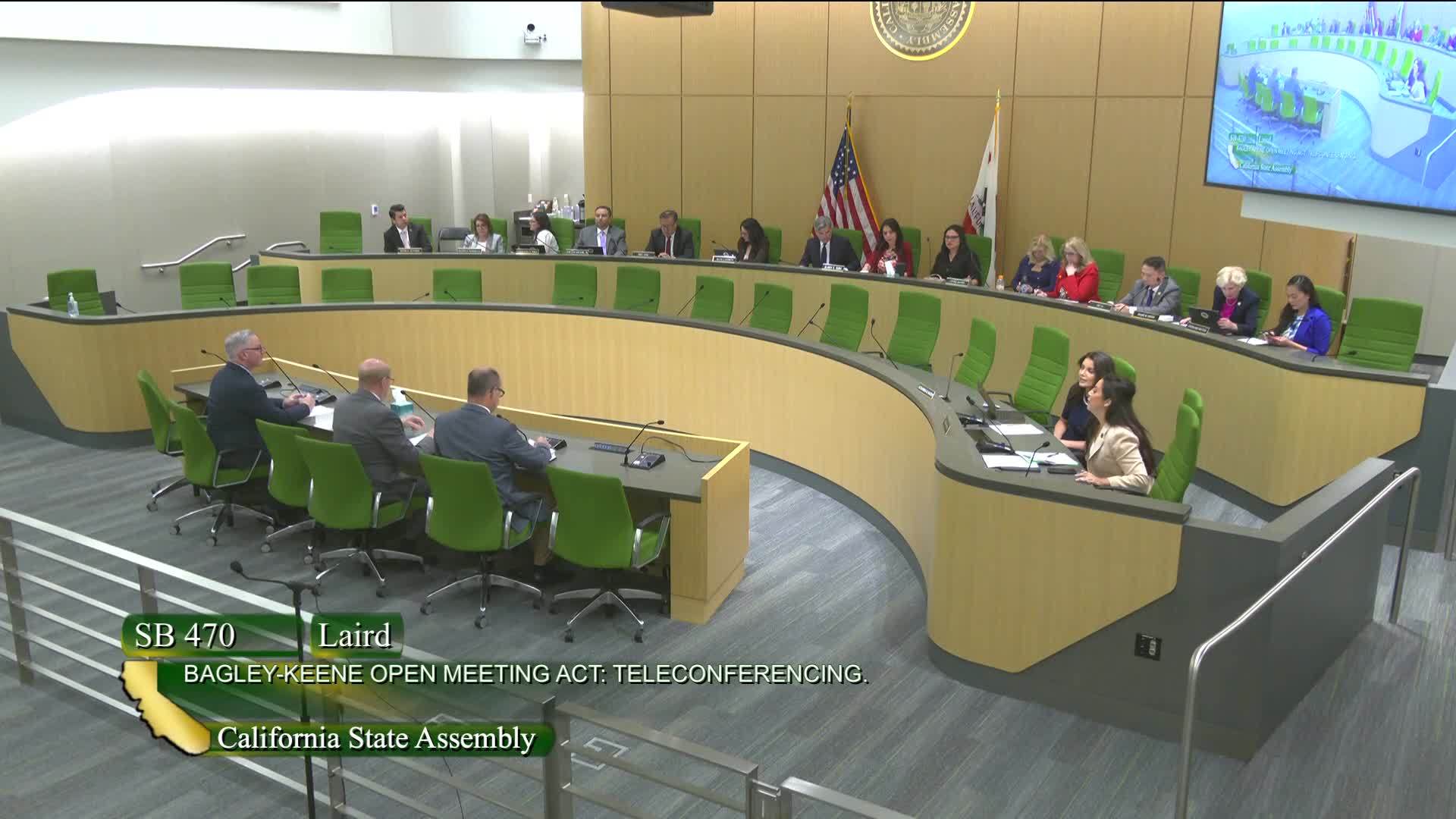
Committee advances SB 470 to extend alternative remote‑meeting rules for state boards through 2030
Summary
The subcommittee voted to send SB 470, which extends an alternative remote‑participation framework for state boards and commissions originally enacted in 2023, to the Appropriations Committee after supporters argued it improves access for seniors and people with disabilities and critics said it could weaken in‑person accountability.
Senator Laird and supporters told the committee SB 470 extends and refines an alternative path for state boards and commissions to allow remote participation, while opponents and several press and transparency groups warned it could reduce public access and oversight.
Senator Laird, the bill’s author, said SB 470 would extend the sunset date of the alternate Bagley‑Keene framework established in SB 544 (2023) to Jan. 1, 2030. “This bill gives a choice. State boards and commissions can choose to use the existing system or the alternative that is set forth by this bill,” Laird said. He described several guardrails in the draft, including that a majority of members must be present at a main location for a meeting to proceed and that remote members must have cameras on; he also said the bill removes a requirement that remote participants provide a home address.
Ethan Rarick, executive director of the Little Hoover Commission, told the committee the commission’s 2021 survey of Bagley‑Keene agencies found increased public attendance and cost savings from remote meetings, and he urged an I vote. “We think this bill increases diversity and equity in state government,” Rarick said. Aaron Carruthers, executive director of the State Council on Developmental Disabilities, described how the council uses a mix of in‑person and remote meetings to enable members with disabilities to serve and participate.
Several news organizations and open‑government advocates testified in opposition. Marshall Arnoine, legislative advocate for the ACLU of California Action, said the bill “would weaken the Bagley‑Keene open meeting act by significantly reducing transparency and accountability.” Britney Barsotti of the California News Publishers Association and a coalition of press and First Amendment groups argued the legislation should prioritize an in‑person quorum and narrow remote participation exceptions to protect public access.
Committee discussion clarified key provisions: the author and committee members confirmed the bill requires cameras to be on for remote members and requires an in‑person quorum before remote participation is counted. Assemblymember Dixon and others raised concerns about reduced in‑person interaction and whether online participation affects engagement and attention.
The committee voted to refer SB 470 as amended to the Appropriations Committee. The clerk read an initial roll showing 12 “aye” votes and left the roll open for additional members to add their votes. Two members recorded “no” votes during the roll call that was captured in committee discussion.