Get Full Government Meeting Transcripts, Videos, & Alerts Forever!
Get email alerts on the Outdoor Advertising topic
No spam. Unsubscribe anytime.
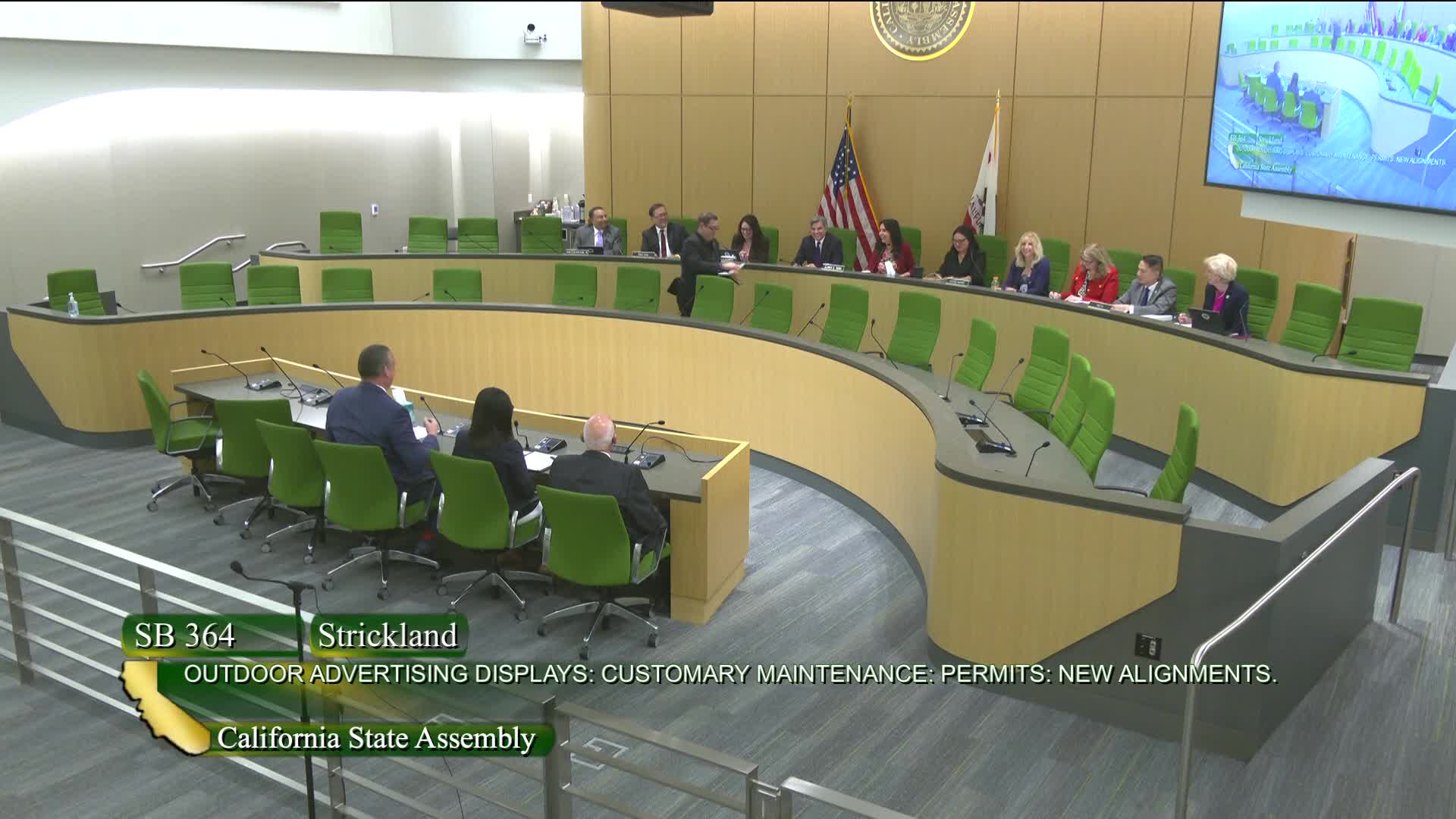
Assembly committee advances SB 364 to let Caltrans process billboard permits for finished freeway segments
Summary
A legislative subcommittee voted to send SB 364, which would allow the Department of Transportation to accept and act on outdoor advertising permit applications for segments of highway projects after those segments are opened to the public, to the appropriations committee as amended.
Senators and witnesses told the Assembly subcommittee that SB 364 would reduce permit backlogs and allow local governments to collect billboard revenue sooner.
Senator Strickland, the bill's author, told the Committee on Governmental Organization that SB 364 clarifies that Caltrans may accept and act on applications for outdoor advertising displays as discrete segments of a highway project are completed and opened to public use. “Allowing Caltrans to proceed in applications as the projects progress will avoid large backlogs of applications that would otherwise be accumulated during months-long construction projects,” Strickland said. He also said he amended the bill to clarify what maintenance activities do not require new permits.
The nut graf: proponents said the current rule — under which Caltrans waits until an entire project is accepted before processing billboard applications — is creating multi-year delays that prevent cities from collecting local revenue they expect from approved signs.
Margaret Lee, identified as city manager of Fountain Valley, described a local example: the 405 Freeway realignment and expansion has been open to traffic for nearly two years but — she said — would not be officially accepted by Caltrans for several more years under the current rules. Lee said her city approved two billboards on that stretch that would generate “at least $1,200,000 each year” and that the delay prevents the city from applying for the signs now. “This delay is attributed to a required plant establishment period for new landscaping along the freeway,” she said, adding that the expansion is complete and “there's no ongoing construction.”
Ron Beals, general counsel of the California State Outdoor Advertising Association and a former Caltrans chief counsel, told the committee the bill contains technical amendments to the Outdoor Advertising Act and urged members to vote aye.
The committee had no witnesses in opposition on the record during the hearing for SB 364. Assemblymember Toh praised the measure and sought to be a principal coauthor.
On a roll call, the committee voted to refer SB 364 as amended to the Appropriations Committee. The clerk reported 13 “aye” votes at the time the tally was first read and the chair left the roll open for additional members to add their votes. The committee record indicates the motion was to “pass as amended to the committee on appropriations.”
Clarifying details recorded at the hearing: proponents said the Fountain Valley signs were projected to generate about $1.2 million annually; supporters argued the change is procedural (allowing Caltrans to accept applications sooner) rather than a relaxation of safety or land‑use standards. The bill text, as discussed by the author, adds a short paragraph defining customary maintenance that would not trigger a new permit requirement.
The bill now goes to the Appropriations Committee for further consideration.