Get Full Government Meeting Transcripts, Videos, & Alerts Forever!
Get email alerts on the Agriculture Extension topic
No spam. Unsubscribe anytime.
University of Hawaii CTAHR outlines county-focused plan to expand local agricultural research, training and services
Summary
The University of Hawaii College of Tropical Agriculture and Human Resources (CTAHR) briefed the council on island stations, recruitment and new workforce-focused programs, seeking deeper county partnerships to replenish extension services and support farm resilience.
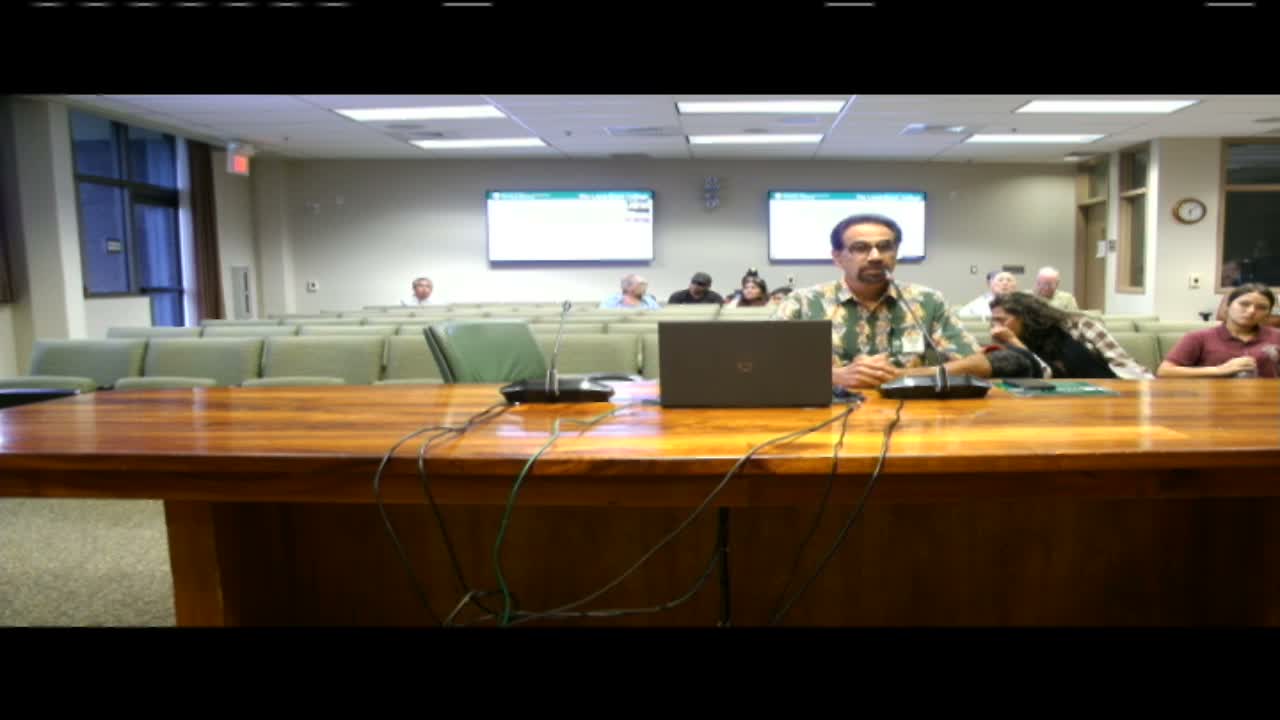
Dr. Parwinder (title and affiliation in meeting record: Dean, CTAHR) briefed the Hawaii County committee on the College of Tropical Agriculture and Human Resources’ existing station network, recent capital investments and new programs aimed at strengthening local food systems and workforce pipelines.
Why it matters: CTAHR provides applied research and extension services that support farmers, nurseries and aquaculture companies on the Big Island. The college’s ability to maintain local positions, labs and diagnostic services affects farm productivity, pest response and training for the next generation of farmers.
What CTAHR described
- Local stations and investments: The dean said CTAHR operates about 22 stations statewide, 11 on the Big Island, and listed recent legislative and university capital investments to renovate facilities and bring faculty to the island.
- CARES initiative and staffing: CTAHR described a CARES (agriculture research and extension stations) initiative to put more applied faculty and technicians on islands, and said the college obtained funding in the last legislative session for additional ‘‘shop’’ or support positions (referred to as ‘‘stock positions’’) for diagnostics, tissue culture and soil work.
- Education and workforce: CTAHR is proposing a practically oriented undergraduate program focused on the modern food and farming entrepreneur, designed to be delivered at county stations or through online/hands-on components so students need not relocate to Manoa. The program would include business, production systems, integrated pest management and a required part-time employment component.
- Threats and programs: The college highlighted work on invasive-species detection (including recent Citrus Red Mite/CRB surveillance in Kona), livestock and nursery support, 4-H youth development and nutrition education; it also noted federal reductions that imperil SNAP-Ed funding and said the college is seeking other program options such as EFNEP.
Council reaction and next steps
Council members and the county’s Director of Research & Development described the relationship as essential but noted long-term gaps in staffing and uneven historical funding; several members asked CTAHR to provide facility capital-improvement details and to pursue county-specific CTAHR plans so county needs can drive campus priorities. The committee voted to close the file after the presentation.
Ending
Council members praised CTAHR’s county engagement and urged follow-up on staffing timelines, the new applied undergraduate program and the college’s facility-improvement documentation.