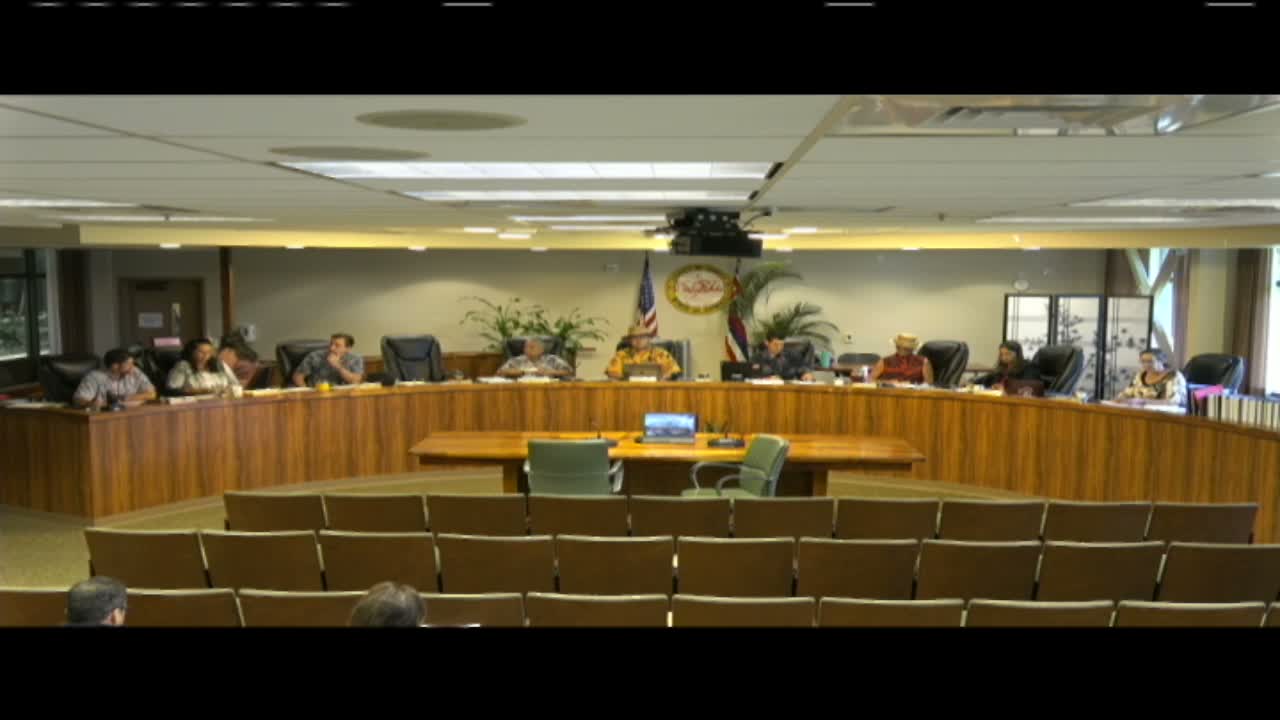
Hawaii County finance committee advances, amends private-road tax-credit bill and postpones final vote
Loading...
Summary
Councilors amended a proposal to create a homeowner tax credit for private-road maintenance, cutting the proposed maximum credit and lowering the minimum annual payment required to qualify; staff warned of administrative complexity and the bill was postponed for further work.
The Hawaii County Finance Committee on July 8 amended a proposal to create a private-road real property tax credit for local homeowners and postponed further consideration to Aug. 5.
The measure, introduced as bill 38 by Council Member Connolly Kleinfelder, would add a private-road maintenance credit to Chapter 19, Article 13 of the Hawaii County Code. Under amendments the committee adopted, qualifying homeowners would receive a credit capped at $250 and must show they paid at least $75 in private-road maintenance or repair in the prior 12 months; earlier drafts proposed a $500 cap and a $100 minimum payment.
The changes were designed to reduce estimated fiscal impact and administrative workload. "These are our local residents...they pay their taxes," Kleinfelder said, framing the bill as a targeted relief for homeowner-class parcels that lack publicly maintained roads. Kleinfelder said the changes respond to concerns from the finance and real property tax divisions and from community testimony.
Why it matters: The bill aims to provide modest tax relief to homeowners on privately maintained roads, a long-standing concern on the island where many rural subdivisions lack county-maintained streets. Committee discussion balanced the social-equity rationale against the county's capacity to implement and verify claims.
Key details and staff concerns - Scope: Kleinfelder told the committee real property tax (RPT) staff estimated roughly 11,000 parcels in the homeowners class could be in scope before further filters; the sponsor narrowed eligibility to parcels in private subdivisions whose roads are open to the public and not gated. - Participation change: RPT staff said lowering the required annual maintenance payment from $100 to $75 would include approximately 460 additional parcels and raise estimated annual cost by about $34,000 for that expansion alone; the adopted $250 credit cap was intended to lower the county revenue reduction compared with earlier proposals. - Administration: Real property tax administrator Lisa Murrah said the department preferred receiving certification spreadsheets from road maintenance organizations rather than processing up to 11,000 individual homeowner applications. Murrah said a standardized electronic format (for example, Excel) would be required to allow cross-checking with the county's homeowner-exemption database.
Committee members and staff repeatedly warned the bill could create significant one-time and ongoing implementation work. Diane Nakagawa, finance director, cited unknowns including software changes and staffing needs. Murrah and staff said a flat credit would be simpler to administer but acknowledged the sponsor's approach sought to target aid to homeowners who contribute to road upkeep.
Amendments, votes and next steps - Amendment 203.5 (mover: Connolly Kleinfelder; second: Kirkowitz) reduced the minimum payment requirement to $75 and changed the credit calculation so the credit is the lesser of $250 or the amount paid. The amendment passed on roll call, 8–1. - Amendment 203.6 (mover: Connolly Kleinfelder; second: Villegas) included clarifying language to allow the director and RPT administrator discretion over documentation and implementation details; that amendment also passed, 8–1. - After amendment action, Kleinfelder moved to postpone final consideration; the committee voted to postpone the bill to the Aug. 5 committee meeting in Hilo (motion: Connolly Kleinfelder; second: Inaba). The clerk announced the motion passed; the committee will return to the item on Aug. 5.
Quotes from the hearing reflect this balance: "We have an obligation ... to provide services to each and every home we allow to build," Kleinfelder said. Real property tax administrator Lisa Murrah said shifting submission responsibility to associations "does lessen the workload on the staff" compared with taking thousands of individual applications.
The committee asked the sponsor to gather additional details before the next hearing, including: (1) sample spreadsheets or standardized reporting formats from road maintenance organizations; (2) lists of subdivisions and the specific portion of associations' fees dedicated to road maintenance; and (3) software/implementation cost estimates to program variable credit amounts.
Ending note: The committee adopted narrower, lower-cost versions of the credit but deferred final action to allow staff, LRB and community groups to work out implementation rules and data requirements before the next committee meeting on Aug. 5.