Get Full Government Meeting Transcripts, Videos, & Alerts Forever!
Get email alerts on the County Budget topic
No spam. Unsubscribe anytime.
Marathon County committee urges earlier, ongoing board input on 2026 budget; administrators highlight fees, compensation and reserves
Summary
At its July 8 meeting, the Marathon County Health and Human Services Committee reviewed the county's 2026 budget development process, urged early committee input, and discussed rates and fees, compensation updates and reserve policy ahead of the administrator's September budget presentation.
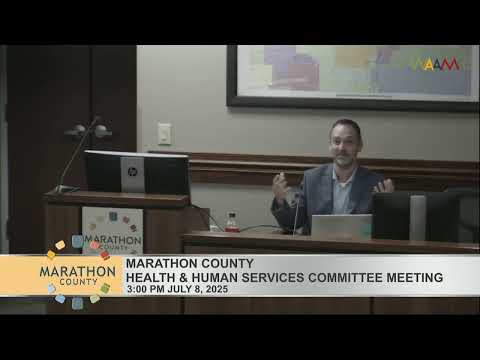
MARATHON COUNTY, Wis. ' The Marathon County Health and Human Services Committee on July 8 heard committee- and administration-led guidance to begin earlier and more frequent involvement by county board members in developing the 2026 budget, with particular attention to fee schedules, employee compensation and the county's working capital reserves.
Committee Chair John Robinson said the county will continue a two-step process in which an administrator's draft is prepared for presentation in September and then becomes the board's budget for final decisions. Robinson, chair of the HR, Finance and Property Committee, told members they should review programs under their committee's jurisdiction and raise priorities early in the process so administration can incorporate policy direction while building the administrator's draft.
Administrator Leonard said staff posted a mandatory and discretionary program overview in the meeting packet (page 20) and a rates-and-fees appendix (Appendix A, beginning page 3). Leonard said those documents are largely unchanged from last year but are intended to make revenue assumptions and fee schedules more transparent. He urged members to scrutinize fee-bearing services where increased fees could recover cost growth rather than requiring additional tax levy.
Leonard also told the committee the county is working with a consultant to update the compensation grid; the pay scale was built on early-2022 data and has not been adjusted since. He said labor-market changes mean the county is likely to need adjustments to remain competitive and to link compensation discussions to decisions on mandated services, service levels and fee recovery.
Robinson and Leonard cautioned that not all budget dollars are interchangeable. Robinson noted examples such as highway aids that are calculated using multi-year averages and match requirements; cutting programs without understanding revenue formulas can reduce future aid. Leonard said reserves are one-time funds and staff expect to present a working capital reserve policy this month to clarify restricted and flexible balances.
On a packet item question about retail food licensing fees, Leonard and Amanda of the Health Department corrected a confusing column title on page 8. The committee was told the apparent drop reported in one column was a misreading: the packet shows the full 2024 rate, the county increase for 2025, the state increase, and the total on the far right. Staff will relabel the columns for clarity.
Robinson encouraged supervisors to contact other standing committees when interests extend beyond Health and Human Services. Leonard and Robinson said HR Finance will discuss budget assumptions and priorities at its next meeting; the committee will continue seeing budget items throughout the cycle.
The committee set its next meeting for Aug. 6 at 3 p.m.