Neighbors press Community Board over late-night liquor hours and clustered sidewalk 'roadbed' cafes; multiple applications reviewed
Loading...
Summary
At a Manhattan Community Board liquor-licensing meeting, neighbors pressed for earlier closing hours and commitments against outdoor seating while applicants and their representatives sought approvals or revisions for liquor licenses and sidewalk/roadway seating. Two issues drew the most attention: an application for a tavern on West 10th Street (2
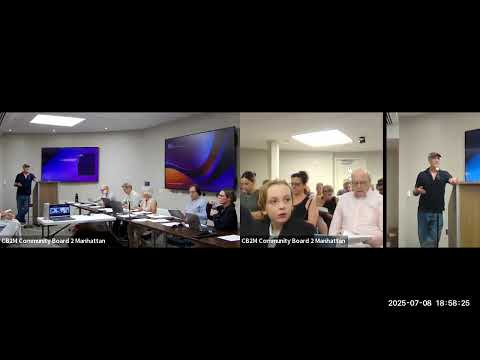
The Community Board's liquor-license committee spent the bulk of its meeting on Sept. 16 reviewing new and altered liquor-license applications and several sidewalk- and roadbed-cafe proposals, with neighbors repeatedly urging earlier closing hours, strict enforcement of stipulations and in several cases an outright ban on outdoor seating.
The meeting saw two flashpoints: a proposed tavern at 142 West 10th Street that drew sustained opposition over proposed 1 a.m. and 2 a.m. closing times, and a cluster of newly built roadside sidewalk/roadbed platforms on narrow Bedford Street that residents and board members said raise public-safety and compliance questions.
Why it matters: The board’s recommendations feed into the State Liquor Authority’s record and shape how outdoor dining and nightlife patterns affect largely residential blocks. Neighbors said late licenses and permanently installed roadside structures have changed the character and safety of narrow village streets.
Details and key outcomes
142 West 10th Street. The applicant said the plan was for a tavern-style concept with a capacity of about 43 seats and proposed hours that included 2 a.m. closing on Friday and Saturday and 1 a.m. other nights. Neighbors said the block is primarily residential and said previous businesses at the site closed earlier. Robin Felsher of the West Tenth/Greenwich Avenue neighbors told the committee: “A 2 a.m. close is totally unacceptable.” Leslie Clark of West Village Residence added that the block “is very residential” and described a high concentration of active and pending licenses within 500 feet. The committee and multiple residents objected to the late hours; the application remained contested at the end of the meeting and the committee indicated it would record the opposition in its advisory comments to the SLA.
Bedford Street roadbed/sidewalk platforms. Three neighboring businesses presented related applications to formalize roadbed/sidewalk cafes that were already constructed on or adjacent to Bedford Street. Committee members and neighborhood speakers raised multiple technical and safety concerns about the platforms: missing or noncompliant barriers, platforms sitting over building ventilation grates, and apparent deviations from published DOT guidance and FDNY spacing suggestions. One resident said platforms were “bolted down” and not removable; another warned of the risk if a vehicle hit a noncompliant structure. The committee asked for clearer engineering documentation and said DOT and FDNY have to provide consistent written guidance; no unconditional approvals were issued at the meeting. Board members said the cluster of three platforms required holistic review rather than piecemeal approvals.
Grama Dog (49 Carmine Street, “Grey Dog”). The applicant sought an alteration to convert an existing 16-foot service bar to a customer bar with eight seats. Owner David (surname recorded in the meeting) explained the bar would primarily accommodate single diners waiting for a table; he described the in-bar sales as a small share of revenue and said the premises “close by 10.” Neighbors from the Carmine Street Block Association raised a history of broken promises and asked for a hard earlier closing time. In response the applicant offered a change: he agreed to a 10 p.m. closing for the entire premises seven days a week and to keep outdoor seating hours to 10 p.m.; the committee recorded that commitment.
63 Bedford Street (asset purchase / Snack Taverna successor). Chef John Fraser and representative Joseph Levy presented a plan for a 45-person neighborhood bistro. Neighbors pressed for a firm commitment that there would be no sidewalk or roadbed dining now or in the future. Levy and Fraser accepted that condition, and the committee recorded a mutual agreement: closing at midnight Thursday–Saturday, 11 p.m. other nights, and “no outdoor seating now or in the future.” The committee noted that future outdoor dining would require a separate change-of-method-of-operation application and further community review.
Ad Hoc Collective (13 Christopher Street) and Slice House (30 Carmine Street). Both applications drew neighborhood objections and were laid over. Ad Hoc, a previously unlicensed cafe seeking beer-and-wine, drew complaints about continual daily sidewalk seating already in place; the applicant asked to hold the application and the committee preferred to see compliance with basic sidewalk rules before moving forward. Slice House, a to-go pizzeria seeking an on-premise license that would include beer and wine, was told by the committee that the liquor authority requires clear access to a patron restroom and asked the applicant to return after design changes; the applicant agreed to lay the application over.
RealMundo (117 Seventh Avenue South) and other sidewalk-cafe adjustments. RealMundo sought to expand a sidewalk café from the DOT-approved 14 tables to an SLA application for 22 tables (44 seats). The committee allowed an increase in principle but stressed two conditions: the outside seating must preserve the pedestrian clear path and all service must be from inside the rope/outlined perimeter, and hours should remain conservative after a history of operating outside without proper temporary approvals. Several residents and a general manager acknowledged improved compliance but asked the committee to require barriers, rope/planter delineation and firm closing hours.
Other applications. The committee also heard a string of on-premise-restaurant and class-change requests (including Oscar’s Place at 466 Hudson, Trouble Chubby Korean barbecue at 206 Spring Street, Cleo at 621 Hudson, Pearl 22 at 22 Greenwich Avenue and others). Most of these prompted routine questions about hours, capacity, whether there would be music or private buyouts and whether outdoor seating would be added. Several applicants agreed to or reaffirmed stipulations for background music only and defined closing hours; a few were asked to return with corrected diagrams or building/ADA clarifications.
What the committee emphasized. Committee members repeatedly requested clear engineering and DOT/FDNY documentation for roadbed/sidewalk structures and insisted that any outdoor seating that hinges on a previously signed stipulation be formally changed through a change-in-method-of-operation filing. Neighbors asked for closed-door enforcement — literally — when interior doors are supposed to be closed under stipulation. The committee said it would record neighbor opposition or conditional support in its advisory recommendations to the SLA, and it urged applicants to address outstanding safety or compliance items before the committee or the SLA acts.
Looking ahead. Several items were held over or left unresolved in light of neighborhood opposition or open DOT/FDNY/ADA questions. The committee’s advisory positions will be sent to the State Liquor Authority; the SLA is the final licensing authority and historically gives weight to community board recommendations and demonstrated neighborhood agreements.
Resident and applicant voices (examples)
• Sasha Green, former community-board member and nearby resident, on Oscar’s Place: “Oscar’s is a wonderful place. It’s clean, it’s nice, it’s accommodating, friendly.”
• Andrea Meyer, Carmine Street resident, on the Grey Dog proposal: “I don’t believe what he says... if the service bar gets approved, why not close it down at 11? ... almost all the restaurants all change closed by 11.”
• David (owner, Grey Dog): “The bar accounts for about 6% of sales. We close at 10.”
• Robin Felsher (West Tenth/Greenwich Avenue neighbors): on 142 West 10th and the tavern application: “A 2 a.m. close is totally unacceptable.”
Ending
The committee’s meeting underscored a recurrent pattern: operators seeking modest expansions or later hours, and neighbors pushing back with demands for stricter hours, no outdoor seating and clearer enforcement of the agreement language. Several applications will return to the committee after applicants supply more detailed diagrams, engineering or ADA clarifications, or after applicants accept stipulated changes to hours and to outdoor seating. The State Liquor Authority will consider the board’s advisory comments as it moves on individual licenses.