Get Full Government Meeting Transcripts, Videos, & Alerts Forever!
Get email alerts on the Nonprofit Capacity Building topic
No spam. Unsubscribe anytime.
Columbus secures funding for second cohort of Getting Grant Ready Academy after first cohort wins nearly $579,000 in grants
Summary
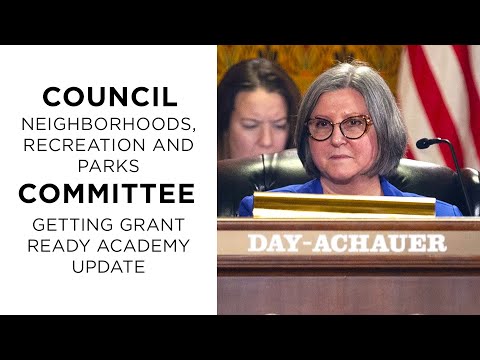
Council member Nancy Day, chair of the Neighborhoods, Recreation and Parks Committee, reported results from the first Getting Grant Ready Academy and announced that the city had funded a second cohort through the 2025 operating budget at a public hearing Thursday.
Council member Nancy Day, chair of the Neighborhoods, Recreation and Parks Committee, reported results from the first Getting Grant Ready Academy and announced that the city had funded a second cohort through the 2025 operating budget at a public hearing Thursday.
The nine-month program, created with private consultants and the Franklin County Human Service Chamber, targets small, community-rooted nonprofits in health and human services and youth programming and aims to teach grant-seeking, organizational strategy and data practices. "Small scrappy nonprofits, you are the safety net of our communities," Council member Nancy Day said in opening remarks.
Why it matters: Council member Day said the academy helps smaller grassroots nonprofits compete for structured funding by translating lived experience into fundable proposals. Organizers and participants told the committee the program produced measurable fundraising outcomes and increased organizational capacity, and the city has committed continuing operating-fund support so the program can run again.
Libby Villa Vincencio, founder of Libby V and Associates, and Frederica Wallace-Dina, founder of Dina Strategies, led the curriculum. Villa Vincencio told the committee, "We had over 100 organizations apply to be part of the program. 19 were selected. 13 are completing the program." She reported that participants won almost $578,980 in grant awards and had more than $10,000,000 in pending applications.
Wallace-Dina described the program's approach as a "community-centered funding framework," emphasizing relationship-building between grassroots groups and funders and instruction on how to present data and impact in language philanthropy recognizes. "Rebel Words doesn't just teach people how to write grants, it teaches them how to build relationships," she said.
Three program participants provided testimonial evidence of the academy's effect. Rekaya Sala, co-founder of International Community Guidance, said the academy "gave us confidence, clarity, and a sense of legitimacy. It made us feel seen." Sydney Green, program director of the Brown Girl Collective (formerly Brown Girls Mentoring), said the program changed how her group tells its story: "We now approach grant writing with confidence, not hesitation." Mark Payne Jr., CEO of What Will Marcus Do, credited the academy with helping his group win a Columbus Office of Violence Prevention grant and run a spring program that served 98 children.
Mike Corey of the Franklin County Human Service Chamber praised the work and put it in a broader context of funding challenges: "It's been a really tough spring and summer for nonprofits," he said, and described recent federal changes as creating additional pressure on local organizations.
Program rules and next steps: Council member Day announced that the city secured funding for another cohort through the 2025 operating budget and that applications are open through July 31. Eligibility requirements announced at the hearing include: organization in existence fewer than 10 years, an annual budget under $500,000, no dedicated grant writer on staff, and programming limited to health and human services or youth programming. The academy will again enroll a cohort (the program design allows up to 20 organizations for a nine-month cycle).
Organizers and council members said selection for the inaugural cohort was competitive and rigorous. Villa Vincencio and Wallace-Dina said the curriculum resembled an intensive college course, requiring significant participant time and work.
Participants and organizers asked the city to sustain the program and expand access over time. Council member Day said she will continue to advocate for the program and encouraged small organizations to apply and to build relationships with council offices.
The hearing concluded with the application announcement and instructions that the city and partners will publicize the application via council and partner social media channels and a QR code provided at the meeting.