Get Full Government Meeting Transcripts, Videos, & Alerts Forever!
Get email alerts on the County Budget Hhs topic
No spam. Unsubscribe anytime.
Sawyer County Health and Human Services previews 2025 budget, flags juvenile placement costs and staffing gaps
Summary
Sawyer County Health and Human Services staff presented a draft 2025 budget and program overview at a July 8 public hearing and flagged several revenue, staffing and program issues that will shape the final budget brought back to the board next month.
Sawyer County Health and Human Services staff presented a draft 2025 budget and program overview at a July 8 public hearing and flagged several revenue, staffing and program issues that will shape the final budget brought back to the board next month.
Julia, the Sawyer County Health and Human Services director, told the committee the department is still finalizing some numbers but is scheduling a final budget vote next month after additional state and federal budget details were published in early July. She reviewed funding sources the department relies on, including county levy, state aids, grants, contracts, client fees and Medicaid settlements under the Wisconsin Medicaid cost-sharing mechanism (WIMCR).
The presentation summarized recent WIMCR returns for services billed in prior years: the community support program generated about $230,000 for 2023 services (and about $65,000 for 2022), comprehensive community services (CCS) returned roughly $92,000, outpatient services about $14,000 and targeted case management about $13,000. Julia said those post‑year-end settlements “help make us whole at the end of the year” because the receipts typically arrive in mid‑December.
Why it matters: department leaders said Medicaid settlements and state aids materially affect the county’s ability to sustain mandated services and pay staff for programs that are 100% state‑ or Medicaid‑funded. The department is balancing mandated programs that are fully funded (for example, CCS and CLTS) against nonmandated programs that still reduce greater county costs, such as preventing out‑of‑home placements.
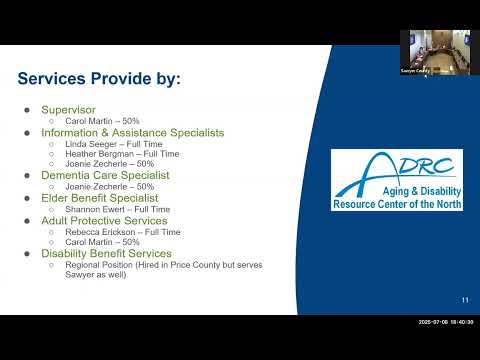
Program and staffing changes Julia reviewed major program areas and staff changes across the department. She said the Aging and Disability Resource Center (ADRC) work includes information and assistance, benefit specialists, dementia care, WIC and birth‑to‑3 services. Carol Martin, supervisor for the adult long‑term care unit and the ADRC branch, reported three recent staffing turnovers in the unit and described replacements: Rebecca Erickson started in May as a full‑time adult protective services staffer, and Shannon Ewert replaced the elder benefit specialist role. Martin said the ADRC team is “small but mighty” and continues to provide dementia screening, benefits assistance and community outreach.
The ADRC’s disability benefits specialist assigned through a regional arrangement with Price County produced measurable financial returns: the specialist handled 51 cases in the quarter, 14 of them in Sawyer County, returning roughly $21,041 to local residents in that quarter and about $1,562,000 year‑to‑date in reported monetary impact across the specialist’s caseload, the presenter said.
Behavioral health and placements Alicia, the behavioral health supervisor, and Caitlin, director of Northland Community Services (a contracted partner), reported steady demand for mobile crisis, community support and crisis stabilization. Caitlin said the county’s CSP caseload is largely stable; two clients discharged in May were replaced immediately. County staff said most hospital discharges do not move straight to community settings and that the department continues to seek alternatives to long‑term inpatient placements.
Julia highlighted a state budget change affecting juvenile corrections that county leaders had been monitoring closely. A proposed increase in the juvenile corrections day rate would have raised daily costs substantially; after county and other advocacy, the governor used a partial veto to set the rate at $501 per day in fiscal 2026 and $758 in fiscal 2027 rather than the higher figure originally in the budget. Julia said the lower rates will substantially reduce potential county exposure for placements such as Lincoln Hills.
Child protective services and local forensic interviewing capacity Child protective services staff told the committee the child advocacy center in Hayward closed in fall 2024 for lack of funding, which left the area without a local forensic interview facility and interviewer capacity. Department staff and the sheriff’s office have trained local personnel in forensic interviewing techniques and are working to repurpose equipment and create a child‑friendly interview space using grant funds. Julia said the county plans to form a multidisciplinary team to support child forensic interviews and related services.
Public health, PFAS rulemaking and emergency preparedness Public health staff reported ongoing communicable disease surveillance, including regional increases in tick‑borne illnesses; the county has not recorded PFAS contamination in local well tests to date, staff said. The department noted an open state rulemaking/public comment period that would adopt federal PFAS maximum contaminant levels into state rules (the presentation referenced changes to state water rules and an open public comment deadline in early July). Staff said the Department of Natural Resources (DNR) testing so far has not identified PFAS positives in Sawyer County well tests.
Other items - The department’s AmeriCorps peer‑recovery support was recently restored through a state legal action; staff said AmeriCorps positions have provided the county roughly 1.5 FTE of service in prior years at a low local cost (about $5,000 per year for hosting those staff). The program’s future beyond existing contracts remains uncertain. - The department is reviewing fee schedules for the local agent program that licenses tourist rooming houses and resorts; state changes to how multiple properties are grouped for licensing will alter local fee structures. - Staff emphasized hiring and retention challenges, particularly for mental health therapists who can earn substantially higher pay in noncounty settings.
Votes at a glance - Approval of minutes from June 10 — motion made and seconded; vote carried. (Roll call showed the following members present at the start of the meeting: Kaye Wilson; Tweed Schuman; Marshall Savitsky; Chuck Van Etten; Jeff Haney; Bill Trepanier; Don Pettit; Carol Pearson; Dr. Dunlap.) - Motion to go into a public hearing on the budget — motion made and seconded; vote carried.
What’s next The department will return next month with final budget numbers and hold another public hearing when the full proposed budget is published. Staff said they will continue to monitor state and federal policy changes that affect Medicaid funding, juvenile placement rates and public health grants.
Sources: presentation and discussion at the Sawyer County Health and Human Services public hearing, July 8; program supervisors and staff in attendance.